AI tools made app building look easy. Then founders hit the wall. The prototype works, the demo feels slick, and the investor nods, until security questions start, performance drops, and the product buckles under real usage. That is why searching for an AI app development company USA is becoming less about outsourcing and more about survival.
Google’s 2025 DORA research found over 80% of developers report productivity gains from AI, yet OWASP’s 2025 guidance makes clear that GenAI apps introduce fresh security risks teams cannot ignore.
Speed alone is not a moat anymore. Stable execution is what wins right now.
The Promise Vs the Reality
DIY AI tools sold founders a dream. Type a prompt. Get an app. Ship by Friday.
And honestly, that dream is not fake.
ChatGPT, Claude, Cursor, Bubble, Bolt, and Lovable can help a non-technical founder move faster than ever. They shrink blank-page time. They help you test ideas before you hire a team. They can even make you feel like you finally have momentum again.
That part matters.
But here is the part most founders learn a little too late. A fast prototype is not the same thing as a reliable product. Google’s 2025 DORA report found AI mostly acts as an amplifier. It boosts strong systems, and it magnifies weak ones too. So if your planning, security, QA, and architecture are messy, AI usually helps you reach the messy part faster.
That is why the conversation has shifted from “Can AI build my MVP?” to “Can this thing survive real users, investor scrutiny, and customer trust checks?”
That is the moment a founder stops looking for a toy and starts looking for the best AI development company for startups.
Need A Stronger AI App Foundation?
Find out whether your product can actually handle scale, security, and real user demand before fragility turns into a bigger problem.
What DIY AI Tools Actually Build Well
Let us be fair. DIY tools are not useless. Far from it.
They are very good at early-stage speed. If your goal is to validate a concept, map a flow, or get a rough demo into a deck, they can save serious time.
Where AI Tools Shine
AI tools are strong at:
-
rapid prototyping and UI scaffolding
-
boilerplate code and CRUD flows
-
draft documentation
-
test case suggestions
-
component-level logic
-
simple integrations
-
landing pages and internal admin panels
This is one reason AI adoption has exploded. In Stack Overflow’s 2025 survey, more than half of respondents said they worry about AI accuracy, but usage is still widespread because the speed advantage is real.
For Jordan Rivera, the burned builder founder, that early speed feels amazing. You go from idea to interface in days. You finally have something to show. You stop feeling blocked.
Then the cracks start.
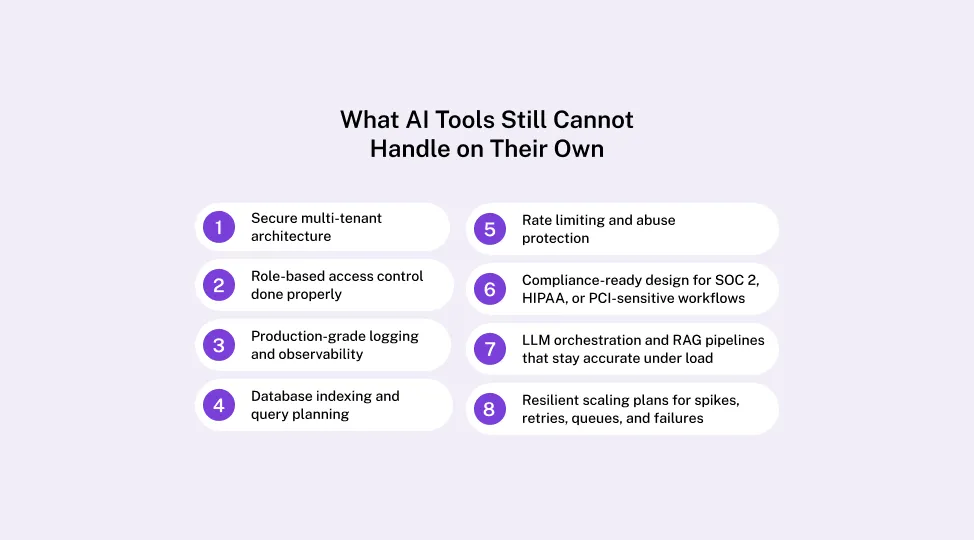
What AI Tools Still Cannot Handle on Their Own
AI does not magically solve:
-
secure multi-tenant architecture
-
role-based access control done properly
-
production-grade logging and observability
-
database indexing and query planning
-
rate limiting and abuse protection
-
compliance-ready design for SOC 2, HIPAA, or PCI-sensitive workflows
-
LLM orchestration and RAG pipelines that stay accurate under load
-
resilient scaling plans for spikes, retries, queues, and failures
OWASP’s 2025 guidance on LLM applications highlights prompt injection, insecure output handling, supply chain vulnerabilities, sensitive information disclosure, and denial-of-service risks as core issues teams must design around. Those are not “prompt better” problems. They are system design problems.
So yes, DIY is great for momentum.
It is not enough for trust.
The Hidden Cost of DIY AI Development
This is where the real pain begins. Not when the app is empty. When it is half-working.
That is the dangerous zone. Because it looks finished enough to keep going, but broken enough to cost you weeks.
The Three-Month Trap
A founder ships an MVP with AI and freelancers. The first ten users love it. Then Product Hunt traffic hits. Or an investor asks about security. Or a prospect wants SSO. Or the app crashes with 50 users at once.
Now you are stuck.
You do not know whether to patch it, rebuild it, or pray through the demo.
Technical due diligence gets sharper as startups move toward larger rounds. Recent startup diligence guides note that investors increasingly examine whether the architecture can handle 10x growth, whether the team has sustainable delivery practices, and whether technical debt is piling up too fast.
And that is the emotional part founders do not talk about enough. Bad code does not just waste time. It makes you feel exposed.
AI Generated Debt Compounds Fast
Here is the thing. AI code often looks polished before it is actually safe.
Veracode’s 2025 GenAI Code Security research tested more than 100 models across Java, JavaScript, Python, and C#. Reporting on that study said roughly 45% of AI-generated code samples contained security flaws. The same research showed no meaningful improvement from many newer models on secure coding performance.
That is brutal for a non-technical founder.
Because you are not just inheriting code. You are inheriting invisible risk:
And once AI has helped generate a messy base quickly, the mess spreads quickly too.
What Buyers and Investors Check Now
This is another reason the AI app agency vs DIY debate is no longer theoretical.
Buyers and investors do not care that the code was generated quickly. They care whether it is dependable.
Security review platforms and compliance firms are clear about what modern buyers now expect: SOC 2 reports or readiness, penetration test summaries, logging and monitoring practices, access controls, vendor risk posture, and increasingly even AI disclosures. For growing startups, SOC 2 has become a common gate for larger deals, not just a nice badge.
So, when a founder says, “We built it with AI,” the next question is not admiration.
It is “Can we trust it?”
How AI App Development Companies in USA is Replacing DIY Tools
This is the turning point.
The smart founders are not abandoning AI. They are changing who controls it.
Instead of asking AI to replace engineering judgment, they hire a team like mobile app development company in Austin that uses AI inside a real delivery process. That is a huge difference.
A serious AI app development company USA does not just write code. It reduces execution risk.
Architecture Before Code
This is where professionals earn their keep.
A good team starts with questions AI tools usually skip:
-
What breaks first if usage spikes?
-
Where should business logic live?
-
What needs to be synchronous and what should be queued?
-
How will permissions work across user roles?
-
What happens when the model returns junk?
-
How do we monitor failure, latency, and cost?
That planning layer is why a custom AI app development company is often cheaper than repeated DIY repairs. You are paying to avoid rebuilding the same product twice.
And for founders moving fast, that matters more than bragging rights.
Security, Compliance, And Scale Are Baked In
A real team builds for the ugly moments early:
The 2025 DORA report says AI can improve productivity and code quality, but it also warns that results depend on the surrounding system. In other words, AI works best when process, review, and engineering discipline are already there.
That is exactly why founders now hire AI developer USA teams instead of trusting prompts alone.
They want speed, yes.
But they want guardrails more.
AI Used the Right Way Is Still a Superpower
This is the part people miss. The best agencies do not reject AI. They operationalize it.
They use AI for scaffolding, documentation, test acceleration, refactor support, and internal productivity. Then humans own architecture, review, security, QA, and launch readiness.
That blended model is winning because it gives founders both things they need:
-
startup speed
-
enterprise confidence
It also pairs well with cross platform mobile app development services when a founder needs one codebase, faster release cycles, and tighter budget control without sacrificing production standards.
And yes, it is still leaner than building a full in-house team too early.
The 2026 Decision Matrix: DIY Or Hire a Company?
Not every project needs an agency on day one. Some absolutely do.
Here is the simplest way to decide.
| Situation |
DIY Tools Can Work |
Hire A Company |
| Clickable prototype for feedback |
Yes |
Not always necessary |
| Internal tool with low security risk |
Yes |
Maybe later |
| Investor demo with limited scope |
Yes, with caution |
Better if diligence is near |
| Customer-facing app with payments or sensitive data |
Risky |
Yes |
| AI feature with RAG, agents, or workflow automation |
Limited |
Yes |
| Need for SOC 2 readiness or enterprise sales |
No |
Yes |
| App must survive growth beyond early beta |
Weak fit |
Yes |
| Founder cannot evaluate code quality |
Dangerous |
Yes |
That is really the heart of AI app agency vs DIY.
DIY is for proving a concept.
A company is for proving the business can survive.
And if mobile is central to the product, many founders eventually move from DIY web experiments to a proper react native app development company that can turn the rough concept into a stable launch across iOS and Android.
Why This Shift is Happening Now
The market matured.
That is the simple answer.
In 2024, people were still impressed that AI could generate an app at all. In 2026, that is not impressive anymore. It is baseline.
What matters now is whether the product is secure, scalable, reviewable, and fundable.
Recent security incidents around AI coding platforms only pushed that concern further. In April 2026, Business Insider reported on a security stumble involving Lovable that exposed how design flaws in AI-assisted development tools can create real trust issues around project visibility and backend controls. Meanwhile, researchers also uncovered critical AI IDE weaknesses affecting developer tooling and agent behavior.
So, founders are adapting.
They still use AI.
They just do not want to bet the company on raw AI output anymore.
Final Take
DIY AI tools are great for getting unstuck. They are not great at carrying founder risk.
That is why more teams are turning to an AI app development company USA when the product has to do more than just exist. It has to survive traffic, scrutiny, security reviews, and real users with zero patience.
Here is the honest question.
If your app got hit with 500 concurrent users today, would it survive?
If the answer is “I hope so,” you are already in the zone where expert help beats another prompt.
Your AI MVP Should Not Break the Moment It Gets Attention
Get a founder-friendly audit of your current app, stack, and risk points, with a clear path to stabilize, scale, and ship with confidence.
FAQs
1. Why are founders choosing an AI app development company instead of DIY tools?
Founders are choosing an AI app development company USA because DIY tools are fast for prototypes, but often weak for production readiness. Once investor diligence, customer security reviews, and scale become real concerns, founders usually need more than generated code. They need architecture, QA, observability, and security planning. Recent research and security guidance keep pointing to the same pattern: AI boosts speed, but strong systems still need human engineering judgment.
2. Are DIY AI app builders good enough for a startup MVP?
Yes, sometimes. DIY AI tools can work well for:
They become risky when your MVP needs:
-
secure authentication
-
sensitive user data handling
-
payment flows
-
enterprise sales readiness
-
reliable performance under load
That is why the AI app agency vs DIY choice usually depends on what the app must survive, not just how fast it can be built.
3. What does an AI app development company do that AI tools cannot?
A strong agency does the work around the code, which is usually the part that protects the business. That includes:
AI tools can generate code blocks and screens. A real delivery team turns those pieces into a product that does not fall apart when real users arrive. That is the core reason many founders now look for the best AI development company for startups instead of relying only on AI builders.
4. Is AI-generated code safe for production apps?
Not by default.
AI-generated code can speed up development, but it still needs expert review. Security research and industry reporting have highlighted recurring problems in AI-assisted code, including weak defaults, logic flaws, and vulnerabilities that traditional scans may miss. If your app handles customer data, payments, healthcare data, or business-critical workflows, generated code should be treated as a draft, not as final production code.
5. When should a startup hire AI developers in the USA?
A startup should usually hire AI developer USA support when one or more of these become true:
-
the MVP is unstable
-
investor due diligence is coming
-
a freelancer disappeared
-
enterprise buyers want security answers
-
the product needs scale beyond early beta
-
the founder cannot confidently judge code quality
-
AI features now need real backend architecture
This is often the point where speed stops being the biggest issue and execution risk becomes the real blocker.
6. How do I choose the best AI development company for startups?
Look for a partner that can reduce risk, not just promise velocity. A good shortlist should include companies that show:
-
startup case studies, not only enterprise decks
-
fixed-scope or founder-friendly pricing
-
strong product and backend experience
-
security and architecture thinking
-
clear communication with non-technical founders
-
fast, realistic scoping
-
experience rescuing messy AI-generated code
The best AI development company for startups is usually the one that explains trade-offs clearly, spots technical risk early, and gives you confidence before they sell you anything.
7. Is hiring an AI app agency more expensive than building with DIY tools?
Up front, usually yes. Over the full build cycle, not always.
DIY tools often look cheaper because they reduce initial build cost. But the total cost can rise fast when founders have to rebuild unstable features, fix security issues, replace vanished freelancers, or rework the product before diligence or launch. A professional team can cost more at the start, but it often reduces wasted spend, timeline slips, and expensive rework later. That is why many founders eventually move from DIY to an AI app development company USA once the product starts carrying real business risk.
Tags
Compliance
Security
Cost of DIY AI Development
DIY AI tools
AI development
Artificial Intelligence