Sports betting app development cost is no longer defined by features alone, but by architecture depth, regulatory complexity, infrastructure resilience, and real-time processing requirements. While many online sources suggest simplified budgets, the realistic cost to build a sports betting app ranges between $30,000 and $400,000+, depending on scale and compliance scope.
An MVP built for market validation differs significantly from an enterprise-grade sportsbook engineered for live betting, multi-jurisdiction licensing, and high-concurrency traffic. Compliance systems, secure payment processing, and scalable backend architecture often exceed frontend development costs.
This blog provides a structured, executive-level breakdown of pricing drivers, helping decision-makers align investment with long-term scalability and regulatory stability.
Sports Betting App Development Cost Overview in 2026
The betting app development cost in 2026 varies widely based on feature depth, regulatory obligations, infrastructure architecture, and platform coverage. While entry-level estimates appear attractive, realistic budgeting must account for compliance systems, real-time data pipelines, and secure financial processing.
The online betting app development cost typically falls within the following structured tiers:
| App Type |
Estimated Cost |
Best For |
| Hybrid / Pre-built |
$5,000 – $25,000 |
Quick launch testing |
| Basic MVP |
$20,000 – $60,000 |
Early-stage operators |
| Mid-Range Platform |
$50,000 – $120,000 |
Growing sportsbooks |
| Enterprise Platform |
$150,000 – $400,000+ |
High-scale, multi-jurisdiction operators |
Hybrid and pre-built solutions offer faster deployment but limited scalability and compliance flexibility. MVP builds allow validation of betting models but often lack advanced in-play functionality and automated regulatory controls.
Mid-range platforms integrate real-time odds feeds, secure wallet systems, and multiple sports categories. Enterprise systems incorporate advanced risk engines, AI-driven insights, high-availability infrastructure, and multi-region compliance management.
Advanced compliance frameworks, high-frequency live betting modules, and robust cloud scaling significantly increase development investment. Cost escalation is driven primarily by backend architecture complexity rather than interface design.
Understanding these tiers enables operators to align budget expectations with long-term business objectives rather than short-term launch ambitions.
Example Cost Scenarios (Realistic Planning Models)
Below are two common budgeting models that show why sportsbook costs vary so widely:
Scenario A: Single-jurisdiction MVP (pre-match + basic wallet)
- Typical scope: core markets, basic bet slip, single odds provider, KYC, basic admin, standard cloud setup.
- Budget range: $30,000–$80,000 (excluding licensing and ongoing feed subscriptions)
Scenario B: Multi-jurisdiction enterprise sportsbook (in-play + redundancy + risk controls)
- Typical scope: in-play betting, multiple odds providers with failover, risk/limits engine, advanced reporting, immutable audit logs, geo-fencing, multi-region cloud, compliance automation.
- Budget range: $200,000–$400,000+ (excluding licensing, legal, and ongoing infrastructure scaling)
What These Cost Ranges Assume
The estimates in this guide assume:
- You are using licensed odds/data providers (not scraped or unofficial sources)
- You need KYC/AML + audit logging for regulated markets
- Your platform is designed for peak-event spikes (not average traffic)
- You plan for operational costs (cloud, monitoring, security updates, compliance audits) beyond launch
If any of these assumptions change, the total cost changes significantly—usually upward.
Sports Betting Cost Breakdown by Development Components
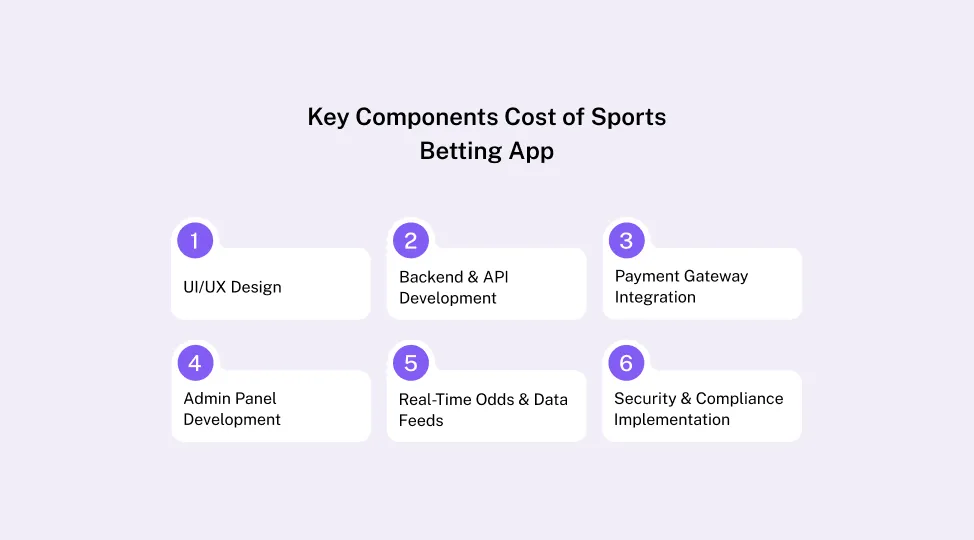
A realistic understanding of sports betting app development cost requires examining the engineering layers beneath the interface. While user-facing features attract attention, backend architecture, data processing, and compliance systems account for the largest share of investment. Below is a structured breakdown of core cost components.
Here’s the detailed cost breakdown by components:
1. UI/UX Design
Estimated Cost: $10,000 – $30,000
Design influences conversion velocity, particularly in live betting environments. Effective UI architecture includes optimized bet slips, real-time odds display, intuitive navigation, and responsive layouts.
However, while critical for engagement, UI/UX typically represents a smaller portion of the overall cost to build a sports betting app compared to backend systems.
2. Backend & API Development
Estimated Cost: $30,000 – $150,000+
Backend engineering represents the most significant portion of the betting app development cost. This layer includes:
- Real-time event processing systems
- Odds ingestion and normalization pipelines
- Bet validation and concurrency control
- Risk management engines
- Secure wallet architecture
Real-time architecture requires distributed systems, microservices segmentation, and high-availability database design. This complexity drives enterprise-level pricing.
3. Payment Gateway Integration
Estimated Cost: $5,000 – $25,000 (excluding transaction fees)
Payment integration includes:
- Secure tokenized transactions
- Wallet reconciliation logic
- Fraud detection systems
- PCI-aligned processing frameworks
Multi-gateway redundancy and crypto integrations increase this cost.
4. Admin Panel Development
Estimated Cost: between $30,000 and $300,000+, depending on complexity, features, and region.
Admin dashboards include:
- User and account management
- Risk exposure monitoring
- Revenue analytics
- Compliance reporting tools
Complex reporting requirements and multi-region compliance controls increase development time.
5. Real-Time Odds & Data Feeds
Estimated Cost: $10,000 – $50,000+ (plus recurring subscription fees)
This layer includes:
- Multi-provider API integration
- Latency optimization
- Feed normalization
- Failover configuration
High-frequency in-play betting significantly increases the online betting app development cost, especially when sub-second updates and redundancy are required.
6. Security & Compliance Implementation
Estimated Cost: $15,000 – $60,000+ (excluding licensing fees)
This includes:
- KYC verification systems
- AML monitoring workflows
- Audit logging architecture
- Data encryption frameworks
For regulated markets, compliance implementation may rival backend costs depending on jurisdiction.
Backend architecture and compliance systems collectively represent the largest share of sportsbook investment. Frontend design enhances experience, but scalable engineering determines long-term operational stability and regulatory readiness.
💡Suggested Read: How to Develop a Sports Betting App: Features, Compliance, & Stack
Platform & Technology Impact on Cost
Technology selection directly influences the sports betting app development cost. Platform decisions determine not only initial investment but also long-term scalability, performance under load, and maintenance complexity.
Executives evaluating the cost to build a sports betting app must assess whether to prioritize speed to market or performance optimization.
1. Native Development (iOS & Android Separately)
Native builds require dedicated codebases for iOS and Android. This approach increases engineering hours and testing cycles, raising overall cost.
Typical cost impact:
- 30% to 50% higher development expense compared to cross-platform.
- Separate QA and optimization pipelines.
- Greater performance control during live betting spikes.
Native development is often preferred for high-scale sportsbooks requiring premium iOS app development services, advanced animations, and deep device-level optimizations.
2. Cross-Platform Development
Frameworks such as React Native and Flutter enable shared codebases across iOS and Android.
Cost advantages include:
- Reduced engineering time
- Faster MVP launch
- Lower upfront investment under custom mobile app development services
However, cross-platform frameworks may face performance limitations during extreme concurrency or complex live-streaming integrations. Additional backend optimization may be required to compensate.
Strategic Cost Considerations
Platform choice affects:
- Real-time rendering performance
- Live betting responsiveness
- Maintenance complexity
- Long-term upgrade cycles
While cross-platform reduces initial investment, enterprise sportsbooks often migrate toward native builds as concurrency demands increase.
Sportsbook Compliance & Licensing Costs
In regulated betting markets, compliance is often the most underestimated contributor to overall investment. In many cases, regulatory alignment and licensing obligations can equal or exceed core engineering expenses.
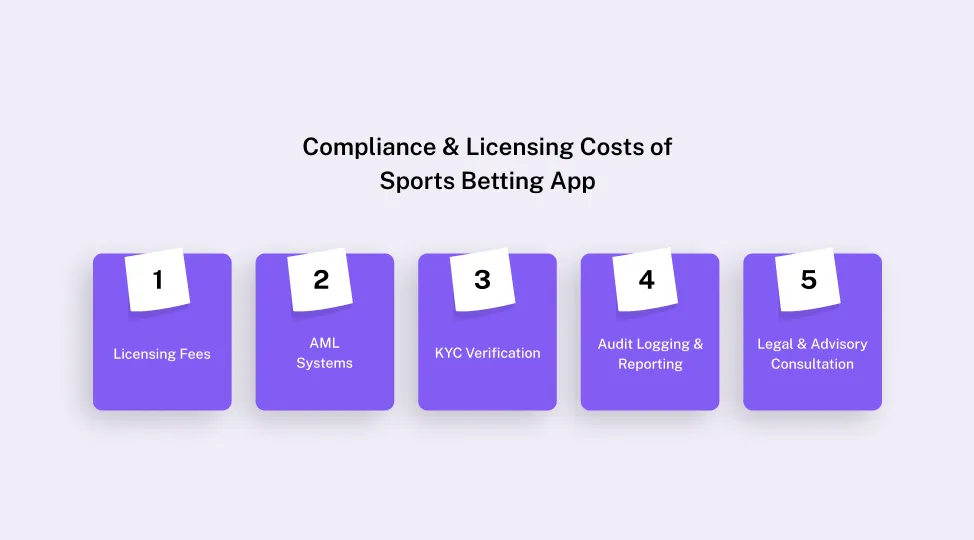
When evaluating the sports betting app development cost, executives must factor compliance as a primary budget driver rather than a secondary add-on.
Regulatory & Legal Cost Factors
1. Licensing Fees
Estimated Cost: $50,000 – $1,000,000+ annually (jurisdiction dependent)
Licensing requirements vary significantly across regions. US state-level approvals, UK Gambling Commission regulations, and European frameworks impose substantial financial and operational commitments. Multi-jurisdiction expansion multiplies legal consultation, reporting obligations, and technical audits.
Licensing fees alone can exceed the initial cost to build a sports betting app in certain regulated markets.
2. AML Systems
Estimated Implementation Cost: $10,000 – $50,000+
Anti-Money Laundering systems require:
- Automated transaction monitoring
- Suspicious activity reporting workflows
- Risk scoring models
- Ongoing identity verification
These systems must integrate deeply into wallet and bet placement services to ensure traceability.
3. KYC Verification
Estimated Cost: $5,000 – $20,000 (plus per-user verification fees)
Identity verification APIs, sanctions screening, and geo-validation mechanisms are mandatory in most regulated markets. Recurring verification costs scale with user growth.
4. Audit Logging & Reporting
Estimated Cost: $5,000 – $25,000
Regulators require immutable logs for every transaction, market change, and administrative action. Designing a compliant audit architecture increases backend complexity.
5. Legal & Advisory Consultation
Estimated Cost: $10,000 – $100,000+, depending on jurisdiction
Legal guidance ensures regulatory filings, advertising compliance, taxation alignment, and responsible gambling mandates are properly implemented.
Regulatory expansion across the US, Europe, and LATAM has intensified compliance expectations. For enterprise sportsbooks, compliance frameworks frequently surpass backend development in both cost and ongoing operational expenditure.
Ignoring regulatory budgeting leads to delayed approvals, fines, and license suspension risks. Strategic planning must treat compliance as foundational infrastructure rather than overhead.
Sports Betting Cloud Infrastructure & Ongoing Operations Cost
Infrastructure is the silent cost center in sports betting app development cost calculations. While development is a one-time investment, cloud infrastructure, scaling resources, and operational tooling create ongoing financial commitments.
High-concurrency betting platforms cannot rely on basic hosting environments. They require resilient, distributed, and auto-scalable systems.
Cloud Infrastructure & Scaling Costs
1. Cloud Hosting (AWS, GCP, Azure)
Estimated Cost: $3,000 – $25,000+ per month (depending on scale)
Enterprise sportsbooks typically deploy across multiple availability zones to ensure uptime. Infrastructure expenses increase during peak sporting events when auto-scaling expands compute capacity.
2. Auto-Scaling Resources
Estimated Cost Impact: 20% – 40% additional cloud overhead during peak traffic
Auto-scaling ensures that placement services, wallet systems, and odds engines handle live betting spikes. Without elastic scaling, latency and transaction failures increase.
3. Monitoring & Observability Tools
Estimated Cost: $500 – $5,000 per month
Advanced sportsbooks rely on:
- Real-time monitoring dashboards
- Distributed tracing
- Log aggregation tools
- Incident alert systems
Observability reduces downtime losses and supports compliance audits.
4. Content Delivery Network (CDN)
Estimated Cost: $1,000 – $10,000 per month
CDNs reduce latency by caching read-heavy endpoints such as market listings and odds displays. Edge caching lowers backend pressure during high-volume events.
5. Backup & Disaster Recovery
Estimated Cost: $1,000 – $8,000 per month
Multi-region backups, disaster recovery replication, and failover clusters protect revenue during infrastructure outages.
Infrastructure and DevOps costs persist long after launch. In many enterprise cases, ongoing infrastructure investment may approach or exceed initial development expenses within the first 18 to 24 months.
Strategic cost planning must account for both initial build and sustained operational scaling.
Online Betting App Development Location & Team Structure
Development geography significantly influences the sports betting app development cost, but hourly rates alone do not determine total investment.
Team expertise, domain experience, and architectural maturity directly affect long-term scalability and compliance resilience. Selecting the right delivery model is a strategic financial decision.
How Development Location Affects Pricing
Hourly development rates generally fall within the following ranges:
- North America: $100 – $200 per hour
- Western & Eastern Europe: $60 – $120 per hour
- India & South Asia: $20 – $70 per hour
At first glance, lower hourly rates appear attractive. However, cost efficiency depends on domain specialization. Sportsbook platforms require experience in high-concurrency systems, financial-grade transaction handling, and regulatory alignment. Without domain expertise, rework and compliance gaps increase the total betting app development cost.
A structured team typically includes:
- Solution architect
- Backend engineers
- Frontend developers
- DevOps specialists
- QA and security testers
- Compliance consultants
Partnering with a specialized sports betting app development company reduces architectural errors and integration delays. Experienced providers deliver optimized microservices design, efficient real-time pipelines, and compliance-ready infrastructure under unified custom mobile app development services frameworks.
Choosing a generic development vendor may lower initial rates but often increases long-term technical debt and scaling costs. Strategic partner selection directly impacts operational sustainability and financial predictability.
Ongoing Maintenance & Post-Launch Costs
Launch does not conclude investment. In regulated betting ecosystems, operational expenditure continues long after initial deployment. The long-term fantasy sports app development cost must account for maintenance, security reinforcement, infrastructure optimization, and compliance updates.
Post-Launch Cost Structure
1. Monthly Maintenance
Estimated Cost: $5,000 – $20,000 per month
Maintenance includes:
- Bug fixes and performance tuning
- Minor feature enhancements
- Version upgrades for frameworks and libraries
- Compatibility updates for OS releases
Maintenance ensures operational continuity but does not include aggressive scaling or expansion.
2. Security Updates & Monitoring
Estimated Cost: $1,000 – $8,000 per month
Continuous security patching protects against evolving cyber threats. Financial-grade platforms must update encryption protocols, authentication layers, and vulnerability defenses regularly.
Security management includes:
- Vulnerability patching
- Threat monitoring tools
- Authentication upgrades
- Encryption updates
Financial-grade platforms require continuous security reinforcement to prevent fraud and regulatory breaches.
Failure to maintain security standards increases regulatory exposure and financial risk.
3. Compliance Audits & Reporting
Estimated Cost: $2,000 – $15,000 per quarter (varies by jurisdiction)
Regulatory frameworks demand:
- Periodic compliance reporting
- AML workflow validation
- Audit log reviews
- Legal advisory updates
Periodic audits verify licensing adherence, transaction traceability, and AML workflows. Compliance updates often require engineering adjustments, particularly when regulations evolve across jurisdictions.
4. Infrastructure Optimization
Estimated Cost: $2,000 – $10,000 per month (scaling dependent)
Optimization includes:
- Auto-scaling adjustments
- Database performance tuning
- Cloud cost optimization
- Redundancy expansion
As user volume grows, infrastructure must be optimized for efficiency, refining auto-scaling policies, optimizing database indexing, and reducing unnecessary cloud spend.
5. Maintenance vs Scaling Cost
Maintenance preserves stability at predictable cost levels, whereas scaling introduces variable expenses driven by user growth, live event traffic, and multi-region expansion.
Over a 12–24-month period, cumulative post-launch costs can approach or exceed the initial cost to build a sports betting app, particularly for high-growth operators.
Hidden Sports Betting App Development Costs Most Operators Ignore
Most public estimates of sports betting app development cost focus on build expenses. However, long-term profitability is often affected by secondary financial obligations that are rarely highlighted.
These hidden costs significantly influence total ownership economics:
1. Third-Party API Subscription Fees: Real-time sports data providers operate on subscription models. Premium in-play feeds, redundancy providers, and low-latency data channels can cost thousands to tens of thousands of dollars per month. As betting volume increases, API tiers and usage-based pricing escalate accordingly.
2. Payment Processing Charges: Payment gateways charge transaction-based fees, often ranging from 1.5% to 5% per transaction, depending on region and method. High deposit volumes increase operational costs, directly affecting margins. Chargebacks and dispute management add further expense.
3. Fraud & Bonus Abuse Losses: Without sophisticated risk engines, operators face revenue leakage through arbitrage betting, bonus exploitation, and identity fraud. Losses in this category are rarely included in early cost to build a sports betting app projections but can materially impact profitability.
4. Marketing & User Acquisition Costs: Customer acquisition costs in competitive betting markets often exceed development investment. Paid advertising, affiliate partnerships, and promotional bonuses represent substantial operational expenditure.
5. Regulatory Renewals & Ongoing Legal Fees: Licenses require renewal fees, periodic audits, and reporting submissions. Regulatory expansion into new jurisdictions multiplies these costs annually.
These overlooked expenses differentiate sustainable operators from undercapitalized entrants. A realistic evaluation of online betting app development cost must incorporate operational risk, API subscriptions, transaction fees, and regulatory continuity.
How to Estimate Your Sports Betting App Development Cost
Estimating the true sports betting app development cost requires more than selecting a pricing tier. Investment must align with jurisdictional scope, feature complexity, infrastructure resilience, and regulatory depth.
Executives evaluating the cost to build a sports betting app should approach budgeting as a strategic modeling exercise rather than a linear quote request.
Here’s the structured evaluation checklist to help you estimate your sports betting app development cost:
1. Target Jurisdiction
- Single vs multi-country launch
- Licensing fees and regulatory audits
- Data localization requirements
- Tax and reporting obligations
Regulated markets significantly increase compliance-related investment.
2. Feature Scope
- Basic pre-match betting only
- Advanced in-play betting
- AI-driven analytics
- Live streaming integration
- Multi-currency wallet support
The breadth of features directly influences backend engineering complexity and the overall sports betting app development cost.
3. Real-Time Capabilities
- Latency tolerance thresholds
- Redundant data feed integrations
- Automated risk recalibration
- High-frequency concurrency handling
Real-time architecture is one of the most expensive system layers.
4. Platform Coverage
- iOS only
- Android only
- Cross-platform
- Native builds requiring premium Android and iOS app development services
Platform strategy impacts initial development and long-term maintenance costs.
5. Compliance Depth
- Basic KYC
- Advanced AML monitoring
- Geo-fencing controls
- Audit-ready logging systems
Regulatory rigor often determines whether compliance costs exceed engineering costs.
6. Scaling Expectations
- Anticipated user volume
- Peak event concurrency
- Geographic expansion roadmap
Infrastructure design must match projected growth, not current demand.
A precise estimate requires aligning these variables with business objectives. Without structured planning, budgeting for sportsbook platforms often underestimates operational realities and scalability requirements.
A Final Takeaway
The sports betting app development cost is defined by architecture sophistication, regulatory obligations, and infrastructure resilience. While entry-level builds may begin at modest budgets, enterprise platforms frequently exceed six figures once compliance, real-time systems, and cloud scaling are accounted for.
The true cost to build a sports betting app is not determined by features alone, but also by the ability to sustain concurrency, protect financial transactions, and maintain regulatory continuity.
Strategic planning prevents undercapitalization and costly re-engineering. Operators who model compliance depth, scaling expectations, and long-term operational expenditure accurately gain a competitive advantage.
If you are evaluating your sportsbook investment strategy, consult our experts in custom mobile app development services to build a cost-optimized, compliant, and scalable betting platform.

Frequently Asked Questions
Q. What is the average sports betting app development cost?
Ans. The average sports betting app development cost ranges between $30,000 and $400,000+, depending on feature complexity, compliance requirements, and infrastructure scale. MVP platforms sit at the lower end, while enterprise-grade systems with live betting and multi-jurisdiction licensing exceed six figures.
Q. Why is betting app development cost so high?
Ans. The betting app development cost is driven primarily by backend engineering, real-time odds processing, compliance systems, secure payment infrastructure, and cloud scalability. Unlike standard apps, sportsbooks function as regulated financial systems requiring high-concurrency resilience.
Q. How does compliance affect online betting app development cost?
Ans. Compliance requirements such as licensing, AML systems, KYC verification, audit logging, and PCI-aligned payment processing substantially increase the online betting app development cost. In many jurisdictions, regulatory implementation may equal or exceed core development expenses.
Q. Is cross-platform development cheaper than native development?
Ans. Yes. Cross-platform frameworks reduce initial engineering time and lower upfront costs. However, native builds, particularly for premium iOS app development services, may offer better performance and long-term scalability under high live-betting traffic.
Q. What are the ongoing costs after launching a sportsbook app?
Ans. Post-launch expenses include infrastructure hosting, maintenance ($5,000–$20,000 per month), security updates, compliance audits, and third-party API subscriptions. Long-term operational costs must be factored into the overall sports betting app development cost.
Q. How can I accurately estimate my sports betting app budget?
Ans. To estimate your cost to build a sports betting app, evaluate jurisdictional licensing, feature scope, real-time requirements, platform coverage, compliance depth, and projected user scale. A structured mobile app development cost assessment prevents underbudgeting and architectural rework.


 Facebook
 Twitter
 LinkedIn
 Pinterest