All architectures appear to be solid in development, but the real trouble begins when actual users show up. Traffic surges, APIs slow down, builds take minutes to complete, and your system, which was functioning fine, now starts to show its vulnerabilities. Scalability is no longer just a feature. It is the distinction between a product that scales and one that collapses under pressure.
Frameworks play a central role in this equation. They do not just assist you in building applications: they determine the scalability of your app: its ability to support concurrent requests, distribute logic across modules, and adapt to new workloads without having to rewrite the system itself.
But not every framework is built to scale. Some of them are quite good at rapid prototyping, but they fail under enterprise demands. The other half of them quietly power systems that handle millions of users on a daily basis, albeit in a mundane manner.
This blog will cover the most popular web app frameworks. These frameworks are trusted by both developers and enterprises for creating high-performing and scalable web applications. We will move beyond the basics and explore what engineering principles, architecture decisions, and ecosystem advantages make these frameworks as foundational as they are today.
By the end, you will understand what actually makes the difference between a framework that only ‘works’ and one that scales.
What “Scalability” Means for Most Popular Web App Frameworks
Scalability is not just about surviving traffic spikes. It is about whether your system can grow in users, features, and integrations without turning into slow releases, fragile deployments, and expensive maintenance. A scalable framework supports higher concurrency, larger codebases, and more complex workflows while keeping performance predictable and structure
The Most Popular Web App Frameworks for Building Scalable Apps
Even though there are many web development frameworks in 2025, only a few of them can be distinguished based on a combination of performance, level of ecosystem maturity, and scalability. Each of the following frameworks has gained its reputation not through any trend cycle, but rather, they have been used to drive large-scale, production-grade systems in industries.
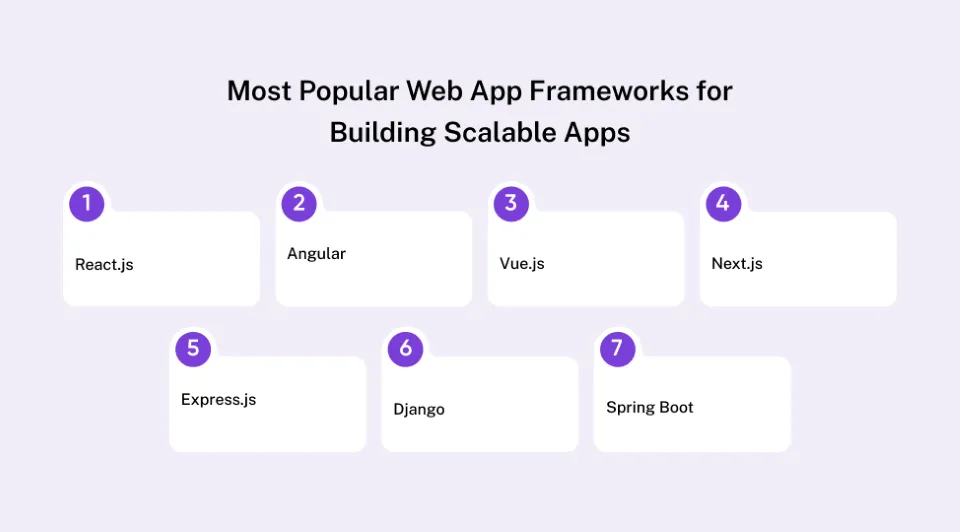
Here is a list of the most popular web development frameworks that have been trusted by developers for their scalability, modularity, and how well they perform in real-life.
1. React.js
React.js continues to be the most popular web framework that helps create scalable user interfaces, which is mainly because it follows a declarative syntax and has a virtual DOM structure. It was created by Facebook. It introduced component-based development that changed how UI logic is restructured and reused.
Why it’s popular:
-
Huge ecosystems of libraries and community tools.
-
Easy integration with frameworks such as Next.js in SSR (Server-Side Rendering).
-
Good developer support and backwards compatibility.
Scalability strengths:
The virtual DOM of React allows rendering even complex and dynamic UIs efficiently. Its modular structure makes it easy for teams to scale frontends across multiple microfrontends or apps with consistent state management through Redux, Zustand, or Recoil.
Lesser-known insight:
Its internal rendering engine, React Fiber, was rebuilt to support incremental rendering. It enables large UI updates without blocking the main thread, which is a minor but important aspect of a high-traffic application.
Best suited for:
Interactive and complex web applications that need dynamic updates and shared UI elements across teams.
2. Angular
Angular, a Google-maintained framework, is good at providing enterprise-level scalability to the frontend. It implements opinionated TypeScript-based architecture, dependency injection, and a good CLI that standardizes project structure. It is suitable for large teams.
Why it’s popular:
-
Supported by Google and popular in the enterprise world.
-
All-inclusive testing, routing, and form management tools.
-
Code consistency and maintainability are guaranteed by strong typing.
Scalability strengths:
Angular’s hierarchical dependency injection model and reactivity system based on RxJS enable huge apps to have a predictable data flow. Ahead-of-time (AOT) compilation and tree-shaking are also supported by the framework to minimize runtime overhead.
Lesser-known insight:
The change detection system (through zones and the Ivy renderer) was tuned to support micro-frontend architectures. This improved render performance at scale.
Best suited for:
It is best for enterprise-grade applications that require a rigid structure, maintainability in the long run, and standardized coding across distributed teams.
3. Vue.js
Vue.js is a good mix of the flexibility of React and the structure of Angular, providing a progressive framework: one that can scale from small widgets to large SPAs.
Why it’s popular:
-
Simplicity and ease of learning.
-
Reactive data binding and virtual DOM for performance.
-
Incremental adoption that works in existing apps without having to rewrite.
Scalability strengths:
Vue’s component system and Vuex (for state management) enable modular scaling. Its ecosystem and CLI (Nuxt.js, Pinia) go further into the enterprise-level development while keeping the footprint minimal.
Lesser-known insight:
The reactivity system of Vue in version 3 is based on Proxies and is more efficient in tracking dependencies than getter/setter-based models. It improves performance in high-frequency update cases.
Best suited for:
Startups and mid-sized projects that grow to an enterprise level, or teams that need speedy performance with minimal boilerplate.
4. Next.js
Next.js is no longer a React framework. It is a full web application framework that is optimized around scalability, performance, and the velocity of developers. Supported by Vercel, it integrates server-side rendering (SSR), static generation, and edge deployment to a single experience.
Why it’s popular:
-
Inbuilt routing, API endpoints, and hybrid rendering.
-
Image optimization and code splitting are automatic.
-
First-class support for edge and serverless deployments.
Scalability strengths:
Next.js provides runtime scalability with incremental static regeneration and edge routing with middleware. Its streaming capabilities of SSR, as well as React Server Components, make sure that it optimally utilizes resources with heavy loads.
Lesser-known insight:
Next.js 14 features Turbopack, a new bundler powered by Rust, which replaces Webpack. It reduces cold starts and build times for large codebases by up to 90%.
Best suited for:
High-traffic applications that require SEO-friendly SSR, microfrontends, and serverless scalability on a global scale of CDNs.
5. Express.js
Express.js is the most popular web development framework for Node.js, and for good reason. Its minimalist philosophy and unopinionated design provide developers with complete control over middleware and routing.
Why it’s popular:
-
Fast and lightweight REST APIs and microservices.
-
High level of middleware ecosystem.
-
Smooth connection to databases, authentication, and logging systems.
Scalability strengths:
Express is good at horizontally scalable environments. The event-driven, asynchronous I/O model is also powered by Node.js, which makes it suitable for handling very large volumes of simultaneous requests.
Lesser-known insight:
Although Express is not complex, it is the basis of more complex structures, such as NestJS and Sails.js, which apply enterprise-scalable frameworks based on the flexible building blocks of Express.
Best suited for:
Microservices, real-time applications, and APIs with low latency and modular scalability.
6. Django
Django is a Python framework and is referred to as the “batteries-included” framework- and it does live up to the name. It is a full-stack web framework that is aimed at quick development, scalability, and security, without affecting performance at all.
Why it’s popular:
-
In-built ORM, authentication, administrator interface, and migrations.
-
High security posture and automatic escaping.
-
Good documentation and long-term sustainability of the community.
Scalability strengths:
Django is scalable both vertically and horizontally using modular applications, caching infrastructure (Redis, Memcached), and asynchronous functionality introduced in recent versions. Its ORM eliminates database bottlenecks and maintains data integrity under loads.
Lesser-known insight:
Django’s async view support (since version 3.1) enables hybrid applications, in which both synchronous and asynchronous operations can coexist, which is also a significant benefit to scaling Python systems in the present day.
Best suited for:
Data-intensive systems, enterprise solutions, and products that require accelerated development and maintainability.
7. Spring Boot
One of the most popular web application frameworks for enterprise Java development is still Spring Boot. It simplifies the complexity of traditional Spring setups to allow developers to create a production-grade application with little configuration.
Why it’s popular:
-
Strong dependency injection and modular architecture.
-
Embedded servers (Tomcat, Jetty) enable easy deployment.
-
Good integration with Kubernetes, Docker, and cloud-native tools.
Scalability strengths:
The architecture of Spring Boot embraces microservices, reactive programming (through WebFlux), and asynchronous communication with the use of messaging systems like Kafka. It has been designed for horizontal scalability and distributed systems.
Lesser-known insight:
The Spring Cloud ecosystem extends Spring with in-built service discovery, distributed tracing, and load balancing. This is necessary in the process of scaling complex enterprise systems.
Best suited for:
Large-scale enterprise apps, financial systems, and businesses that need microservice orchestration and high reliability.
8. Ruby on Rails
Convention over configuration was popularized by Ruby on Rails, which is one of the most popular web dev frameworks of its era. It remains particularly popular in the context of modern startups and SaaS platforms.
Why it’s popular:
-
Quick prototyping in clean, readable syntax.
-
Fully grown ecosystem containing gems for almost all use cases.
-
Good community and stability in the long run.
Scalability strengths:
Rails can be scaled with the help of abstraction: ActiveJob for background processing, ActiveRecord for ORM efficiency, and caching layers (Redis, Memcached) for high performance. Modular services and cloud-native deployment assist in horizontal scaling.
Lesser-known insight:
Large-scale systems such as GitHub and Shopify are built on tailored Rails frameworks, which deploy job queues, caching hierarchies, and parallel request processing to achieve huge scalability.
Best suited for:
SaaS products, e-commerce platforms, and startups that need to balance speed of development and structural scalability.

Comparative Analysis: Choosing the Right Framework for Scalable Web Apps
There is no single framework that is best for all applications. Each of the most popular web app frameworks can be used to obtain certain advantages based on its architecture, concurrency model, and ecosystem maturity. Choosing the right one depends on your project’s workload, scaling strategy, and the professionals on your team.
1. Core Comparison
| Framework |
Primary Language |
Architecture Model |
Concurrency Handling |
Ideal Use Case |
| React.js |
JavaScript |
Component-based |
Virtual DOM diffing |
Scalable frontends, microfrontends |
| Angular |
TypeScript |
MVC + Dependency Injection |
Reactive (RxJS) |
Enterprise SPAs with strict structure |
| Vue.js |
JavaScript |
Reactive MVVM |
Virtual DOM + Proxy reactivity |
Lightweight apps scaling progressively |
| Next.js |
JavaScript/TypeScript |
Hybrid SSR/SSG |
Async event loop (Node.js) |
SEO-driven scalable frontends |
| Express.js |
JavaScript |
Middleware-based |
Event-driven, non-blocking I/O |
APIs, real-time apps, microservices |
| Django |
Python |
MTV (Model-Template-View) |
Multi-threaded + async support |
Data-heavy, enterprise apps |
| Spring Boot |
Java |
Microservice-based |
Reactive Streams + multi-threading |
Large enterprise systems |
| Ruby on Rails |
Ruby |
MVC, convention-driven |
Threaded + process-based |
SaaS, eCommerce, MVPs |
2. Concurrency and Performance
-
Frameworks based on Node.js (React, Next.js, Express.js) are found in high-concurrency environments, which are, by definition, event-driven, non-blocking I/O, which is suitable for microservices and live data systems.
-
Spring Boot and Django are both useful in scaling CPU-intensive or high-transactions systems in which multi-threading and data integrity is more important than raw I/O throughput.
-
Frontend frameworks such as Angular and Vue.js are built with efficient rendering engines, so that they can scale the UI when dealing with even complicated data changes.
3. Developer Productivity, Ecosystem Maturity
Express.js and Vue.js focus on minimal setup and high agility, which are well-suited for rapid MVPs or iterative development.
Angular and Spring Boot include architecture and tooling that encourage consistency across large developer teams.
- React.js and Next.js offer a balance between flexibility and an established ecosystem of rich plug-ins, components that are reusable, and constant innovation by the community.
4. Trade-offs and Suitability
-
Lightweight frameworks such as Express.js provide freedom but require architectural discipline to avoid scaling issues.
-
Opinionated frameworks such as Angular, Rails, and Spring Boot enforce structure. It is best when a team values maintainability more than flexibility.
-
Full-stack frameworks like Next.js and Django make scaling easier as the optimizations of the backend, frontend, and deployment are merged into a single workflow.
Collaborating with a renowned web application development company can help you figure out which frameworks suit your business objectives the best.
Why Framework Choice Fails Without Architectural Fit
Popularity does not make a framework scalable. Fit does. Many of the most popular web application frameworks struggle in production because teams select them based on adoption signals, then force them into workloads and operating models they were not designed to handle.
At scale, a framework is not a neutral tool. It shapes how concurrency is handled, how state flows through the system, how teams split ownership, and how safely changes move from commit to production. When those assumptions conflict with the system’s reality, the framework becomes a bottleneck—usually in ways that are expensive to reverse.
A common failure pattern looks like this: a team chooses a framework because it ships fast early on, but the system grows into a different shape. Features multiply, teams expand, integrations deepen, and operational load increases. The framework is still “popular,” but release velocity slows, incidents rise, and engineering time shifts from building to stabilizing.
Architectural fit depends on alignment across four areas:
-
Traffic characteristics: Real-time, bursty workloads, and steady high-throughput systems stress frameworks differently.
-
Team structure and velocity: Some frameworks enforce conventions that scale across teams; others require strong architectural discipline to avoid fragmentation.
-
Deployment and infrastructure model: Framework behavior changes significantly across monolithic, serverless, and microservice environments.
-
Long-term maintainability: Popular abstractions can still create fast-growing technical debt if they do not match how the system evolves.
This is why experienced teams do not ask, “Which is the most popular web development framework?”
They ask, “Which framework’s architectural model will still work when this system is five times larger?”
The Engineering Behind Scalable Frameworks
Scalability is not an accident. It is in the DNA of frameworks. The most popular web development frameworks have one thing in common: they abstract complexity, but do not hide control. Understanding how these abstractions operate makes it clear why certain frameworks perform well at scale, and others fail during implementation.
On a technical aspect, scalability is the result of a well-coordinated arrangement of four main principles in engineering:
Concurrency Models:
Frameworks are scaled in various concurrency philosophies. Non-blocking systems, which are event-driven (such as frameworks based on Node.js), are effective at serving thousands of concurrent I/O requests with a small number of threads. Through thread pools and the use of loops of asynchrony (such as Java or Python), multi-threaded systems or reactive systems are based on the concept of graduated distribution of computation across cores.
Rendering and Execution Pipelines:
Rendering strategies are frequently used for frontend scalability. Virtual DOM diffing (React, Vue) reduces unnecessary reflows. Server-side rendering (SSR) and static generation (Next.js, Nuxt) delegate work to servers, which is better optimized based on SEO and perceived performance.
Caching and Data Access Optimization:
Database load is reduced drastically by ORM-level caching, query batching, and distributed caches (Redis, Memcached). Those frameworks whose caching layers are mature will successfully decouple the I/O latency from user experience so that the response time will be consistent at scale.
Dependency Injection and Modularity:
Composable architectures are required in scalable systems. Components are isolated by dependency injection containers, service registries, and modular builds and enable teams to develop, deploy, and test in isolation. This is a key characteristic for distributed development environments.
Building for Scale Is About Choosing Smart Foundations
Scalability, in the digital ecosystem today, is an important design philosophy. The most popular web app development languages and frameworks have developed beyond mere libraries or toolkits and have become an ecosystem that influences how developers think about structure, performance, and maintainability.
It can be the non-blocking architecture of Node.js, the durable conventions of Django, or the type-safe performance of Angular; the framework of your choice not only makes development faster, but it also safeguards your app against unexpected user surges and complex workloads.
Scalable applications are not merely about exploring how to survive traffic spikes but about evolving gracefully. For developers and product teams, selecting a framework and utilizing custom web app development services is not about popularity but more of a strategic choice that will reflect long-term scalability objectives.

Tags
web app development cost
web app development languages
web app
web app development


 Facebook
 Twitter
 LinkedIn
 Pinterest