Choosing web app development languages is not just a coding call - it’s a business decision. The stack you pick shapes your delivery speed, your hiring options, your security posture, and how well you scale next quarter and next year. Two quick signals show why this choice matters:
-
JavaScript runs on about 98.9% of all websites, which makes it the default browser runtime for modern apps.
-
In the 2025 Stack Overflow survey, Python usage rose by 7% points year over year, reflecting its pull for AI, data, and back-end work. survey.stackoverflow.co
Your goal should not chase hype. It’s to match a stack to your model, budget, and roadmap. This guide compares the leading web app development languages, shows practical stacks, and gives a decision framework you can run in days - not months.
What is a Tech Stack? The Engine Behind Every Web App
A tech stack is the integrated set of tools and web app development languages that power your application from the browser to the database and deployment.
Core layers to know:
-
Front end: Browser interface (HTML, CSS, JS/TS, frameworks)
-
Back end: Server logic, APIs, and business rules
-
Database & cache: Where data lives and how fast you retrieve it
-
Build & observability: CI/CD, testing, logging, monitoring
Why layer fit matters:
Changing one layer often forces new skills, new tools, and new costs. Smooth alignment between layers lowers maintenance and keeps feature velocity high.
With the layers clear, let’s map where each language lives, so your choice of web app development languages is grounded, not guessed.
Front End Vs. Back End - Where Each Web App Development Languages Lives
Front end essentials
-
JavaScript runs natively in every browser; TypeScript adds types for safer scaling.
-
Frameworks like React, Angular, Vue, and Svelte shape structure and performance.
-
For multi-team or long-lived apps, TypeScript helps prevent regressions and speeds code reviews.
If you’re planning a complex UI and need extra hands, consider expert Frontend Development Services to build a robust design system early - before features pile up.
Back end essentials
-
Common web app development languages on the server: Node.js (JS/TS), Python, Java, C#, Go, PHP, Ruby, Rust, Kotlin.
-
Typical patterns: REST or GraphQL, and deployment as monolith, modular monolith, or services.
-
The best language for web app development depends on runtime performance needs, integration depth, and your team’s skill mix.
Now that you see the split, let’s walk through the core languages - their strengths, trade-offs, and where they fit best.
Core Web App Development Languages - Strengths, Trade-offs, And Best Fits
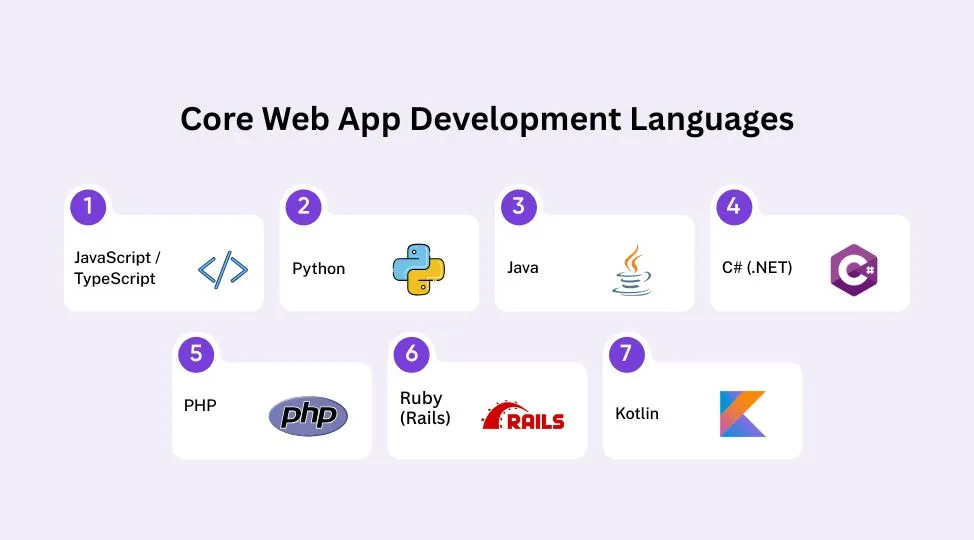
JavaScript / TypeScript
-
Why it leads: It’s the only language native to the browser and, with Node.js, it powers back ends too.
-
Best-fit: Interactive dashboards, SaaS UIs, real-time apps.
-
Ecosystem: MERN/MEAN/MEVN, Next.js + Node.
-
Business takeaway: One runtime across client and server reduces context switching. For many teams, it’s the best language to develop web apps that must evolve weekly.
Python
-
Strengths: Clear syntax; massive package ecosystem (Django, FastAPI).
-
Best-fit: Data-driven apps, AI-powered tools, internal dashboards.
-
Why it wins: Rapid API development, great testing culture, and high developer availability. For data-heavy builds, Python often becomes the best web app development language.
Building AI features like recommendations or semantic search? Partner with specialists in AI Development Services to ship reliable ML features without derailing your main roadmap.
Java
-
Strengths: JVM stability, performance, mature frameworks like Spring Boot.
-
Best-fit: Regulated, large-scale, long-lifecycle systems.
-
Why it matters: Strong governance and a deep talent pool reduce operational risk - key for enterprises choosing the best programming language for web and app development with strict compliance needs.
C# (.NET)
-
Strengths: Productive tooling, first-class cross-platform runtime, cloud-friendly.
-
Best-fit: Enterprise portals, ERP/CRM systems, deep Microsoft integrations.
-
Pick it when: You rely on Azure, AD/Entra ID, or Windows-centric infrastructure.
PHP
Strengths: Mature CMS and commerce ecosystem (Laravel, WordPress).
Best-fit: Content sites, e-commerce, and MVPs.
Business note: Lower hosting costs and quick onboarding. In practical terms, it’s still a candidate for the best language for web app development when content velocity is king.
Ruby (Rails)
-
Strengths: Opinionated defaults that speed delivery.
-
Best-fit: SaaS MVPs and early-stage products.
-
When it shines: When speed to first revenue matters more than fine-grained performance.
Go (Golang)
-
Strengths: Lightweight, fast, excellent concurrency, easy to deploy.
-
Best-fit: High-throughput APIs, streaming, infra-heavy back ends.
-
Business benefit: Handles traffic with small memory footprints, which keeps infrastructure bills in check.
Rust
-
Strengths: Memory safety and performance; growing web frameworks.
-
Best-fit: Security-critical, compute-intensive services.
-
Long-term value: Fewer runtime faults can mean lower maintenance spend.
Kotlin
Swift (server-side)
Teams ship stacks, not single tools. Here’s how popular stacks combine these web app development languages in 2025–2026.
Tech Stacks That Dominate 2025 - 2026 (And When to Use Them)
-
Next.js + Node + Postgres: Hybrid rendering for SEO, server actions, real-time support.
-
Django/FastAPI + React: Data/ML-heavy apps with modern UIs.
-
Spring Boot + React: Enterprise reliability with flexible front end.
-
.NET + Angular/React: Best for Azure and Microsoft-aligned organizations.
-
Rails + Hotwire / Laravel + Inertia: Rapid MVPs with strong conventions.
-
Go + HTMX/React: Lightweight APIs, simple deploys, high throughput.
-
Jamstack (Next.js + Headless CMS): Ideal for content at scale and fast e-commerce.
If you’re evaluating end-to-end delivery options, a trusted Web app development company can benchmark two candidate stacks against your KPIs and total cost of ownership.
Ready to shortlist? Start with a quick comparison so the best web app development language for your case stands out fast.
Quick-compare Table - Strengths, Risks, And Hiring Insights
| Language |
Typical Stack |
Strengths |
Watch-outs |
Best-fit projects |
Hiring availability |
| JavaScript / TypeScript |
MERN, Next.js + Node |
Universal, vast ecosystem |
Over-choice fatigue |
SaaS, dashboards, realtime |
Very high |
| Python |
Django, FastAPI |
Data/AI friendly, rapid APIs |
Slower raw runtime |
Analytics tools, internal apps |
Very high |
| Java |
Spring Boot |
Scale, reliability |
Verbose for tiny MVPs |
Enterprise, regulated |
Very high |
| C# |
ASP.NET Core |
Tooling, Azure fit |
“Legacy” bias perception |
Portals, B2B apps |
High |
| PHP |
Laravel |
MVP speed, hosting ease |
Inconsistent legacy code |
Commerce, content |
Very high |
| Ruby |
Rails |
Rapid dev, clear conventions |
Scaling cost later |
SaaS MVPs |
Medium |
| Go |
Gin, Echo |
Fast, efficient, simple deploys |
UI learning curve |
High-throughput APIs |
Medium |
| Rust |
Axum, Actix |
Safety + speed |
Smaller hiring pool |
Security-sensitive systems |
Low–Medium |
| Kotlin |
Ktor, Spring |
Modern JVM |
Smaller ecosystem |
JVM shops modernizing |
Medium |
Now, use this framework to move from “it depends” to “we’ve picked the right stack.”
Decision Framework - Match Business Goals to The Right Stack
| Goal |
Recommended stack |
Primary language(s) |
Why it works |
| Launch an MVP fast |
Rails / Laravel / Next.js + Node |
Ruby / PHP / TypeScript |
Batteries-included frameworks and fast feedback |
| AI-driven or data apps |
Django + React (or FastAPI) |
Python + TypeScript |
Strong data/ML libraries plus a modern UI |
| Real-time collaboration |
Next.js + Node + WebSockets |
TypeScript |
One runtime, realtime-friendly |
| Enterprise SSO portals |
ASP.NET Core + React |
C# + TypeScript |
Mature auth, Azure alignment |
| High-throughput APIs |
Go + React or HTMX |
Go + TypeScript |
Great concurrency and simple deployment |
| Compliance-heavy systems |
Spring Boot + React |
Java + TypeScript |
Governance, tooling, proven patterns |
Moving from idea to API? Experienced Backend Development Services can stand up a secure foundation quickly, so your front end can ship features instead of fighting infrastructure
Cost, Hiring, And Maintenance Realities
-
Time to market: Rails, Laravel, Django, and Next.js stacks often deliver MVPs faster than heavyweight enterprise stacks because of their defaults and scaffolds.
-
Hiring pools: JavaScript/TypeScript, Python, PHP, and Java talent is abundant. Easier hiring lowers time to staff and keeps costs stable.
-
Maintenance posture:
-
- Static typing (TypeScript, Java, C#) helps large codebases evolve.
-
- Convention-heavy frameworks (Rails, Laravel) help small teams ship predictably.
-
Cloud alignment:
-
- .NET pairs naturally with Azure.
-
- Node and Python shine in serverless patterns.
-
- Java, Go, and Python scale well on AWS/GCP managed services.
-
Total cost of ownership: Simple deployment (Go), safety (Rust), and batteries-included frameworks (Rails, Laravel, Django) each reduce cost - but in different ways. The best programming language for web and app development for you is the one that cuts the most risk for your context.
When your roadmap spans multiple products, it’s smart to bring in Web app development services to design standards for auth, logging, and testing that every team reuses.
Shipping faster only helps if you’re shipping securely. Here’s what to check - no matter which web app development languages you choose.
Security & Compliance Essentials by Stack
Baseline checklist
-
AuthN/AuthZ: Use framework-native libraries (Devise/Rails, Laravel Breeze, Spring Security, ASP.NET Identity).
-
Input validation: Zod (TypeScript), Pydantic (Python), Jakarta Validation (Java).
-
Secrets & config: 12-factor environment variables and a cloud secret manager.
-
Patch cadence: Prefer frameworks with active LTS and frequent security releases.
-
Compliance readiness: Audit logging, role-based access, encryption at rest/in transit, and documented data retention for GDPR/CCPA.
Practical tips
-
Centralize logging early.
-
Add rate limits to public APIs.
-
Automate dependency scanning in CI.
-
Keep a living threat model; revisit it each quarter.
With the guardrails in place, plan how you’ll prove stack fit before you fully commit.
Sample Sprint Roadmaps (By Stack)
Next.js + Node (TypeScript)
-
Sprint 0: Design system, auth, and routing.
-
Sprint 1–2: Core flows, SSR/ISR pages, form validation.
-
Sprint 3: CI/CD, error tracking, analytics, first load test.
Django + React
-
Sprint 0: Data models, admin, baseline tests.
-
Sprint 1–2: REST/GraphQL, React pages, permissions.
-
Sprint 3: Caching, async tasks, load/perf passes.
Spring Boot + React
-
Sprint 0: Domain modeling, security, project scaffolding.
-
Sprint 1–3: Services, integrations, pagination, file storage.
-
Sprint 4: SSO, non-functional testing, deployment hardening.
Real-world Scenarios
-
Content-heavy SaaS: A team shipped a working MVP in weeks using Laravel + Inertia for quick CRUD and clean URLs, then layered a React component where interactivity mattered most.
-
Data platform: A product combine
-
ed Django + React to leverage Python’s data libraries for ETL jobs and a reactive UI for analysis.
-
High-traffic API: A logistics service moved read-heavy endpoints to Go, cutting tail latency and cloud spend while keeping a TypeScript front end.
-
Enterprise portal: A healthcare portal used ASP.NET Core + React for easy SSO, robust audit logging, and Azure policy controls.
-
Realtime collaboration: A document tool chose Next.js + Node for a unified TypeScript runtime and WebSocket events.
Conclusion - The Right Stack is a Strategic Advantage
Your pick of web app development languages sets the pace for delivery, the shape of your team, and the future cost of change. Use the comparison tables to shortlist two stacks then commit with confidence.
If you want hands-on help - from audits to build-outs - tap trusted partners like Quokka Labs for Web application development services to get a production-ready foundation.
Planning AI features in your backlog? Keep your core stack lean and explore targeted AI Development Services to add recommendations, RAG search, or predictive analytics without slowing your main release train.
Tags
application development
web app
web app development