Traffic spikes, feature expansion, and data growth expose weak engineering decisions faster than anything else. Teams often discover this the hard way. When a web app that worked fine at launch starts slowing down, scaling costs rise, and even small changes become risky. In many cases, the root cause is not code quality, but the tech stack chosen early on.
Studies consistently show that users abandon slow experiences quickly, with more than half of mobile visitors leaving pages that take over a few seconds to load. Performance delays also compound business impact, affecting conversion rates, retention, and long-term trust. These outcomes make Web App Performance a business concern, not just a technical one.
The reality is simple: Tech stacks for web app development influence performance, scalability, and cost far more than most teams anticipate. Language runtimes, frameworks, databases, and infrastructure patterns quietly add or remove latency, operational complexity, and cost over time. When stacks don’t scale cleanly, teams are forced into expensive re-architecture, slowing roadmaps, and increasing total ownership cost.
This guide breaks down the most popular tech stacks used in modern web applications and explains when each supports a scalable web architecture. You’ll see how different stacks perform under real workloads, where they struggle, and which environments they fit best, whether you’re building real-time apps, transactional SaaS platforms, enterprise systems, or globally distributed products.
Top 9 Tech Stacks for Web App Development
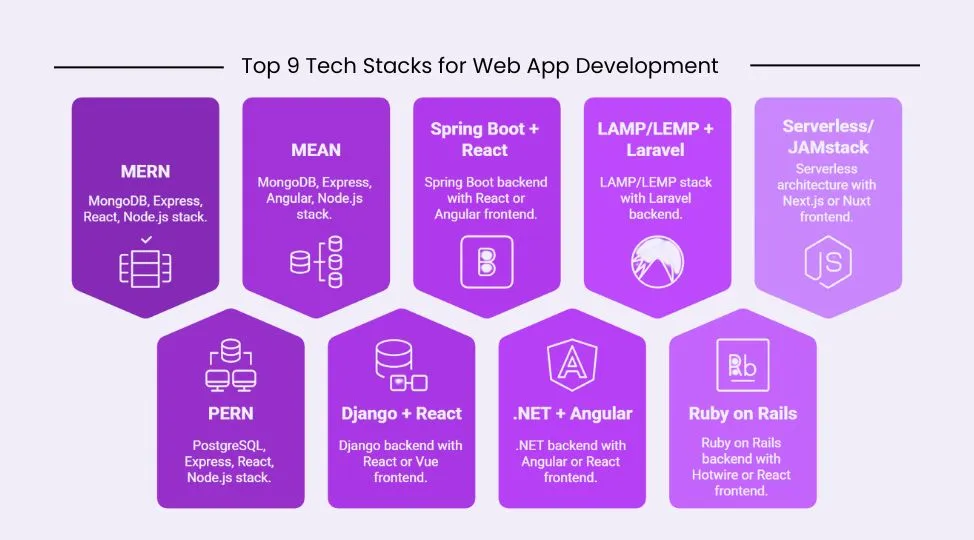
1) MERN: MongoDB + Express + React + Node.js
A JavaScript-first stack designed for fast iteration, real-time experiences, and horizontal scaling when architected correctly.
Front end: React (TypeScript recommended)
Back end: Node.js + Express
Technology:
-
MongoDB: A document database that stores JSON-like documents. Flexible schemas make it easy to evolve features. Sharding and replicas help scale reads and writes.
-
Express: A minimal Node.js web framework for routing, middleware, and APIs. Keeps the server simple and fast to adapt.
-
React: A component-based UI library. Virtual DOM and hooks help build interactive interfaces that are easy to compose and test.
-
Node.js: A JavaScript runtime with an event loop. Great for I/O-heavy workloads and streaming data. Works well with microservices.
Why it scales:
MERN scales well for I/O-heavy workloads because Node.js uses a non-blocking event loop, React enables efficient UI updates, and MongoDB supports horizontal scaling through sharding and replicas. When paired with stateless APIs and caching, MERN handles growing traffic with predictable performance.
Best-fit use cases
-
Real-time dashboards and collaboration tools
-
Content-driven platforms and CMS-style applications
-
Early-stage SaaS products that need fast iteration without early over-engineering
When MERN is not ideal
Architecture tips
-
API gateway + stateless Node services; isolate heavy jobs to queues
-
Redis for caching and rate limiting; connection pooling for MongoDB
-
Use TypeScript, Mongoose schemas, and strict API contracts
Hiring market
Excellent. React and Node.js developers are widely available across regions, making MERN easy to staff and scale from a team perspective.
2) PERN: PostgreSQL + Express + React + Node.js
A JavaScript-first stack anchored by a relational database, built for scalability where data integrity, reporting, and transactions matter as much as speed. Why it scales
PERN combines Node.js’ non-blocking I/O with PostgreSQL’s strong ACID guarantees and advanced query engine. This makes it well-suited for applications that grow in both traffic and data complexity. Features like indexing, JSONB, window functions, and read replicas allow teams to scale reads, writes, and analytics without changing databases mid-flight.
Database contention and connection limits. As usage grows, poorly indexed queries, chatty APIs, or unpooled connections can increase latency and exhaust Postgres connections faster than expected.
How teams fix it in practice
-
Design schemas intentionally early; use proper indexes and avoid unbounded joins
-
Add connection pooling (pgBouncer or managed cloud pooling) to stabilize concurrency
-
Separate read-heavy workloads using replicas or analytics databases
-
Cache hot queries and computed results with Redis
-
Enforce API contracts and data access patterns to prevent query sprawl
Best-fit use cases
-
Transactional SaaS platforms with audits and reporting
-
B2B products handling billing, subscriptions, or financial data
-
Applications that mix relational data with semi-structured JSON fields
When PERN is not ideal
Hiring market
Very strong. PostgreSQL, Node.js, and React skills are widely available, making PERN one of the easiest scalable stacks to hire for long term.
3) MEAN: MongoDB + Express + Angular + Node.js
A full TypeScript, opinionated JavaScript stack designed for large teams that value structure, consistency, and long-term maintainability at scale.
Why it scales
MEAN scales well when teams need architectural consistency across front end and back end. Angular’s strict patterns, dependency injection, and module system reduce code drift as teams grow, while Node.js handles concurrent I/O efficiently. MongoDB’s horizontal scaling model supports evolving product schemas without frequent migrations.
First scaling bottleneck you’ll hit
Front-end complexity and bundle size, followed by backend CPU pressure. Angular applications can grow heavy if change detection and module loading aren’t tuned, while Node.js still struggles with CPU-bound workloads under high concurrency.
How teams fix it in practice
-
Use strict module boundaries and lazy loading to control Angular bundle size
-
Tune change detection strategies and avoid unnecessary re-renders
-
Offload compute-heavy work to background workers or separate services
-
Enforce schema validation and indexing discipline in MongoDB
-
Introduce Redis for caching, rate limiting, and shared state
Best-fit use cases
-
Enterprise dashboards and admin-heavy platforms
-
Internal tools with long lifecycles and many contributors
-
Products where consistency and governance outweigh rapid UI experimentation
When MEAN is not ideal
Hiring market
Solid but more specialized. Angular talent is widely available, though generally narrower than React, making hiring slightly more constrained in some regions.
4) Django + React (or Vue) + PostgreSQL
A compliance-friendly, batteries-included Python backend paired with a modern JavaScript front end, built for reliability, data integrity, and long-term scalability.
Why it scales
Django scales by enforcing strong conventions early: clear app boundaries, a mature ORM, built-in security defaults, and a powerful admin layer. Paired with PostgreSQL, it handles complex relational data reliably. Background job systems (Celery, RQ) and caching layers allow teams to scale throughput without bloating the request path.
First scaling bottleneck you’ll hit
Database inefficiencies and synchronous request paths. As traffic grows, N+1 queries, heavy ORM usage, and CPU-bound logic inside web requests can quickly increase latency.
How teams fix it in practice
-
Audit and eliminate N+1 queries using query optimization and prefetching
-
Add Redis for caching hot paths, sessions, and rate limiting
-
Move long-running or CPU-heavy work to background workers (Celery/RQ)
-
Use ASGI with Gunicorn/Uvicorn and introduce Django Channels only when real-time features are required
-
Apply strict API boundaries with Django REST Framework to keep services clean
Best-fit use cases
Content-heavy platforms with editorial workflows
Healthcare, education, and compliance-driven SaaS
Products that need a powerful internal admin from day one
When Django + React is not ideal
Ultra-low-latency systems where Python overhead dominates
Teams without Python experience or discipline around ORM usage
Hiring market
Strong. Django and Python developers are widely available globally, especially for backend-heavy and regulated applications.
5) Spring Boot (Java) + React/Angular + PostgreSQL/MySQL
An enterprise-grade stack built for high throughput, long-term maintainability, and systems that must stay predictable under sustained load.
Why it scales
Spring Boot scales well because it runs on the JVM, which offers strong concurrency, mature memory management, and decades of production hardening. Its opinionated setup reduces misconfiguration, while deep integration with security, messaging, and observability tools makes it suitable for large, distributed systems. When paired with relational databases like PostgreSQL or MySQL, it supports high transaction volumes with consistency.
First scaling bottleneck you’ll hit
Operational complexity and JVM tuning. As systems grow, poorly tuned thread pools, blocking I/O, or inefficient garbage collection can increase latency and resource usage faster than expected.
How teams fix it in practice
-
Tune thread pools, connection pools, and JVM memory/GC settings early
-
Use non-blocking or reactive patterns only where they add real value
-
Introduce event-driven processing with Kafka or similar brokers for high-volume workflows
-
Add distributed caching (Redis) to reduce database load
-
Standardize observability with metrics, tracing, and structured logs to catch issues before they scale
Best-fit use cases
-
Mission-critical B2B platforms and enterprise SaaS
-
Fintech, logistics, telecom, and regulated industries
-
Systems expected to evolve into microservices over time
When Spring Boot is not ideal
Hiring market
Strong and stable. Java and Spring Boot talent is widely available, especially for enterprise and long-lifecycle systems.
6) .NET (ASP.NET Core + C#) + Angular/React + SQL Server/Postgres
A high-performance, strongly typed stack designed for security-first, identity-heavy applications that need predictable scaling and long-term support.
Why it scales
ASP.NET Core runs on a fast, cross-platform runtime with efficient async I/O, strong threading, and a lightweight web server (Kestrel). Combined with C#’s async/await model and mature identity libraries, the stack handles high concurrency with stable latency. Paired with SQL Server or PostgreSQL, it supports consistent transactional workloads at scale.
First scaling bottleneck you’ll hit
Thread pool saturation and database pressure. As traffic grows, synchronous calls, blocking I/O, or chatty data access patterns can consume threads quickly and increase response times.
How teams fix it in practice
-
Enforce async-first patterns end to end; eliminate blocking calls in request paths
-
Tune thread pools and database connection pools early
-
Use Redis for caching, session state, and rate limiting
-
Apply CQRS or clean service boundaries to reduce coupling
-
Standardize structured logging, metrics, and distributed tracing for early visibility
Best-fit use cases
-
Identity-heavy business applications (SSO, RBAC, SCIM)
-
Enterprises standardized on Microsoft and Azure
-
Internal and external systems with strict security and compliance needs
When .NET is not ideal
Hiring market
Very strong. .NET and C# developers are widely available, particularly in enterprise and Azure-focused environments.
7) LAMP/LEMP + Laravel (PHP) + MySQL/MariaDB
A mature, cost-efficient web stack that emphasizes developer productivity, predictable scaling, and simple operations for CRUD-heavy applications.
Why it scales
Laravel scales reliably by leaning on proven web fundamentals: PHP-FPM for process isolation, Nginx or Apache for request handling, and relational databases for structured data. Laravel’s built-in queues, caching, and auth systems allow teams to separate slow work from request paths early, keeping response times stable as traffic grows.
Synchronous request handling and database load. As usage increases, heavy logic inside controllers, unoptimized queries, and lack of caching can quickly slow response times and increase infrastructure costs.
How teams fix it in practice
-
Move long-running tasks to queues using Horizon and background workers
-
Add Redis for caching hot paths, sessions, and rate limiting
-
Optimize database access with indexing, read replicas, and query profiling
-
Use Laravel Octane (Swoole or RoadRunner) to reduce request boot time
-
Modularize large codebases with service layers to avoid monolithic sprawl
Best-fit use cases
-
Content platforms and SMB SaaS products
-
Marketplaces and CRUD-heavy business applications
-
Teams that want fast delivery with simple hosting and predictable costs
When Laravel is not ideal
Hiring market
Strong and cost-effective. PHP and Laravel developers are widely available globally, making it easier to scale teams without escalating payroll costs.
8) Ruby on Rails + Hotwire/Turbo (or React) + PostgreSQL
A convention-driven stack optimized for rapid product iteration, clean domain modeling, and scaling through simplicity rather than complexity.
Why it scales
Rails scales by enforcing strong conventions that reduce architectural drift as teams grow. PostgreSQL provides reliable transactional guarantees, while modern Rails versions (Rails 7+) paired with Hotwire/Turbo reduce heavy client-side JavaScript and shift work back to the server. With aggressive caching and background jobs, Rails apps can scale to millions of users without excessive infrastructure.
First scaling bottleneck you’ll hit
Database inefficiencies and synchronous request work. N+1 queries, insufficient caching, and heavy logic in controllers can quickly increase response times as traffic rises. Ruby’s lower raw compute performance also makes CPU-bound work expensive in the request path.
How teams fix it in practice
-
Detect and eliminate N+1 queries early using eager loading and query analysis
-
Introduce Redis-backed caching for views, fragments, and computed data
-
Move heavy or slow tasks to background jobs with Sidekiq
-
Partition large PostgreSQL tables and add targeted indexes
-
Use API-only Rails services when splitting into microservices
Best-fit use cases
-
Marketplaces, social platforms, and productivity tools
-
Startups shipping features weekly with tight feedback loops
-
Products where developer speed outweighs raw compute efficiency
When Ruby on Rails is not ideal
Hiring market
Moderate but stable. Rails developers are experienced and productive, though the pool is smaller than JavaScript or Java ecosystems in some regions.
9) Serverless/JAMstack: Next.js (or Nuxt) + Edge/CDN + Functions (AWS Lambda/GCP CF) + DynamoDB/Postgres
A CDN-first, event-driven architecture designed for global reach, spiky traffic, and rapid delivery with minimal infrastructure management.
Why it scales
Serverless/JAMstack scales by default. Front-end rendering happens at the edge via CDNs, while backend logic runs in stateless functions that automatically scale with demand. This removes the need to pre-provision servers and allows applications to handle sudden traffic spikes without manual intervention. For globally distributed users, edge rendering dramatically reduces latency.
First scaling bottleneck you’ll hit
Observability, database connections, and cost predictability. As usage grows, cold starts, limited visibility into distributed execution, and database connection exhaustion (especially with SQL) can introduce latency and unexpected cost spikes.
How teams fix it in practice
-
Use edge caching, ISR/SSG, and aggressive CDN strategies to minimize function invocations
-
Add database proxies or pooling layers (RDS Proxy, Neon, PgBouncer-like services)
-
Prefer event-driven flows and queues for long-running or bursty workloads
-
Instrument logs, metrics, and traces early to regain observability
-
Monitor per-request cost and set budgets/alerts to avoid silent overruns
Best-fit use cases
-
Content-heavy websites and marketing platforms
-
Applications with global audiences and unpredictable traffic
-
MVPs and early-stage products prioritizing speed to launch
When Serverless / JAMstack is not ideal
-
Systems with sustained high throughput where per-request pricing becomes expensive
-
Workloads requiring long-lived connections or heavy background processing
-
Teams without experience managing distributed, event-driven systems
Hiring market
Growing but specialized. Talent familiar with serverless patterns, edge caching, and cost governance is in demand, though not as abundant as traditional full-stack roles.
💡 Suggested Read: Ultimate Guide to Web App Development
How to Choose the Best Tech Stack for Web App Scale
The best tech stack for web app success depends on a few non-negotiables. Use this checklist to match your context.
Evaluation criteria
-
Performance targets: Define P95 latency, cold start budget, throughput, and memory ceilings.
-
Traffic pattern: Steady vs. spiky; regional vs. global users; weekday vs. weekend peaks.
-
Data needs: Strong relational integrity or flexible documents; do you need analytics and streaming now or later?
-
Team skills & hiring: Mid/senior availability in your region matters more than brand names.
-
Ecosystem maturity: Libraries, cloud integrations, observability, and security updates.
-
Total cost: Infrastructure, tooling, and developer time. If budgeting, see Web application development cost to align stack choice with spend stages.
-
Compliance/security: Audits, encryption, access control, SSO/SCIM, and data residency.
-
Time-to-market: Learning curve, boilerplate, and conventions vs. maximum flexibility.
Wrap-up
Scaling is about smart trade-offs, not picking a celebrity framework. Use the criteria above, compare the most popular tech stacks, and choose the tech stack for web app development that matches your performance targets, data model, team strengths, and roadmap. Start lean, add observability early, and design for change. When in doubt, build a thin vertical slice and measure.
If you need a capable partner to turn plans into shipped value, explore Quokka Lab’s Web app development services and ship with confidence.

Tags
Tech Stacks
web application
web app development


 Facebook
 Twitter
 LinkedIn
 Pinterest