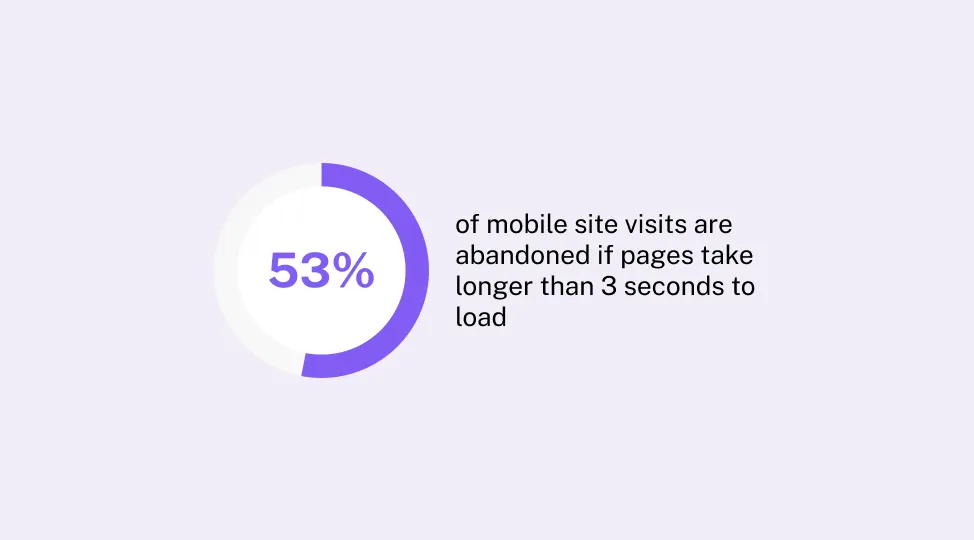
For product and engineering teams, API architecture decisions show up quickly in the places users notice most: slow screen loads, fragile caching, and backend changes that delay releases. Google notes that 53% of mobile site visits are abandoned if pages take longer than 3 seconds to load, which makes one thing clear: mobile users have very little patience for slow experiences.
That same expectation often carries into mobile apps, where delays in data fetching quickly become product issues. This is why REST vs GraphQL for mobile apps is more than a backend debate. It affects how efficiently screens load on unstable networks, how easily teams support changing product requirements, and how well the app scales as usage grows.
In practice, the right choice depends on the shape of your mobile experience. Some apps benefit from REST’s predictable endpoints and mature caching model. Others need GraphQL’s ability to combine multiple data sources into a single response for more dynamic screens.
REST vs GraphQL For Mobile Apps: A Quick Comparison
Choosing between REST vs GraphQL is not simply a backend preference. In mobile development, it directly affects payload efficiency, caching behavior, flexibility, and long-term scalability. A strong decision here leads to better API design for mobile apps, especially when screens depend on multiple services and changing data needs.
The table below gives a quick comparison of how both approaches behave in real mobile environments.
| Comparison Area |
REST |
GraphQL |
| Data fetching model |
The server decides the response structure for each endpoint |
Client requests exactly the fields it needs |
| Endpoints |
Multiple endpoints for different resources |
Single endpoint for all queries and mutations |
| Payload efficiency |
Can lead to over-fetching or under-fetching |
Usually more efficient for complex, data-rich screens |
| Caching |
Strong native support through HTTP caching, CDNs, and ETags |
More complex and usually handled through client-side caching libraries |
| Network round-trip |
Often requires multiple requests for one mobile view |
Can reduce round-trip queries by combining related data in one query |
| Versioning |
Commonly handled through versioned endpoints like v1 and v2 |
Schema evolves over time through field deprecation |
| Scaling complexity |
Easier to monitor and control operationally |
More flexible, but adds resolver and query management complexity |
| Offline-first support |
Possible, but often requires more custom handling |
Better suited for normalized caching and optimistic UI workflows |
| Best-fit use cases |
Simple CRUD apps, public APIs, caching-heavy systems |
Complex mobile interfaces, multi-client products, nested data needs |
For mobile teams, the key difference in GraphQL vs REST performance mobile is practical. REST works well when screens map cleanly to stable resources and caching needs to stay simple. GraphQL becomes more useful when a single screen pulls data from several services and the client needs tighter control over payload size.

Performance Trade-offs In REST vs GraphQL For Mobile Apps
Performance in mobile products is shaped by more than response time alone. It depends on network round trips, payload size, and how much work shifts from the network layer to the server. That is why GraphQL vs REST performance mobile is such an important consideration when evaluating data flow for modern apps.
Here are the key performance trade-offs in REST vs GraphQL for mobile apps:
1. Screen-Level Data Loading
In REST, one mobile screen often depends on multiple endpoints. A dashboard might need separate calls for user data, activity, recommendations, and notifications. On fast networks, that may be manageable. On mobile connections with higher latency, those extra round trips add up quickly.
GraphQL can reduce that overhead by allowing the client to request all required fields in a single query. For screens that combine multiple resources, this often improves perceived load speed.
2. Payload Efficiency
REST endpoints usually return a fixed response structure. That is fine when the screen uses most of the returned data, but wasteful when it only needs a small subset. In mobile apps, that matters because every unnecessary field adds payload weight and affects performance on weaker connections.
GraphQL gives the client control over the fields it requests, which can make responses lighter. That said, leaner payloads do not automatically mean better performance if the server has to do more expensive query resolution behind the scenes.
3. Network Cost vs Server Cost
REST keeps request handling relatively predictable because each endpoint is purpose-built. That makes performance easier to monitor and optimize over time.
GraphQL reduces network chatter, but it can increase execution cost on the backend. Poorly designed resolvers, deeply nested queries, or missing batching strategies can introduce N+1 query problems and shift latency from the client side to the application layer.
4. Predictability vs Flexibility
REST is easier to optimize when request patterns are stable. GraphQL is more adaptable when product teams frequently change screens or combine data in new ways. The trade-off is that flexibility requires stricter query controls, better resolver design, and stronger backend discipline.
For mobile products with simple, resource-based flows, REST often performs well with less complexity. For data-rich screens that pull from multiple services, GraphQL can improve responsiveness, but only when the backend is designed to support it properly.
Caching Trade-Offs In REST vs GraphQL For Mobile Apps
Apps that follow an offline first mobile app architecture often benefit from GraphQL when screens depend on interconnected data and smoother client-side state handling.
Why REST Caching is Easier to Operationalize
REST works naturally with HTTP caching because each resource has its own URL. That means teams can use proven mechanisms like Cache-Control headers, ETags, and CDN distribution without adding much application-level complexity. This is especially useful in mobile apps that serve stable resources such as product catalogs, category pages, media assets, or reference data.
Because the caching model is already built into the web stack, REST is usually easier to reason about, easier to monitor, and easier to scale for content-heavy experiences.
Why GraphQL Caching Needs More Design Effort
GraphQL usually sends requests through a single endpoint, so traditional URL-based caching is far less useful. In most cases, effective caching depends on the client layer through tools such as Apollo Client or Relay. These libraries can support normalized caching, optimistic updates, and smoother offline interactions, which is valuable for mobile apps with complex UI state.
The problem is that this power comes with more moving parts. Teams need strong cache key strategy, reliable entity identification, and clear mutation handling. If that work is not done carefully, stale UI state and hard-to-debug cache inconsistencies become a real issue.
What This Means For Mobile Architecture
If your app relies heavily on repeatable reads of stable content, REST usually gives you a cleaner caching path. If your app has highly personalized screens, interconnected entities, and offline-first workflows, GraphQL can offer a stronger client experience, but the implementation cost is higher.
In other words, REST gives you simpler caching infrastructure. GraphQL gives you more granular client-side control. The better choice depends on whether your main problem is cache efficiency at the HTTP layer or state consistency at the screen level.
Scaling Trade-Offs in REST vs GraphQL for Mobile Apps
As a mobile product grows, API architecture starts affecting much more than data delivery. It influences service boundaries, observability, release coordination, and the cost of supporting multiple clients over time.
1. Scaling Services
REST usually scales cleanly when backend services map well to business domains. Teams can isolate endpoints, monitor traffic patterns, and optimize resource-specific behavior with relatively low ambiguity.
GraphQL introduces a unified schema that can simplify the client experience, especially across iOS, Android, and web. But that convenience at the client layer often shifts coordination pressure to the backend. Schema ownership, resolver consistency, and cross-team governance become more important as the product expands.
2. Scaling Team Workflows
REST is often easier for backend teams to manage when product requirements are stable. Each endpoint has a defined purpose, which helps with ownership and debugging.
GraphQL is often better for frontend-heavy environments where screens evolve quickly and multiple clients need different data shapes. The trade-off is that teams need stronger schema review processes and better communication between frontend and backend developers.
3. Scaling Observability And Control
REST requests are easier to inspect because the request path usually tells you what resource is being accessed. That makes monitoring, rate limiting, and troubleshooting more straightforward.
GraphQL requests are harder to evaluate at a glance because many different query shapes pass through the same endpoint. Once traffic grows, teams often need query cost analysis, depth limits, persisted queries, and more advanced observability to prevent misuse or performance regression.
4. Scaling Without Overengineering
REST is usually the safer choice when the app has stable workflows and the main priority is operational simplicity. GraphQL is more compelling when the app surface becomes more dynamic and multiple screens repeatedly compose data from different services.
In many real-world mobile architectures, the most scalable answer is not choosing one model for everything. Teams often keep REST for stable internal services such as authentication, uploads, payments, or media delivery, while using GraphQL as a client-facing aggregation layer for more dynamic app experiences.

When to Use REST in Mobile Apps
REST is usually the better choice when simplicity, caching predictability, and operational control matter more than payload flexibility. It fits mobile apps where screens map cleanly to stable resources and the data model does not change constantly.
You should use REST when:
-
Your app is built around clear resource-based operations such as products, bookings, user accounts, or orders.
-
You want to rely on mature HTTP caching and CDN support.
-
Your backend team prefers explicit endpoints with predictable monitoring and lower execution overhead.
-
The product does not require highly customized responses for every screen.
-
You need a faster implementation path without introducing extra schema or resolver complexity.
REST is often a strong fit for commerce apps, booking flows, media delivery, admin tools, and public API ecosystems where consistency matters more than query flexibility.
REST Mobile App Use Cases (Existing Apps)
-
Airbnb style booking flows work well with REST when listings, reservations, pricing, and user profiles are exposed as stable resources.
-
Retail apps often benefit from REST for product listings, detail pages, and media assets because these can be cached efficiently and served repeatedly.
-
LinkedIn-style profile and account operations are also a good fit when the interactions are structured and endpoint behavior needs to stay predictable.
When to Use GraphQL in Mobile Apps
GraphQL is often the better fit when a mobile screen needs data from multiple sources and the frontend team wants tighter control over what gets returned. It becomes especially useful in products with fast-moving UI requirements, personalized feeds, and shared data needs across iOS, Android, and web.
You should use GraphQL when:
-
A single screen combines several related entities, such as profile data, recommendations, notifications, and activity.
-
Different clients need different field sets from the same backend domain.
-
Mobile performance suffers because REST requires too many round trips to assemble one view.
-
Frontend teams need to iterate quickly without requesting new endpoint variations every time the UI changes.
-
The app uses normalized client-side caching, optimistic UI patterns, or more advanced offline support.
GraphQL is a strong option for dashboards, social feeds, collaborative products, and other interfaces where data relationships are deep and screen requirements evolve quickly. The key is to use it with disciplined schema design and resolver performance controls, not as a shortcut for weak backend design.
GraphQL Mobile App Use Cases (Existing Apps)
-
Spotify-like personalized home screens benefit from GraphQL when recommendations, playlists, listening history, and user context need to load together.
-
GitHub-style developer views are a good fit because repositories, commits, pull requests, and contributors often need to be queried in different combinations.
-
Social feeds are another strong use case because one screen may combine posts, reactions, comments, profiles, and ranking logic in a single client-driven response.
Teams comparing options, including any mobile app development company in Austin, should look beyond feature delivery and ask how the partner approaches API performance, caching, and long-term scalability.

Conclusion
REST and GraphQL solve different problems, so the right choice depends on how your app actually behaves. If your mobile product relies on stable resources, straightforward caching, and predictable backend operations, REST is usually the better fit. If your screens combine multiple data sources, change often, and need tighter payload control across clients, GraphQL can provide a better developer and user experience.
For many teams, the smartest decision is not choosing one model everywhere. A hybrid approach often works best: REST for stable backend services and GraphQL for client-facing aggregation where flexibility matters most. The goal is not to follow a trend, but to choose an approach that supports better API design and long-term product growth.
If your app also involves intelligent features, real-time data processing, or complex integrations, working with an experienced AI application development company can help ensure your API architecture aligns with both performance and future scalability.
Frequently Asked Questions
Which API style is better for offline-first mobile apps?
GraphQL is often a better fit for offline-first mobile apps because normalized caching and optimistic UI patterns can make local state handling smoother. REST can support offline workflows too, but it usually needs more custom client-side logic. Teams offering web application development services often consider GraphQL in these cases when the app depends heavily on synchronized data across multiple screens.
Is GraphQL better than REST for mobile apps?
GraphQL is not inherently better than REST for mobile apps; it depends on the app’s complexity. GraphQL is ideal for dynamic, data-rich apps with flexible UI requirements, while REST excels in simpler, predictable applications with stable data needs.
Why is caching easier in REST than GraphQL?
Caching in REST is easier because each resource has a unique URL, making it compatible with standard HTTP caching mechanisms (like ETags and Cache-Control). GraphQL, with its single endpoint, requires more complex client-side caching solutions, making it less straightforward.
Can REST and GraphQL be used together in one mobile architecture?
Yes, many apps use both REST and GraphQL. REST is often used for stable, internal services, while GraphQL handles dynamic client data fetching. This hybrid approach balances simplicity and flexibility, improving performance and scalability.
Does GraphQL always improve mobile app performance?
GraphQL can improve mobile app performance by reducing the number of network requests and optimizing payloads. However, it introduces complexity in query execution and may increase server load. It’s best suited for apps with complex data interactions and high data volume.