Dinner hour traffic can look calm on paper, then it hits your system like a wave. That is why teams get confused about pricing. They compare “an app” with “a full delivery system,” and the numbers never match.
Food delivery’s share of global foodservice spending rose from 9% in 2019 to 21 percent in 2024. (Source: McKinsey) Another signal is market size. The worldwide online food delivery market was estimated at USD 288.84B in 2024, and multiple forecasts expect strong growth through 2030. (Source: Grand View Research)
If you are budgeting a build, the food delivery app development cost depends on features, tech, and rollout speed.
In this guide, you will get:
- Real cost ranges from MVP to enterprise builds
- The feature list that drives scope in the real world
- Tech stack choices that change budget and timeline
- A phased budget plan that keeps risk under control
Now let’s break down what you are actually building, because that changes the number fast.
What Type of Food Delivery App You Are Building and Why Cost Varies
Food Delivery App Types
Not every product is the same “food app.” The model decides how many apps, how many workflows, and how much admin control you need.
Common models include:
- Aggregator marketplace: multiple restaurants, one customer experience, your logistics rules
- Single brand: one chain with many outlets, tighter menu control, simpler onboarding
- Cloud kitchen plus fleet: inventory and prep flow matters a lot, routing is constant
- Corporate meals or subscriptions: recurring billing, scheduled delivery, tighter SLAs
Operating Models That Impact Complexity
Some decisions sound small, but they shift the development cost of a food delivery app a lot.
Examples:
- Self-delivery vs third party drivers: dispatch logic vs simple order handoff
- Single city vs multi region: zones, taxes, language, payment mix, and ops dashboards
- Scheduled orders vs instant delivery: time slots, capacity planning, and cancellation rules
- Multi-vendor menu customization: add ons, combos, dietary tags, and kitchen constraints
What Adds Food Delivery App Development Cost Quickly
These items usually increase the cost to develop a food delivery app because they touch many parts of the system.
- Multi language and multi currency
- Driver routing plus batching orders
- Refunds, disputes, coupons, wallet
- Real time tracking at scale, not just a demo map
With that clear, let’s talk numbers in a way finance teams can use.
Food Delivery App Development Cost Ranges In 2026
When leaders ask for the food delivery app development cost, they want a range they can plan around. The right range depends on whether you are building just an MVP or a production grade system that can handle peak hour loads.
Here are typical bands we see for 2026 builds. These ranges assume a professional team, full QA, and release support. They are indicative, not promises, because scope changes everything.
| Build Level |
Who It Fits |
Timeline Range |
Budget Range (Indicative) |
| MVP |
Startups validating demand |
8–14 weeks |
$50k–$120k |
| Growth Build |
Scaling operations |
4–7 months |
$120k–$300k |
| Enterprise |
Multi-region, deep integrations |
6–12+ months |
$300k–$900k+ |
What Those Estimates Usually Include
A reliable food delivery app development cost estimate usually includes these core items:
- Discovery and product mapping
- UX and UI design for customer, driver, and restaurant flows
- App development (often 2 to 3 apps plus admin)
- Backend and database, plus core APIs (typically delivered as Backend development services)
- QA testing, release setup, and store submissions
- Basic analytics events for funnels and drop offs
What They Often Do Not Include
This is where quotes can mislead you. Many “cheap” quotes skip these, then add them later.
- Marketing site, SEO content, and ASO work
- Heavy data engineering, advanced ML ranking, or deep personalization that can shift overall AI Development cost
- 24 by 7 support coverage and incident response
- Major re platforming later if the backend was rushed
If you are comparing vendors, ask them to explain what drives the food delivery app development cost in your exact model. If they cannot map the cost to modules, the quote is risky.
Next, we will map features to cost, because features are the real budget engine.
Core Features That Drive Food Delivery App Development Cost Scope
Core features usually decide the cost to develop a food delivery app. Features are not just screens. They are workflows, edge cases, and support operations.
Customer App Features
Must have features
- Sign up and login (OTP, email, social optional)
- Location and address management
- Restaurant discovery, search, filters
- Menu with add ons, cart, and checkout
- Payments, tips, invoices
- Order status and push notifications
- Ratings, support, refund request flow
Nice to have features
- Subscriptions or membership pricing
- Scheduled delivery and time slots
- Group ordering
- In app chat with restaurant or driver
- Reorder, favorites, and smart suggestions
Every “nice to have” can look small. But it often increases the food delivery app development cost because it touches backend rules, notifications, and admin tools too.
Driver App Features
If you run your own fleet, the driver app becomes a cost center and a reliability center.
- KYC onboarding, documents, and verification
- Availability toggle and shift control
- Accept or reject order, navigation support
- Batch deliveries, proof of delivery
- Earnings, incentives, wallet payouts
- Safety features like SOS and masked calls
Dispatch logic and driver incentives are two areas where the development cost of a food delivery app grows fast. You are not building “a driver screen,” you are building a rules engine.
Restaurant Panel Features
Restaurants need speed and clarity. If they struggle, orders fail and support costs rise.
- Menu and inventory management
- Prep time controls and accept decline rules
- Promo tools like coupons and combos
- Sales reports and settlements
Admin Dashboard Features
Enterprises almost always need strong admin control. This is not optional at scale.
- City zones, surge rules, commission settings
- Customer, driver, restaurant management
- Disputes, refunds, chargebacks workflow
- Audit logs and role based access
Now that features are clear, let’s connect them to a technical architecture that can hold up in real traffic.
Tech Stack Choices That Change Food Delivery App Development Cost
Tech decisions do not just impact build cost. They change long term operating cost and how often you need rebuilds. That is part of the true food delivery app development cost.
Mobile App Approach
Native iOS + Android
- Best performance and smoother maps
- Better control over background location
- Higher upfront cost, longer timeline
Cross-platform
- Faster initial build for startups
- Shared code can reduce cost to develop a food delivery app
- Needs careful performance work for maps and real time updates
A practical rule: if you expect heavy delivery tracking, native often pays off. If you are validating demand, cross platform is usually fine - especially when you choose the right Trending Technologies early.
Backend And Data Layer
Keep the architecture simple, but ready to scale.
- REST is often enough for most teams
- GraphQL can help when UI needs flexible payloads, but it adds complexity
- Relational DB for orders and payments, caching for speed
- Real time updates for order status and driver location
Real time systems are a core driver in the food delivery app development cost estimate because they need monitoring, load testing, and careful data design.
Key Integrations
Integrations can add weeks if not planned early.
- Maps and routing
- Payments and wallets (plus fraud checks)
- SMS, email, push notifications
- Analytics and event tracking
- Customer support tools and ticketing
Hosting And Scalability Basics
If your stack cannot handle dinner peaks, the cheapest build becomes expensive later.
- Cloud hosting with auto scaling (using reliable Cloud services)
- CDN for images and menu assets
- Monitoring, alerts, and error tracking
- Basic incident playbooks for outages
Tech sets the base cost, but the next part decides if your app survives peak dinner hours.
Food Delivery App Development Cost Drivers Most Teams Underestimate
This is where budgets get blown, even when the feature list looked “done.” The cost of developing food delivery app systems is often decided by edge cases and ops details.
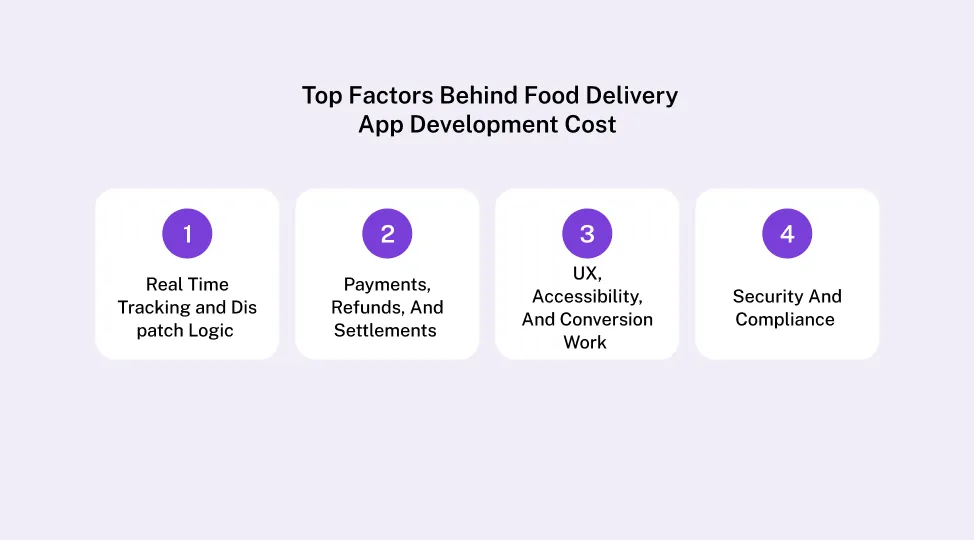
Real Time Tracking and Dispatch Logic
Real time tracking is not just showing a moving pin.
- Location accuracy vs battery drain trade off
- Update frequency rules by order state
- Dispatch rules using distance, prep time, driver score
- Fake GPS and fraud prevention needs
If you want batching, your food delivery app development cost increases again. Batching touches routing, ETAs, and customer communication.
Payments, Refunds, And Settlements
Money flow creates complexity across the entire system.
- Partial refunds and item level refunds
- Failed payments and retry logic
- Restaurant payouts and reconciliation
- Taxes, invoices, and region rules
This is a top reason the development cost of a food delivery app changes between “prototype” and “production.” Finance workflows are rarely simple.
UX, Accessibility, And Conversion Work
Conversion is where you win. It is also where you keep iterating.
- Checkout drop off fixes
- Search relevance improvements
- Clear delivery fee breakdown
- Design system to ship faster
UX iteration adds to the cost to develop a food delivery app over time, but it is usually worth it because it improves retention.
Security And Compliance
Most teams under budget this. Then it becomes urgent later.
- Data encryption in transit and at rest
- Secure storage and token handling
- Role based access control
- Privacy readiness and basic policy flows
Alright, let’s turn those drivers into a practical build plan that fits budgets.
MVP Vs Phase 2 Vs Scale Plan A Budget Safe Roadmap
A phased rollout is the simplest way to control the food delivery app development cost without losing speed.
Phase 1 - MVP 8 To 14 Weeks
The goal is proving demand with controlled ops.
- Single city, limited restaurant onboarding
- Basic dispatch and tracking
- Simple offers, simple refund requests
- Admin tools for order monitoring and support
This phase gives you a baseline food delivery app development cost estimate you can trust, because real usage reveals real issues.
Phase 2 - Growth 3 To 5 Months
Now you add stability and workflow depth.
- Multi zone setup, scheduled orders
- Better restaurant inventory and menu workflows
- Support operations with dispute tools
- Stronger analytics for funnels and cohorts
This is where the cost to develop a food delivery app often jumps, because you are formalizing operations.
Phase 3 - Enterprise Scale 6 To 12 Months
This phase is for aggressive expansion and reliability.
- Multi region, multi brand management
- High availability and redundancy planning
- Advanced routing and batching
- Deeper integrations like POS, ERP, CRM when needed
How To Avoid Rebuild Later
- Do not overbuild UI early, invest in backend foundations
- Track events cleanly from day one, it saves months later
- Use feature flags so rollouts do not break stable flows
Now we’ll talk about ongoing cost, because launch day is just the start.
Maintenance, Ops, And Ongoing Costs
Many teams focus only on launch budget. But the cost of developing food delivery app solutions over 12 months includes ongoing operations and product iteration.
Monthly Cost Buckets
Typical monthly cost categories include:
- Cloud hosting and storage
- SMS OTP and push message costs
- Maps usage fees and routing APIs
- Support, bug fixes, and small improvements
- Security updates and dependency upgrades
Your monthly spend depends on order volume, map calls, and notification volume. It also depends on how often you ship updates.
Recommended Maintenance Models
Starter
- A few releases per month
- Fixes, small features, basic monitoring
Growth
- Weekly releases
- A steady backlog of improvements
- More QA coverage and better analytics support (including consistent Mobile app testing)
Enterprise
- Continuous delivery with SLAs
- Incident response processes
- Dedicated security checks and uptime targets
After you know ongoing cost, the next big question is how to get a reliable estimate that leadership will trust.
How To Get a Reliable Food Delivery App Development Cost Estimate
A reliable quote is not a single number. It is a clear model of scope, complexity, and risk. That is the only way to trust a food delivery app development cost estimate.
Inputs You Must Decide First
Decide these before you ask for quotes:
- Cities and zones for launch
- Expected order volume targets
- Delivery model, own fleet vs partner fleet
- Payment methods and settlement rules
- Integrations list, maps, CRM, POS, support tools
If you are unsure about user behavior, use benchmarks. For example, Lightspeed reports 60 percent of US consumers order delivery or takeout once a week in their compiled stats. (Lightspeed) Use data like this carefully, but it helps planning.
Estimation Method Simple and Clear
A practical approach finance teams like:
- Break features into modules (customer, driver, restaurant, admin, backend)
- Assign complexity levels (simple, medium, complex)
- Add QA, PM, DevOps, and release tasks
- Add a risk buffer of 10 to 20 percent
This approach makes the food delivery app development cost traceable. It also makes vendor comparison easier.
Red Flags in Quotes
Watch for these signs:
- No QA line item at all
- No post launch plan, no monitoring plan
- One number with no scope detail
- No mention of refunds, settlements, or disputes
Cost calculator inputs block you can copy into your brief
- Launch cities and zones
- Restaurant count at launch, and expected growth
- Self delivery or third party
- Payment methods, tips, wallet, COD if needed
- Tracking frequency and batching needs
- Support workflows, refunds, disputes
- Required integrations
Let’s wrap up with a simple decision framework and what Quokka Labs can handle end to end.
Final Words
The real food delivery app development cost is not about screen count. It is about workflows, reliability, and the operational system behind the app. If you treat it like “just an app,” the rebuild cost shows up later, and it is painful.
A smart plan is simple:
- Launch an MVP that proves demand and validates operations
- Scale in phases so your budget stays predictable
- Choose tech that supports peak hour reliability, not just fast delivery of features
At Quokka Labs - an AI Native Engineering company, we approach food platforms with product thinking first, then engineering discipline. We run discovery workshops that turn vague ideas into a usable scope, timeline, and food delivery app development cost estimate leadership can trust. Then we build MVPs that are ready to scale, with security basics and monitoring baked in from day one - supported by end-to-end Mobile app development services where needed.
FAQs
How much does it cost to build an MVP food delivery app?
Most MVP builds land around $50k to $120k, depending on whether you include driver workflows and real time tracking. Your food delivery app development cost is lower if you launch in one city with simple ops.
Can I build without a driver app at first?
Yes, if you use third party delivery or manual dispatch. It reduces the cost to develop a food delivery app, but it can limit control over experience.
What features increase cost the most?
Real time tracking, batching, payments and settlements, and admin workflows for disputes. These features expand the development cost of a food delivery app fast.
How long does development usually take?
An MVP often takes 8 to 14 weeks. A growth build can take 4 to 7 months. Enterprise builds often take 6 to 12 months or more.
What is the difference between marketplace and single brand cost?
Marketplace needs onboarding, commissions, multi vendor operations, and bigger admin tools. That increases the food delivery app development cost estimate.
What ongoing costs should I plan for?
Hosting, maps, OTP, support, and regular updates. Over 12 months, this becomes part of the total cost of developing food delivery app systems.
How do you estimate multi city rollout cost?
Estimate one city first with real usage, then add the cost of new zones, ops workflows, and scaling work. Avoid guessing big expansion numbers from day one.


 Facebook
 Twitter
 LinkedIn
 Pinterest