The fastest way to lose riders is a slow match, wrong ETA, or a failed payment. The fastest way to lose drivers is unfair dispatch and delayed payouts.
In Q3 2025, Uber reported 3.5 billion trips, which shows how quickly demand scales when reliability is consistent. Uber Investor Relations The ride hailing market is projected at about USD 158.65B in 2025, with strong growth expected through 2030. Mordor Intelligence
If you are planning taxi booking app development, you are not just building two mobile apps. You are building a real-time system where pricing, maps, payments, and support must work together under peak load, and the build should follow a Custom Mobile app development approach so the core journeys stay stable as demand grows.
Now, let's see what you are building, so features and costs stay under control.
Taxi Booking App Development In 2026: What Users Now Expect
In 2026, users compare your experience to the smoothest apps on their phone. They expect fast booking, accurate ETAs, and predictable pricing. For taxi booking app development, “good enough” UX is not enough. Small delays compound into cancellations and bad ratings.
A modern taxi booking app plan starts with product type. That choice decides your dispatch logic, your admin workload, and your cost.
Define The Product Type Before You List Features
-
Ride hailing point to point: automated matching, dynamic supply control
-
Taxi dispatch with call center workflows: manual overrides, driver assignment tools
-
Pre booking and airport rides: scheduling, driver reservation, cancellation policies
-
Multi city and franchise model: zone rules, operator roles, city level reporting
Core Journeys That Must Work Every Time
-
Rider: choose pickup and drop, confirm fare, track driver, pay, rate
-
Driver: go online, accept trip, navigate, complete ride, see payout
-
Ops team: monitor supply, handle disputes, issue refunds, manage driver risk
For taxi booking mobile app development, these journeys should be the first design artifacts. Everything else is a feature add on.
Now that the journeys are clear, lock the feature set for the rider app first.
Rider App Features for Taxi Booking App Development
Best features for a taxi booking platform ensure fast booking and safety. Here’s a breakdown of key rider features for building a scalable ride-hailing app. For taxi booking app development, the rider app must stay stable on weak networks, handle GPS noise, and recover from payment failures without confusing the user.
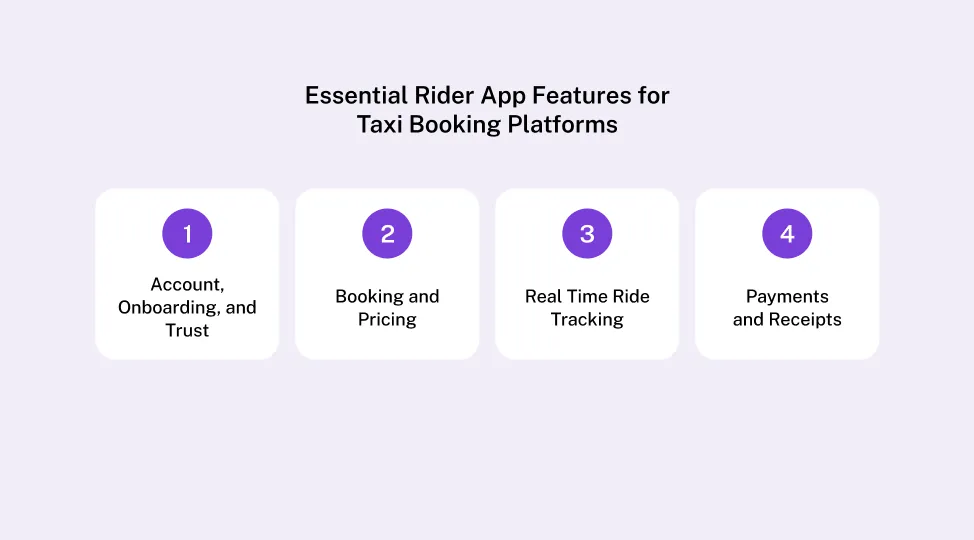
Below is a feature set that supports an MVP and still leaves room for growth.
Account, Onboarding, and Trust
-
Phone OTP login, optional social login
-
Profile and ride history with receipts
-
Driver profile, vehicle details, rating visibility
-
Safety center: SOS, share trip, trusted contacts
Booking and Pricing
-
Pickup and drop search with map pin and address suggestions
-
Fare estimate with a clear breakdown (base, distance, time, fees)
-
Ride options like standard, XL, premium, accessibility preferences
-
Scheduled rides with reschedule and cancellation rules
Real Time Ride Tracking
-
Live driver location, ETA refresh, route preview
-
Notifications for driver arrival, reroutes, and delays
-
In app chat or masked calling when required by ops policy
Payments and Receipts
-
Cards, wallets, region based options, optional cash mode
-
Tips, promo codes, invoices, refund request flow
-
Payment failure recovery that keeps the booking state consistent
Feature depth has a direct link to taxi booking app development cost. Real time tracking, rich receipts, and in app chat add build time and testing scope.
A stable rider app is half the product. The other half is a driver experience that keeps supply online.
Driver App Features for On-demand Taxi Booking App Development
Drivers stay loyal when the system feels fair and earnings are clear. In on-demand taxi booking app development, the driver app is not a simple mirror of the rider app. It needs fast dispatch handling, reliable navigation, and payout transparency.
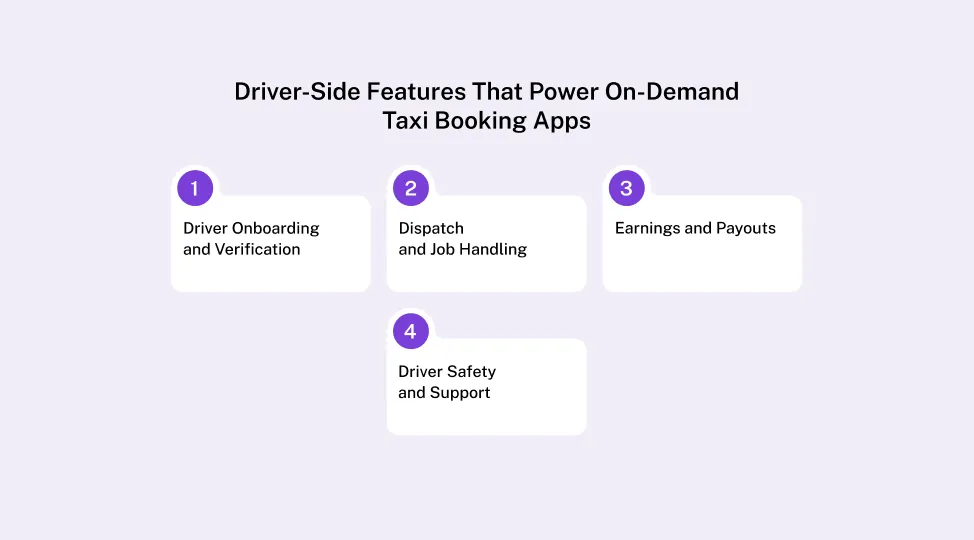
Strong taxi booking app development also means the driver app must stay usable on low end devices. Many fleets include older phones with limited storage and unstable GPS.
Driver Onboarding and Verification
-
KYC capture with document upload and status tracking
-
License and vehicle document verification
-
Training checklist and policy acceptance logs
Dispatch and Job Handling
-
Online and offline toggle, optional heatmap view
-
Trip request screen with acceptance timer and clear trip summary
-
Navigation handoff to Google Maps or an in app route view
-
Cancellation reasons aligned with policy rules and penalties
Earnings and Payouts
-
Daily and weekly earnings with incentive breakdown
-
Trip level summary including fees and taxes
-
Bank setup, payout schedule, payout status tracking
Driver Safety and Support
-
SOS and incident reporting
-
In app support tickets with history
-
Chat or call masking options based on region and ops needs
With both apps defined, the admin and dispatch layer decides whether operations scale or collapse.
💡Suggested Read: New Technology Trends in 2026
Admin, Dispatch, and Support Panel Features
The admin panel is where real businesses survive. If dispatch is slow, riders churn. If disputes are unmanaged, support costs spike. For taxi booking app development, the admin layer must be treated as a core product, not an internal tool.
A good admin system also supports audits. You should always be able to answer “why did this driver get this ride” and “why did this price change.”
Live Operations, Dispatch Cockpit
-
Map view showing drivers, active rides, demand zones
-
Manual dispatch and reassignment rules for exceptions
-
Supply health metrics: online drivers, acceptance rate, cancellations
Pricing, Promos, and Zones
-
City and zone setup with geofences
-
Surge rules, minimum fare rules, fees and taxes
-
Promo engine with restrictions, fraud controls, and budgets
Risk, Compliance, and Disputes
-
Fraud flags: device risk, GPS jumps, payment risk indicators
-
Refund workflows with evidence capture and approval steps
-
Data retention rules and role based access for staff
In larger taxi booking app development programs, this admin scope is where teams under estimate time. It touches every edge case.
Next comes the part most teams underestimate, integrations that add cost and complexity fast.
Integrations Checklist, What Impacts Scope And Cost
Integrations decide your timeline more than your UI does. Each vendor has API limits, failure patterns, and test requirements. For taxi booking app development, integrations also increase long term maintenance because vendors change pricing and policy.
Group your integration plan early so you can estimate effort and ongoing costs.
-
Maps and routing: geocoding, directions, distance matrix, place autocomplete
-
Messaging: push notifications, SMS OTP, email receipts
-
Payments: card processing, wallets, refunds, webhook handling
-
Driver onboarding: KYC vendor, background checks
-
Support: ticketing, chat, call masking
-
Analytics: events, funnels, cohort tracking
-
Fraud and risk: device signals, payment risk scoring
Integration count and depth strongly influence taxi booking app development cost. Maps usage and SMS volume also hit monthly spend, not just build cost.
With scope locked, you can estimate cost with fewer surprises, and align the API layer with solid Backend development services so dispatch, payments, and monitoring hold up under real load.
💡Suggested Read: On-Demand Application Development
Taxi Booking App Development Cost Breakdown, MVP Vs Scale
Let’s be direct about pricing. Taxi booking app development cost is not a fixed number because platform count, real time depth, and compliance needs vary. Still, you can model costs clearly if you state assumptions.
At Quokka Labs, we estimate by splitting work into build streams, then applying a delivery model and a testing plan. This keeps the estimate stable even when features change.
Cost Drivers You Should State Upfront
-
Platforms: Android, iOS, and web admin
-
Real time features: tracking frequency, chat, dispatch updates
-
Regions: taxes, privacy rules, and payment methods
-
Payment complexity: multi currency, split payouts, refunds
-
Reliability targets: redundancy, monitoring, recovery plans
How We Estimate Cost, The Simple Method
-
List MVP flows for rider, driver, and ops
-
Assign each flow a complexity level (low, medium, high)
-
Map complexity to engineering time and QA time
-
Add integration effort and load testing effort
-
Add release work and post launch hardening
This approach helps you avoid under quoting the admin system, which is a common issue in taxi booking app development bids.
Cost Breakdown
| Workstream |
What’s included |
Cost impact level |
| Product discovery |
requirements, user flows, risk list, estimates |
Medium |
| UI and UX |
maps UX, error states, accessibility checks |
Medium |
| Mobile apps |
rider and driver apps, offline handling |
High |
| Backend |
auth, trips, pricing, dispatch, payments |
High |
| Admin panel |
live ops, promos, disputes, reporting |
Medium to High |
| Integrations |
maps, SMS, payments, KYC, analytics |
High |
| QA and release |
device testing, load tests, store release |
Medium |
| Observability |
logs, metrics, alerts, dashboards |
Medium |
Cost Ranges, Write Ranges, Not A Single Number
These ranges assume a professional team, staged releases, and real device testing.
- MVP build range: USD 80k to 180k
Includes rider app, driver app, backend, admin, maps, and basic payments.
- Growth build range: USD 180k to 450k
Adds surge pricing rules, incentives, advanced dispatch, fraud controls, richer reporting.
- Ongoing monthly costs: USD 3k to 30k plus usage
Driven by servers, maps usage, SMS OTP, payment fees, support tooling, monitoring.
Use these as planning anchors. Your final taxi booking app development cost depends on integrations, quality targets, and how many cities you launch at once. For larger launches, taxi booking app development also needs load testing and a stronger monitoring setup, which adds cost but reduces outages.
Cost is only half the story. Timeline and delivery plan determine how fast you reach market safely.
Delivery Roadmap and Timeline
A timeline is only realistic when it matches scope and testing. For taxi booking app development, the “build” is often shorter than the “harden” phase, because real time systems need tuning under load.
Here is a roadmap we use for predictable delivery.
MVP vs Phase 2 vs Phase 3
-
MVP: core booking, live tracking, basic dispatch, payments, receipts
-
Phase 2: surge pricing, promos, incentives, improved matching, stronger support tools
-
Phase 3: multi city controls, advanced fraud, data warehouse, partner APIs
Timeline
| Phase |
Duration |
Output |
| Discovery |
2 to 4 weeks |
PRD, architecture plan, estimates |
| MVP build |
10 to 14 weeks |
rider and driver apps plus backend and admin |
| Hardening |
3 to 5 weeks |
performance, load, security review |
| Scale |
ongoing |
reliability work plus new markets |
This timeline assumes a focused team and clear decisions. If you add more regions or heavy compliance, taxi booking app development timelines expand.
After launch, scale issues show up fast, especially in matching, maps costs, and real time load.
Scalability Challenges in Taxi Booking App Development and Fixes
Scaling problems are rarely “server size.” They are usually about state handling, vendor limits, and uneven demand patterns. In taxi booking app development, most failures happen at peak hours when riders and drivers behave differently than in tests.
Below are common failure points and fixes that work in production.
Real Time Matching at High Load
Challenge: demand spikes at commute hours and event exits. Matching can slow down, then cancellations rise.
Fixes:
-
Use a queue based matching pipeline so spikes do not overwhelm APIs
-
Add rate limits and a fallback matching mode under stress
-
Use zone based dispatch to reduce search space and speed up decisions
Location Accuracy and GPS Noise
Challenge: wrong pickup pins, driver location jumps, and “teleporting” in the UI.
Fixes:
-
Apply map matching filters to smooth GPS noise
-
Use pickup confirmation UX for tricky locations
-
Add sanity checks for impossible location jumps
Pricing Under Stress, Surge and Fairness
Challenge: surge feels random and riders lose trust.
Fixes:
-
Show a transparent fare breakdown before booking
-
Add caps and clear rules by zone and time windows
-
Keep audit logs for price decisions so support can explain charges
Payment Reliability and Disputes
Challenge: delayed webhooks, duplicate charges, refunds that get stuck.
Fixes:
-
Make payment requests duplicate safe by using unique transaction keys
-
Use a clear payment state machine so each trip has one source of truth
-
Store dispute evidence logs, including trip route and timestamps
Driver Supply Scaling
Challenge: onboarding bottlenecks and weak retention.
Fixes:
-
Fast KYC flows with clear status steps
-
Incentive clarity, no hidden rules
-
Driver support tools that reduce ticket backlog
At higher volume, on-demand taxi booking app development becomes a systems problem. You need controls, not just features. Strong taxi booking app development plans include these controls before the first city launch.
If you want fewer outages, the architecture must support scale from day one.
Architecture Blueprint for Scalable Taxi Booking App Development
Architecture does not need to be complex to be scalable. For taxi booking app development, the goal is clean separation of responsibilities so you can change pricing, dispatch, or payments without breaking everything, while keeping UI UX design consistent across rider, driver, and admin experiences.
Below is a blueprint that fits most taxi products.
Suggested Component Map
-
Mobile apps: rider app and driver app
-
API layer: auth, trips, pricing, payments, support
-
Real time layer: websockets where needed, push for most updates
-
Data stores: transactions database for core flows, analytics store for reporting
-
Queue and events: matching, notifications, payouts, fraud checks
-
Caching: ETA snapshots, driver availability snapshots
This split helps taxi booking app development teams manage peak traffic. It also limits how much a vendor outage affects the core booking flow.
Data Model Essentials
-
Users, drivers, vehicles
-
Trips with clear state transitions
-
Locations, zones, service areas
-
Pricing rules, promos, budgets
-
Payments ledger and payout ledger
Reliability Basics You Should Include
-
Retries with backoff for vendor calls
-
Circuit breakers so one bad vendor does not take down booking
-
Backups and disaster recovery planning
-
Multi region planning only when business needs it
A clean architecture reduces long term taxi booking app development cost because changes become safer and faster.
Scaling means nothing if security and compliance fail, especially with payments and location data.
Security, Privacy, And Compliance Checklist
Taxi apps store sensitive data: live location, identity documents, and payment signals. For taxi booking app development, security is part of the feature set, not a separate task.
Here is a practical checklist that teams can ship with.
Security Controls
-
Encryption in transit and at rest
-
Role based access for admin tools
-
Secrets management and key rotation
-
Secure logging, do not store sensitive data in logs
Privacy Controls
-
Location data minimization, store only what you need
-
Retention rules by region and policy
-
User data export and deletion flows
Payments and Fraud Basics
-
Reduce PCI scope where possible by using tokenized payments
-
Chargeback workflow with stored evidence
-
Device risk signals and suspicious behavior flags
Compliance needs can increase taxi booking app development cost, but the alternative is higher fraud loss and brand damage.
Quality is your insurance policy. Without strong testing, fragmentation and edge cases will sink ratings.
QA Strategy and Performance Targets
Testing for taxi apps must reflect real world chaos. Networks drop. GPS jumps. Drivers cancel. Payments fail. For taxi booking mobile app development, you need both automation and real device testing, plus disciplined Mobile app testing practices so releases don’t regress matching, payments, or location flows.
Testing Matrix
-
Low end Android device profiles and older OS versions
-
Poor network simulation and offline scenarios
-
GPS drift and fake location attempts
-
Payment retries, webhook delays, partial refunds
Performance and Stability targets
-
Cold start target for both rider and driver apps
-
Crash free sessions target as a release gate
-
Matching time target under normal and peak load
-
Payment success rate target with vendor monitoring
Observability
-
Logs, metrics, and traces for key flows
-
Alerts for booking failures, payment failures, payout delays
-
Dashboards for supply health and cancellation reasons
In practice, taxi booking mobile app development becomes smoother when you treat monitoring as part of release, not something added later.
After the product works, you still need a business model that supports unit economics.
Monetization Models and Unit Economics Levers
A taxi platform survives when the unit economics stay positive. For taxi booking app development, pricing is not only revenue. It is also supply control.
Common monetization models:
-
Commission per ride
-
Subscription for drivers
-
Service fees and minimum fare rules
-
Ads or partnerships, used carefully
-
Enterprise accounts like hotels and corporate travel
Mini table for decision making:
| Lever |
Impacts |
Risk |
| Commission |
revenue per ride |
driver churn |
| Surge |
availability at peak times |
rider churn |
| Subscription |
predictable revenue |
adoption friction |
Link levers to operations. For example, incentives can reduce cancellations, which improves ratings and reduces support tickets. That is a real taxi booking app development win.
Finally, decide if you should build now, or start with a smaller MVP.
Build Vs White Label: When Taxi Booking App Development is the Better Choice
White label tools can be fast, but they limit control. Choose full taxi booking app development when the business needs custom logic and data ownership.
Build is usually the better choice when:
-
You need custom dispatch logic for your city or fleet
-
You require deep integration with local payment methods
-
You operate multi city markets with strict role controls
-
You want full ownership of pricing rules, fraud controls, and analytics
For many teams, on-demand taxi booking app development starts as an MVP, then becomes a platform. Building early avoids painful migrations later.
Close with a practical launch checklist, so the plan turns into execution.
Launch Checklist and Scalability Ready Go Live Plan
Before you launch a city, treat it like a controlled deployment. For taxi booking app development, a staged rollout catches issues while volume is still manageable.
Launch checklist:
-
Driver onboarding pipeline ready, KYC, training, support
-
City and zone configs tested with real pickup points
-
Pricing rules and promo guardrails reviewed
-
Support workflows live for refunds, disputes, and incidents
-
Monitoring dashboards and alerts active
-
Staged rollout plan: beta, then one zone, then full city, then expansion
This checklist lowers post launch surprises and keeps your taxi booking app development cost from ballooning due to emergency fixes.
Your Next Step
A reliable taxi platform is a system, not a screen. If you want fewer cancellations and higher driver retention, treat taxi booking app development like an operating product from day one: rider flow, driver flow, admin ops, and real time reliability all moving together.
Here is a practical way to move forward this week:
-
Lock your MVP scope in one page: rider booking, driver dispatch, payments, and a basic admin panel.
-
Define your first city setup: zones, minimum fare, cancellation rules, and support workflows.
-
Pick your integrations early: maps, SMS, payments, KYC, and analytics, then estimate based on those choices.
-
Set 5 launch metrics: booking success rate, match time, cancellation rate, payment success rate, and driver acceptance rate.
-
Plan a staged rollout: beta users → one zone → full city → second city, with monitoring and alerts live.
That is what solid taxi booking app development looks like in production: stable booking, accurate ETAs, resilient payments, and admin tools that handle exceptions without chaos.
If you are planning a launch, share your target cities, platform needs, and required integrations with Quokka Labs, a Native AI engineering company, including whether you need IOS app development alongside Android and web admin from day one.
Frequently Asked Questions About Taxi Booking App Development
1. How much does taxi booking app development cost in 2026?
Taxi booking app development cost typically ranges from USD 80,000 to 180,000 for an MVP, and USD 180,000 to 450,000+ for a scalable multi-city platform. The final cost depends on real-time tracking depth, dispatch complexity, payment integrations, fraud controls, and reliability targets. Monthly infrastructure and vendor usage costs must also be planned from day one.
2. How long does it take to build a taxi booking mobile app?
A production-ready MVP usually takes 14 to 20 weeks, including discovery, development, testing, and performance hardening. If you’re launching across multiple cities or adding advanced dispatch logic, fraud detection, or enterprise reporting, timelines expand accordingly. Real-time systems require load testing before go-live.
3. What makes on-demand taxi booking app development technically complex?
The complexity is not the screens. It’s the system behavior under peak demand. Matching drivers in seconds, handling GPS noise, processing payments reliably, and keeping pricing transparent during surge conditions require event-driven architecture and careful state management. Without that foundation, cancellations and payment disputes increase quickly.
4. Should we build a custom taxi app or use a white-label solution?
White-label tools work for small, single-city launches with limited customization. Custom taxi booking app development is the better choice when you need control over dispatch logic, multi-city expansion, regional payment integrations, analytics ownership, and long-term scalability. Migration from white-label systems later can be costly.
5. What scalability issues appear after launch?
Common post-launch challenges include:
- Slower matching during peak hours
- Rising map and SMS costs
- Payment webhook delays
- Driver retention bottlenecks
- Surge pricing disputes
A scalable architecture with queue-based dispatch, proper caching, monitoring dashboards, and vendor fallback mechanisms reduces these risks significantly.
6. What metrics should we track after launch?
For a healthy taxi platform, monitor:
- Booking success rate
- Average match time
- Cancellation rate (rider and driver)
- Payment success rate
- Driver acceptance rate
These metrics reveal operational issues before ratings and churn expose them publicly.
Tags
mobile app compliences
app fearures
on demand App Development
App Development Cost
App Development


 Facebook
 Twitter
 LinkedIn
 Pinterest