Most sportsbooks don’t lose users because of branding or a weak promo, but because trust breaks in the first few sessions. The fastest way to kill retention is to ship sports betting app features that look complete on the surface, but fail under real betting behavior.
Odds latency is the first trust killer. If odds move after a user taps “Place Bet,” they assume manipulation, even when it’s just slow feeds or weak acceptance logic. Withdrawal friction is the second, where many users decide whether they trust you based on the first cash-out attempt, and unclear or delayed payouts make them churn.
Verification is next, where too much process complexity hurts conversion, too little invites fraud, chargebacks, and regulator pressure, and that’s exactly why teams investing in custom mobile app development focus on reliability before polish. Here’s the detailed breakdown of the must-have sports betting app features that every sportsbook app should contain.
Top 5 Sports Betting App Features For The Player Experience
This is the foundational checklist for the user entry experience. If these sports betting app features aren’t tight, everything else you build feels irrelevant. Users judge a sportsbook by how quickly they can find a market, place a bet, and verify what just happened. Confusion here becomes disputes, refunds, and churn.
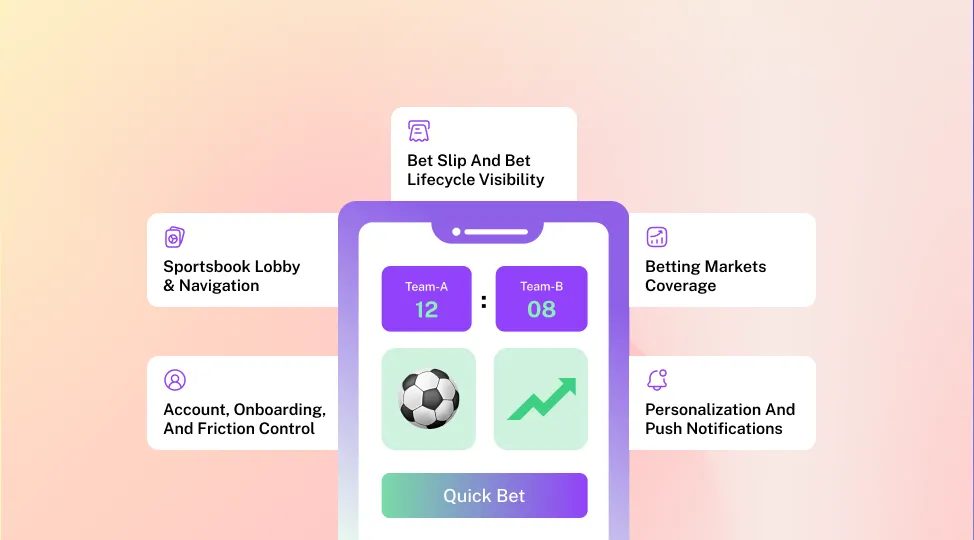
1. Account, Onboarding, And Friction Control
Your onboarding should do two things at once: get the user to a first bet fast, and still keep you inside legal and fraud boundaries. Over-optimizing for speed without controls usually backfires.
Here’s the must-have checklist:
- Email and phone login (with verification)
- Optional social login (only if it doesn’t weaken identity proofing)
- MFA (recommended) with device-based step-up for withdrawals
- Age gating and jurisdiction gating (country/state rules)
- Clear “first bet” path, like pick sport, then pick event, then pick market, and finally bet slip
- Short onboarding tips inside the flow (not a long tutorial wall)
Why it matters: Onboarding is where perception forms. If the first session feels slow or uncertain, users assume the rest of the product is the same.
2. Sportsbook Lobby & Navigation That Reduces Misclick Bets
A sportsbook lobby isn’t just UI, but also a risk control layer. Poor navigation causes misclick bets, wrong market selections, and “I didn’t mean that” chargebacks. In 2026, your lobby must be fast, searchable, and consistent across devices.
Here’s the must-have checklist:
- Sports, league, and event hierarchy that’s predictable
- Search that actually works (teams, players, leagues, events)
- Filters for date/time, market type, live vs pre-match
- Favorites and watchlists (one-tap access to repeat behavior)
- Quick add to bet slip without losing context
- Clear labeling for live markets vs scheduled markets
Practical note: small UX mistakes become financial issues. That’s why these sports betting app features are not design preferences, but are dispute prevention.
3. Bet Slip And Bet Lifecycle Visibility
Your bet slip must read like a receipt. Users should never wonder what they placed, at what odds, and what the current status is. If you hide details, you increase support tickets and mistrust.
Here’s the must-have checklist:
- Clear stake, odds format (decimal/american), potential payout
- Transparent display of fees/taxes where applicable
- Explicit confirmation step (placed vs accepted)
- Bet status timeline, i.e., placed, then accepted, then active, and finally settled/voided
- Re-price handling: “odds changed” prompt with accept/decline
- A “receipt-like” confirmation screen with a reference ID
This is one of the most important sports betting app features because it’s the proof layer. It reduces disputes without needing humans.
4. Betting Markets Coverage
Users don’t want “a lot of markets.” They want the right markets for their multi-sport support and region, priced correctly, and easy to understand. Market design also has compliance constraints depending on jurisdiction.
Here’s the must-have checklist:
- Core markets: moneyline, spread/handicap, totals
- Parlays and teasers (where supported)
- and futures (sport dependent)
- Clear market naming (avoid internal trader shorthand)
- Localization by rules (what’s allowed varies by market)
- Same-game context where bet builder is permitted
Coverage isn’t about dumping options, but about making sure your sports betting app features match how bettors actually behave.
5. Personalization And Push Notifications
Personalization is a retention tool, but it can also trigger risk if it pushes aggressive behavior. Treat it as relevance and convenience, not manipulation. Keep user control obvious.
Here’s the must-have checklist:
- Watchlists and favorites with smart ordering
- Odds change alerts (user-controlled thresholds)
- Match start reminders for followed teams/leagues.
- Personalized promos with guardrails (avoid spam loops)
- Notification controls, like opt-in types, quiet hours, frequency caps
- Messaging that’s consistent with responsible play policies
Also, don’t copy patterns from fantasy sports app features without thinking. Fantasy users tolerate deeper “game-like” engagement loops. Sports betting users are more sensitive to money friction and trust signals.

Top In-Play Betting Features
In-play is where sportsbooks earn loyalty and also where they get exposed. Live betting creates constant state changes, as odds move, markets suspend, clocks update, and users spam taps during high-emotion moments.
If your in-play betting features aren’t engineered for speed and clarity, users will assume the platform is unfair, even when it’s just underpowered systems.
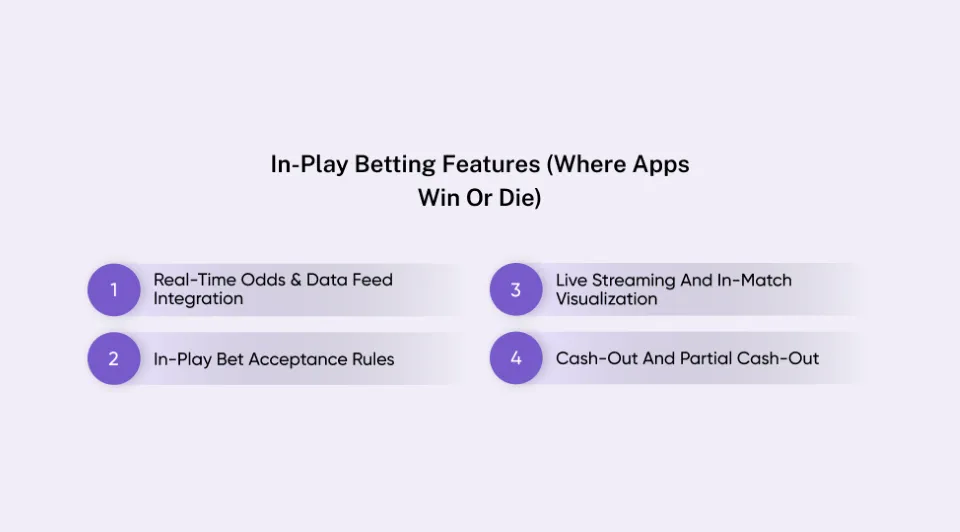
1. Real-Time Odds & Data Feed Integration
Live wagering runs on feeds. You’re integrating odds, scores, clocks, incidents, and market status updates, usually through third-party providers. The key is not “having an API,” but managing latency, reliability, and reconciliation so your live markets don’t drift from reality.
Here’s the must-have checklist:
- Odds feed, score feed, and clock feed (not just one combined stream)
- Incident events (goals, penalties, red cards, injuries) that trigger suspensions
- Market suspension and re-open signals wired to the UI
- Latency budget defined (what “real-time updates” means for your product)
- Caching strategy that avoids stale odds during spikes
- Secondary feed or fallback behavior when the primary feed degrades
- “Odds change/accept” logic that’s consistent and explainable
Why it matters: “instant updates” is the core promise of live betting. If a user taps at +120 and gets +105 without a clear re-offer, they don’t see a technical issue. They see a trust breach, which is why sports betting app features in 2026 are judged under live pressure, not on a demo.
2. In-Play Bet Acceptance Rules
Acceptance rules decide whether the experience feels smooth or hostile. In-play is not like pre-match betting, where odds are stable for minutes. Here, the platform must enforce timing windows fairly while still protecting against obvious edge cases.
Here’s the must-have checklist:
- Market suspension windows that match incidents (stop-play means suspend)
- Re-offer flows when odds moved (clear old odds vs new odds)
- Maximum acceptance delay guardrail (don’t let “pending” hang forever)
- Practical anti-arbitrage protections (rate limits, sanity checks)
- Consistent “rejected reason” messages that users can understand
Keep it practical, don’t overexplain arbitrage like a trading book. Users just need clarity and consistent outcomes. Operators need predictable rules. Your in-play betting features should satisfy both.
3. Live Streaming And In-Match Visualization
Streaming is powerful, but it’s not a checkbox. It’s licensing, geo rules, bandwidth, and latency coordination. Many sportsbooks win without streaming by using a strong match tracker, especially in early phases.
Here’s the must-have checklist:
- Either live streaming or a real-time match tracker (minimum)
- Event timeline visualization (shots, fouls, corners, key plays)
- Stream delay awareness (don’t pretend it’s synced if it isn’t)
- Bandwidth adaptation and graceful fallback
- Clear disclosure if streaming is unavailable due to rights/region
Reality check: “Just add streaming” is how teams blow timelines and budgets. If licensing doesn’t work, a match tracker still supports sports betting app features that matter: confidence during live wagers.
4. Cash-Out And Partial Cash-Out
Cash-out reduces anxiety, as it keeps users engaged longer because they feel they have an escape hatch. It also reduces rage quits when a match swings against them. But it must be transparent enough to avoid suspicion.
Here’s the must-have checklist:
- Multi-currency support
- Full cash-out availability rules per market type
- Partial cash-out support if you’re targeting mature bettors
- Clear cash-out value calculation explanation (basic is fine)
- Instant confirmation and updated wallet balance visibility
- Guardrails for rapid, repeated cash-out abuse patterns
Cash-out is one of those sports betting app features that looks simple in UI and is complex under the hood. You’re pricing risk in real time. If you do it poorly, users think the numbers are fake.
Betting Wallet System And Secure Transaction System
This is the money layer. Your sportsbook can have beautiful markets and solid in-play betting features, but if deposits feel risky or withdrawals feel blocked, users leave.
A reliable betting wallet system and a provable secure transaction system are what turn “interest” into repeat betting, and what keep regulators and payment partners comfortable.
1. Wallet Fundamentals
A sportsbook wallet is not just “a balance,” but also a ledger with rules. You need to track what’s available, what’s locked in active bets, what’s bonus-restricted, and what’s pending verification. When teams skip a proper ledger, they end up with balance drift, refund confusion, and support nightmares.
Here’s the must-have checklist:
- Main balance, bonus balance, and locked/held funds separated
- Transaction ledger (every movement: deposit, bet hold, win credit, void, refund)
- Bet reserve/hold logic (funds reserved at bet placement, released on settlement)
- Wallet history view for users (simple, readable, filterable)
- Clear bonus wagering requirements visibility (no hidden math)
- Idempotency handling for payment callbacks (prevents double credits)
This is one of the most important sports betting app features because it’s proof of fairness. If the wallet history is confusing, users assume you’re hiding something.
2. Payment Methods And Payouts
Payments should be broad, but also jurisdiction-aware and risk-aware. The goal is to reduce deposit friction while keeping payout flows clean and compliant. In many sportsbooks, the first withdrawal is the real conversion moment. If it’s slow or unclear, retention falls off fast.
Here’s the must-have checklist:
- Multi-rail deposits (cards, bank transfer, e-wallets, local rails where legal)
- Fast withdrawals with clear ETA messaging (don’t promise what you can’t meet)
- Withdrawal method controls (same-method payout rules where required)
- Payout automation with manual review triggers for risk cases
- Deposit limits and responsible play alignment (ties into governance)
- Crypto support only if jurisdiction allows, and monitoring is stronger than standard rails
Crypto is not “modern by default.” It’s “allowed only by law and monitored harder.” If you offer it casually, you create a risk you didn’t price.
3. Fraud, Chargebacks, And Payout Abuse Controls
Sportsbooks attract fraud because there’s money movement, promos, and fast outcomes. If you don’t plan for abuse, you’ll spend more time fighting fires than growing. Fraud prevention doesn’t mean blocking good users. It means blocking patterns early with sensible friction.
Here’s the must-have checklist:
- Velocity checks (deposit frequency, withdrawal frequency, bet volume spikes)
- Device and session signals (new device, suspicious IP behavior, rapid switching)
- Promo abuse controls (multi-account detection signals, unusual redemption patterns)
- Withdrawal rules: cooldown windows, verification triggers, and risk scoring gates
- Chargeback workflow: evidence logs, transaction traceability, user history snapshots
- Escalation paths for manual review without stalling normal withdrawals
A sportsbook-grade secure transaction system is really three things, i.e., strong identity signals, clean logs, and predictable rules. When those are missing, chargebacks and disputes scale with your growth.
KYC Verification Integration And Responsible Gambling Controls
In 2026, KYC, AML, and player protection are not optional add-ons, but are a trust infrastructure. Good KYC verification integration protects payouts, reduces chargebacks, and keeps your license posture clean, while responsible tools reduce regulator heat and support burden.
1. Secure KYC And Onboarding
KYC needs to feel fast for normal users and strict for risky users. The trick is designing verification as a staged flow, not a single hard wall that kills conversion. Many operators allow deposits with light checks, but tighten verification at withdrawal or higher thresholds. The exact gating rules depend on jurisdiction, so don’t assume one global flow.
Here’s the must-have checklist:
- ID verification (document capture and validation)
- Liveness/selfie checks where required or high-risk
- Address checks where required (utility, database checks, or equivalent)
- Duplicate account detection signals (name, doc patterns, device indicators)
- Clear verification states: pending, approved, failed, needs review
- Smart gating: when to gate withdrawals vs deposits (jurisdiction-dependent)
- Retry UX that doesn’t feel like punishment (clear reason and next step)
A clean KYC verification integration also means your support team can see what failed and why. Otherwise, you get angry tickets and chargebacks.
2. AML Basics And Risk Scoring
You don’t need a giant compliance essay inside the app, but you do need systems that detect suspicious activity and create audit-ready evidence. AML, at a practical level, is about watching for patterns that don’t look like normal betting behavior.
Here’s the must-have checklist:
- Risk scoring based on deposit/withdrawal behavior
- Suspicious patterns: rapid in/out movement, unusual bonus cycling
- Threshold-based triggers for enhanced review
- Case notes and decision logs for auditability
- Tamper-resistant logs regulators can request later
AML controls are part of your sports betting app features set, not just back-office policy. If you can’t explain a payout decision later, you’re exposed.
3. Responsible Gambling Toolkit & Multi-Currency Support
Responsible gambling is not just for regulators. It reduces churn from “regret moments,” lowers support load, and protects brand trust. The key is making tools easy to find and genuinely usable, not buried.
Multi-currency support matters for the same reason, i.e., it prevents confusion, failed payouts, and “missing money” disputes when users deposit, bet, and withdraw across different currencies.
Responsible gambling controls:
- Deposit limits, loss limits, wager limits (configurable by user)
- Time limits and session reminders (reality checks)
- Cooling-off periods (short breaks) and self-exclusion (longer blocks)
- Self-exclusion enforcement across devices and channels
- Activity summaries that show net position, not just wins
- Clear path to help resources and support
Here are the multi-currency support essentials:
- Multi-currency wallet balances (separate balances per currency, not one blended number)
- Clear currency selection at deposit and withdrawal, with confirmation before submission
- Transparent FX handling: exchange rate source, timestamp, and applied fees (if any)
Rounding rules that are consistent (avoid “penny drift” across bets and settlements)
- Currency-aware limits (deposit/withdrawal limits should apply per currency and per jurisdiction rules)
- Settlement accuracy across currencies (bet placed in one currency, payout in another only if explicitly supported)
- Receipt-grade transaction history showing original amount, converted amount, rate, and final credited value
- Payout rail compatibility by currency (some methods only support specific currencies)
- Fraud controls for cross-currency abuse (rapid conversion patterns, bonus cycling across currencies)
Regulators care because harm becomes a public incident. Product teams should care because harm becomes refunds, disputes, and reputational damage. Done right, these sports betting app features make the platform feel safer, not stricter, and make money movement feel predictable even when currencies vary.
Essential AI-Driven Sports Betting App Features
AI can help, but only in two places that are defensible, i.e., relevance and safety. In 2026, “AI picks” hype is common, and it also creates trust issues quickly.
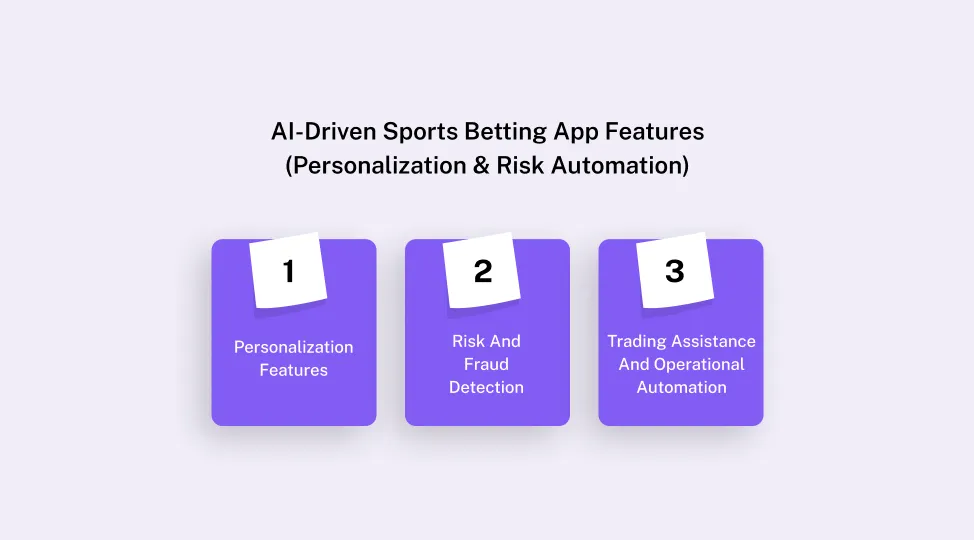
The smarter approach is to use AI-driven sports betting app features to reduce clutter, improve retention, and detect risk patterns earlier, without crossing ethical lines.
1. Personalization Features
- Inputs: bet history & analytics, followed teams/leagues, time-of-day behavior, device context
- Ranked lobby and “continue watching” for live events
- Guardrails: cap promo frequency, avoid “loss chasing” triggers, let users turn it off
2. Risk And Fraud Detection
- Anomaly detection: unusual deposit/withdraw behavior, rapid bet cycling, promo farming
- Account takeover signals: device change, session spikes, and payment instrument mismatch
- Triage scoring: most risky cases go to manual review, normal users stay fast
3. Trading Assistance And Operational Automation
- Alerts for abnormal bet volumes per market/event
- Feed health monitoring (latency spikes, stale updates)
- Human-in-the-loop rules so traders can quickly override during incidents
Must Have Betting App Admin Panel Features
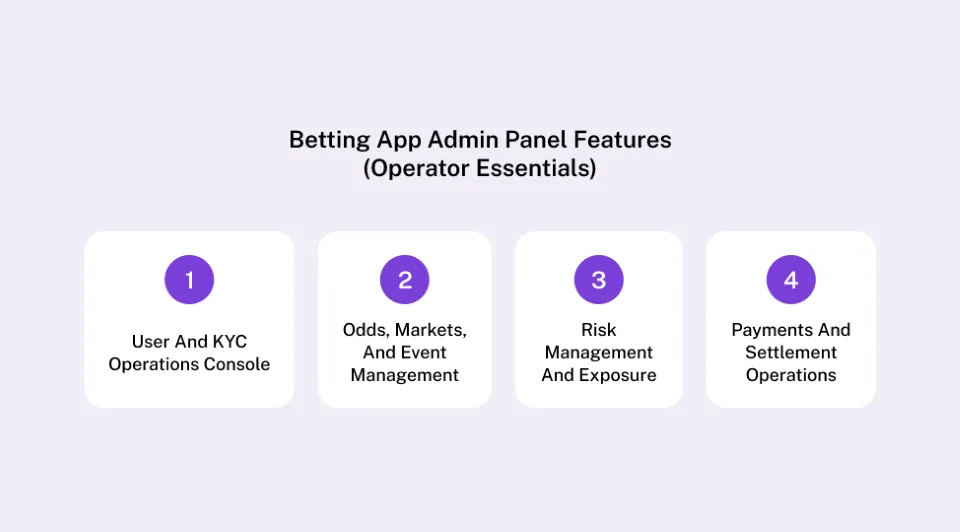
Most competitor posts mention “admin dashboard” and stop there. In reality, the betting app admin panel features decide whether you can operate safely at scale. If your ops team can’t see exposure, verification status, and payout queues in one place, your risk grows faster than your user base.
1. User And KYC Operations Console
- KYC review queues, exception handling, internal notes, and decision history
- Self-exclusion enforcement and limit changes with approval trails
- User-level audit timeline: login, device, deposits, bets, withdrawals
2. Odds, Markets, And Event Management
- Market toggles, suspensions, and incident monitoring
- Manual overrides where allowed (with full logging)
- Feed status indicators (stale odds warnings, provider failover)
3. Risk Management And Exposure
- Liability views by market/event and player segments
- Max stake rules and dynamic limits during volatility
- Alerts for sharp action patterns (practical, not academic)
4. Payments And Settlement Operations
- Withdrawal queues with risk flags and SLA tracking
- Chargeback handling workflow
- Reconciliation reports (ledger vs payment processor vs bank)
Security Architecture That Prevents Sportsbook-Grade Incidents
A sportsbook is a real-time financial system under adversarial pressure. Security isn’t one feature, but the baseline that keeps every other sports betting app features promise credible.
- Authentication: MFA, session management, device binding, step-up checks for withdrawals
- Data security: encryption in transit/at rest, secrets management, least-privilege access
- App security: jailbreak/root detection, API abuse protection, rate limiting
- Logging: tamper-resistant audit trails (who did what, when, from where)
Sports Betting App Feature-To-Cost Reality Check
This is where teams get delusional. Mobile app development cost jumps when you move from “standard app” to “sportsbook under live load.”
Here are the main cost multipliers:
- Real-time updates, feeds, and scaling for peak events (live spikes aren’t linear)
- In-play reliability tooling (suspensions, re-offers, cash-out math)
- KYC/AML and audit requirements (logs, review consoles, evidence trails)
- Payments and payout automation (ledger accuracy, chargebacks, reconciliation)
- Live streaming licensing and delivery (if you pursue it)
Also, MVP vs enterprise isn’t just “more screens,” but more controls, more auditability, and more failure handling. Live betting being a majority share in many markets is exactly why you’re building for spikes first, not later.
Implementation Checklist (What To Validate Before Launch)
Before launch, validate the ugly edge cases. That’s where trust breaks.
- Latency and load testing during peak events (feed, bet placement, and wallet updates)
- Withdrawal scenarios: failed bank transfer, chargeback paths, fraud triggers, manual review
- KYC edge cases: name mismatch, expired documents, geo restrictions, re-verification triggers
- Incident playbook: odds feed outage, settlement disputes, partial void rules, cash-out failures
If you can’t reproduce and resolve these cases in staging, you’ll resolve them in public.
A Quick Recap
The winning formula in sportsbook app development in 2026 is to build a reliable real-time engine, clean money movement, strong governance, and operator-grade admin ops. That’s what makes users stay, and what makes regulators leave you alone.
The common failure pattern is building the visible UI first, then trying to “bolt on” real-time reliability, payouts, and compliance later. That order is backwards. Treat odds latency, wallet ledger accuracy, KYC gating, and admin controls as first-class product requirements from day one, because they decide whether users trust the platform when money is on the line.
Once those foundations are stable, you can safely iterate on personalization, promos, and deeper in-play experiences without increasing disputes, chargebacks, or regulatory exposure.
If you’re evaluating scope, compliance, and scalability, work with a sports betting app development company that can deliver robust Android and iOS app development services, and also understands adjacent patterns from fantasy sports app features without copying the wrong engagement loops.
Frequently Asked Questions
Q. Which in-play betting features are considered standard now?
Ans. Live odds and markets updates, suspension logic, re-offer flows, a match tracker (or streaming if licensed), and cash-out. Without these in-play betting features, users churn during peak events.
Q. What’s included in the betting app admin panel features?
Ans. KYC queues, user audit trails, market controls, exposure dashboards, payout operations, chargeback handling, and reconciliation reporting. It’s the operational nervous system.
Q. How does KYC verification integration impact conversion?
Ans. Bad KYC kills onboarding, but good KYC is staged, i.e., light checks early, stricter checks at withdrawal thresholds, with clear status messaging and fast retry paths.
Q. What defines a secure transaction system in sportsbooks?
Ans. A ledger-first wallet, encrypted payment flows, fraud signals, chargeback evidence logs, and withdrawal rules that are consistent and auditable. Speed matters, but proof matters more.
Q. Do I need live streaming, or is a match tracker enough?
Ans. A match tracker is enough for many launches. Streaming adds licensing, geo rules, and delivery complexity. Add streaming only when rights and ROI are clear.
Tags
sports betting app development
App Development


 Facebook
 Twitter
 LinkedIn
 Pinterest