Food delivery is huge, but the build is not the hard part. Operations are.
Building a food delivery app like DoorDash is a tempting opportunity, but it’s not just about designing a sleek app—success depends on mastering the complex operational workflows that ensure efficiency and reliability. Many apps fail because they overlook key logistical details that drive profitability.
Here is why the category is worth doing right. The U.S. online food delivery market generated about $52.7B in 2024 and is projected to reach about $93.4B by 2030. (Source: Grand View Research)
And DoorDash reported roughly $10.72B revenue in 2024, showing how big the ceiling can get. (Source: Business of Apps)
In this blog, we’ll walk you through critical business model decisions, tech stack choices, and cost drivers that will help you avoid common pitfalls and scale effectively.
How To Make an App Like Doordash, A Product Plan That Doesn’t Waste Months
You can copy screens from DoorDash and still fail. To build a platform that works, you need a wedge, a model, and basic unit economics that do not lie to you.
Start With a Clear Wedge, Don’t Copy Doordash Feature for Feature
Building a food delivery app that competes with DoorDash doesn’t mean copying everything they do. In fact, most DoorDash-like apps fail because they try to launch with too many features at once, hoping to cover every base. This is what we call "wide and shallow"—you end up spreading your resources thin without offering a compelling reason for customers to switch from established players.
Pick one entry angle:
- One city, one or two dense zones where drivers stay busy
- One category like late night, quick service, groceries, or campus delivery
- One differentiator like better ETAs, fewer missing items, or smarter substitutions
A simple decision rule helps: if a feature does not reduce delivery time, improve order accuracy, or cut refunds, it is not phase one.
When teams ask how to make an app like DoorDash faster, the answer is often “ship less, measure more.”
Pick Your Operating Model, This Changes Everything
Your operating model shapes your entire business—how you scale, how you manage costs, and how complex your mobile app development tech stack becomes. Choosing the wrong one can result in unforeseen challenges as you scale, while the right choice will make it easier to adjust and grow as demand increases.
Common models:
-
Marketplace model
Restaurants handle delivery or already have drivers. You are mostly discovery, ordering, and payments.
-
Logistics model
You provide drivers. This adds dispatch, tracking, payouts, and more support load.
-
Hybrid model
Some merchants use your drivers, some use theirs. This is a strong early path in many cities.
-
Dark store or micro fulfillment
More control and better speed, but higher upfront cost and inventory problems.
If you want to create a delivery app that feels reliable, the hybrid path often balances speed to launch and control.
Unit Economics Basics, Simple and Useful
In the world of on-demand delivery, understanding your unit economics is critical to making sure your business is sustainable. Unit economics are the metrics that measure the profitability of each individual order, delivery, or customer interaction. Without tracking these numbers, you won’t have a clear picture of what’s working—and what’s draining your resources.
Here are the key metrics you need to keep an eye on, along with actionable insights on what they mean and how to optimize them:
Define these early:
-
Contribution margin per order
Revenue from fees and commissions minus delivery costs, refunds, and payment fees.
-
Refund rate
If this creeps up, it will crush growth spend.
-
Courier utilization
Active minutes versus paid minutes. Low utilization usually means you expanded too fast.
-
ETA accuracy
Not just average delivery time. Accuracy matters more than optimistic estimates.
What good looks like, in plain terms: orders complete without manual rescue, refunds are rare and explainable, and drivers stay busy during peaks.
Once your model is set, you can design the right user flows and features.
What Users Expect from Doordash Like Apps, And What You Can Skip Early
When building a DoorDash-like app, the first step is understanding what users (customers, drivers, merchants) expect and ensuring your app delivers on these basic needs. It’s easy to get caught up in adding fancy features, but at the start, you need to focus on functionality and reliability.
Customers compare you to the best apps they already use. Drivers compare you to the easiest money they can make in the next hour. Merchants compare you to whatever causes the least chaos.
Customer App Must Haves, Phase One
Ship these first:
- Login, location permission, address management
- Restaurant discovery, search, filters, open now
- Menu browsing with modifiers and notes
- Cart with tips, taxes, fees, and clear totals
- Payments and receipts
- Live order status and map tracking
- Ratings plus a simple support entry point
Skipping early is fine for:
- Advanced loyalty programs
- Complex bundles and subscriptions
- Too many promo types
If you are learning how to make an app like DoorDash, remember this: a fast reorder beats a fancy homepage.
Driver App Must Haves, Phase One
Drivers need clarity and speed.
- Identity verification flow (manual review is fine early)
- Job offer, accept, decline, timeout rules
- Navigation handoff to maps
- Pickup and drop proof, photo, notes, contactless toggle
- Earnings summary and payout schedule
- Basic in app help, like “store closed” and “can’t reach customer”
Merchant Portal Must Haves, Phase One
Most early merchants will not install another app happily. A web portal can work.
- Order acceptance and prep time
- Item availability toggles
- Basic menu management or CSV import
- Simple promos, if you use them
- Payout reporting
Admin Console Must Haves, Phase One
This is where you save orders and stop refund leaks.
- Full order timeline view
- Refund tools with reason codes
- Courier reassignment override
- Merchant onboarding tracker
- Manual credits and promo controls
- Support notes per order
Feature priority by phase
| Feature |
Who |
Phase |
Why it matters |
Tech complexity |
| Order tracking + status |
Customer |
1 |
Trust and fewer tickets |
Medium |
| Proof of delivery |
Driver |
1 |
Disputes and safety |
Low |
| Refund reasons + logs |
Admin |
1 |
Stops silent margin loss |
Medium |
| Substitutions |
Customer, Merchant |
2 |
Fewer refunds, better CX |
Medium |
| POS integrations |
Merchant |
3 |
Scale and automation |
High |
| Smart batching |
Driver, Ops |
3 |
Efficiency at volume |
High |
Features are the easy part to list. The hard part is designing workflows that stay stable at scale.
Product Strategy That Helps You Create a Delivery App People Repeat Use
Retention is brutal in most categories, so quality has to show up fast. Average day 30 retention can drop very low across mobile apps, often single digits depending on platform and category. (Business of Apps)
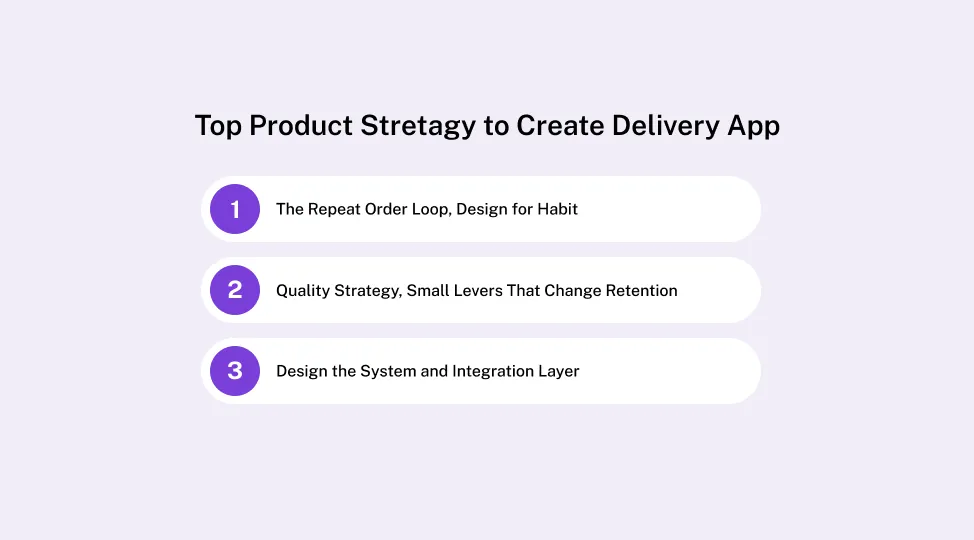
If you want to make food delivery app usage that sticks, focus on the repeat loop and the failure points.
The Repeat Order Loop, Design for Habit
A repeat loop is not magic. It is fewer taps.
Do this:
- One tap reorder
- Saved addresses with smart defaults
- Favorites for restaurants and items
- Saved carts for common meals
- Smart timing nudges, lunch, dinner, late night
- Promotions with limits so you do not burn margin
When clients ask how to make an app like DoorDash that grows, we usually start by improving reorder speed before spending more on ads.
Reduce Failure Points, This Is Where Money Leaks
The top failure sources are boring, and expensive:
- Stockouts and substitutions
- Missing items, especially drinks and sides
- Late orders
- Wrong address pin
- Driver no show during peaks
Anti chaos tools that pay back fast:
- Substitution rules per item
- Prep time buffers by merchant and time of day
- Customer confirmation for high risk notes
- Fraud flags for new accounts with high refunds
- Store closed flow with photo proof
Quality Strategy, Small Levers That Change Retention
Three levers move trust:
- ETA accuracy over optimistic ETAs
- Refund speed and clarity
- Support routing that matches the issue
Customer issue, courier issue, or merchant issue.
Next, let’s map these flows to a tech stack that won’t collapse when orders spike.
Tech Stack Choices for An On-demand Delivery App, Practical and Scalable
Your stack should match your reality. If you are operating in one city, you do not need exotic systems. You do need correctness, observability, and clean boundaries.
Mobile Apps, Customer, Driver, Merchant
Native vs cross platform
Choose native when you need:
- Heavy maps and smooth animations for the best UI/UX design experience.
- Reliable background location tracking to ensure accuracy for drivers and customers.
- Highest performance on older devices, especially for complex animations or UI transitions.
Choose cross platform when you need:
- Faster shipping with a smaller team
- Shared UI and faster iteration
- One codebase for customer and merchant
Non negotiables either way:
- Crash reporting and release tracking
- Analytics events plan to understand user behavior and optimize backend development accordingly.
- Offline-tolerant driver flow for weak network zones to ensure driver functionality even in areas with limited connectivity
If you are deciding how to make an app like DoorDash, do not underestimate background location. It is where many builds get weird bugs.
Backend Basics, What Services You Actually Need
Start with clear services, even if they live in one repo early.
- Identity and auth
- Menu and catalog service
- Order service with a state machine
- Dispatch service
- Pricing, fees, promos service
- Payment service
- Notifications service
- Support and refunds service
Infrastructure And Data Layer, Simple but Correct
A practical baseline:
- Relational database for orders, payments, payouts
- Cache for menus and sessions
- Queue for dispatch, notifications, webhooks
- Object storage for receipts, proof photos, chat attachments
- Monitoring and logs that ops can actually read
Third Party Integrations, Decide Early
Pick these early so you do not rewrite flows.
- Payments provider
- Maps, routing, geocoding
- SMS, email, push
- Support tooling
Optional later: POS integrations
Stack options and when to choose each
| Layer |
Option A |
Option B |
Best for |
Risks |
| Mobile |
Native |
Cross platform |
Native for tracking heavy apps |
Cross platform plugins can lag |
| Orders data |
Relational DB |
Event store add on |
Relational is simplest |
Bad schema causes pain |
| Async work |
Queue |
Cron only |
Queue for dispatch, webhooks |
Cron misses spikes |
| Realtime |
WebSockets |
Polling |
WebSockets for live tracking |
Needs scaling plan |
Stack is only half the story. Architecture decisions decide whether you can scale without rewrites.
Architecture That Supports on Demand Food Delivery App Development at Scale
This is where most “simple MVPs” break. Delivery is a multi actor system with real time updates, money movement, and frequent exceptions.
The Order State Machine, Keep It Explicit
A state machine prevents weird edge cases.
Core states:
- Created
- Paid
- Confirmed
- Preparing
- Ready
- Picked up
- Delivered
- Completed
Rollback and exception states you must define:
- Cancelled before confirm
- Cancelled after confirm with partial refund
- Store closed
- Customer unreachable
- Driver reassigned
Mini diagram description you can use in docs: a single order moves left to right through states, and every transition records who triggered it, when, and why. Any reversal is a new transition, not a silent edit.
Dispatch Logic, Start Simple and Evolve
Phase one dispatch that works:
- Nearest available courier within a radius
- Minimum acceptance threshold
- Simple rules to avoid sending a driver to a store with long prep time
Phase two improvements:
- Zone based pooling
- Heatmaps from recent demand
- Better prep time prediction by merchant and hour
Phase three:
- Multi pick and multi drop
- SLA based assignments
- Demand forecasting and scheduled shifts
When someone asks how to make an app like DoorDash, dispatch is usually the part they under budget. It is not just an algorithm. It is ops feedback and constant tuning.
Real Time Tracking, What Real Time Actually Means
Define it plainly:
- Driver location update cadence, for example every few seconds while on trip
- Battery protection rules
- Privacy boundaries, only track while on active delivery
- Map smoothing so the icon does not jump
Reliability And Safety Rails
These are not optional in money flows.
- Idempotency keys for payments and order updates
- Rate limits for promo abuse
- Audit logs for refunds and manual overrides
- Back office tools for forced completion with reason codes
With architecture set, we can talk about timelines and what it takes to develop food delivery app features without overspending.
Timeline And Delivery Plan, MVP To V1 To Scale
Timelines only work when scope is real. You are not building one app. You are building a system to scale from MVP to market leader.
MVP Scope, 8 to 14 Weeks, Realistic Range
A real MVP is small but complete.
- Limited geography, one city, a couple zones
- Limited merchants, start with friendly partners
- Limited promo types
- Manual support is allowed, but every manual action is tracked
If you are learning how to make an app like DoorDash, an MVP should prove order completion, not growth.
V1 Scope, Next 10 To 16 Weeks
Now you improve quality and reduce manual work.
- Better dispatch rules and better prep time logic
- Merchant tooling upgrades for menu and availability
- Payments upgrades, tip edits, partial refunds
- Analytics dashboards for ops and growth
Scale Scope, Post V1
Only after one city works.
- POS integrations
- Multi city rollout tooling
- Advanced fraud and risk systems
- Experimentation framework for growth and pricing
MVP exit criteria checklist
- 50 to 100 real orders completed without “hero ops”
- Refund and dispute flows tested end to end
- Driver app stable with background location
- Admin can see the full timeline and act fast
- Support scripts exist for top 10 problems
Timelines are easy to promise. Costs are where plans get real.
Real Costs to Develop an On Demand Delivery App, What Changes Your Budget
Cost depends on scope, number of apps, and how much real time logic you build from scratch.
Cost Ranges by Scope, Honest Bands
Below are common bands we see in market builds. Your geography, rates, and integrations shift the number.
-
MVP, single city, basic features
Roughly $80k to $180k
-
Standard platform, customer plus driver plus merchant plus admin
Roughly $180k to $450k
-
Advanced platform, optimization plus integrations plus automation
Roughly $450k to $900k plus
A reality check: general app projects on Clutch often fall in smaller ranges, but delivery platforms are multi app systems with dispatch and operations tooling, so they trend higher than “one app” builds. (Clutch)
Cost Drivers, What Makes It Expensive Fast
These are the big levers:
- Multi app ecosystem, customer, driver, merchant, admin
- Dispatch and real time tracking complexity
- Payments, refunds, chargebacks, payout reporting
- Support tooling and admin workflows
- Integrations, especially POS and loyalty
If your goal is how to make an app like DoorDash with real reliability, budget for admin and support. It saves money later.
Build Vs Buy Decisions That Cut Cost Without Killing Quality
Buy early:
- Payments
- Messaging and notifications
- Maps and routing
- Basic support tooling
Build custom early:
- Order state engine
- Dispatch logic
- Basic fee rules
Build custom later:
- Complex fee engine and promo stack
- Forecasting and optimization
- Deep POS integrations
Ongoing Monthly Costs, Teams Forget This
Plan for:
- Cloud plus monitoring
- Support operations coverage
- Compliance and security maintenance
- Bugfix budget after launch
- Map and messaging usage costs
Cost breakdown by component
| Component |
MVP range |
V1 range |
Scale range |
Notes |
| Mobile apps |
$35k to $80k |
$60k to $140k |
$140k+ |
More apps, more QA |
| Backend |
$30k to $70k |
$70k to $170k |
$250k+ |
Dispatch drives cost |
| Admin console |
$10k to $25k |
$25k to $60k |
$90k+ |
Pays for itself |
| QA |
$10k to $25k |
$20k to $45k |
$60k+ |
Device matrix grows |
| DevOps |
$5k to $15k |
$10k to $30k |
$50k+ |
Monitoring matters |
| Design |
$8k to $20k |
$15k to $35k |
$50k+ |
Flows over screens |
Now let’s make costs predictable by tying them to decisions you can control.
Cost Control Without Shipping Something Weak
You control cost with scope rules, safe shortcuts, and a reusable estimation method.
Scope Control Rules
One core use case per persona in MVP
Customer orders, driver delivers, merchant accepts.
Avoid loyalty systems early
Loyalty comes after reliability.
No multi city routing until city one is stable
Multi city multiplies ops overhead.
This is how to make an app like DoorDash without a year of rebuilds.
Technical Shortcuts That Are Safe, And Ones That Aren’t
Safe early shortcuts:
- Manual merchant onboarding with a checklist
- Manual dispute handling with clear internal SOP
- Limited promo types, fewer edge cases
Not safe shortcuts:
- Weak payment auditing
- No event tracking
- No idempotency in order and payment flows
- No refund reason codes
Estimation Method You Can Reuse
Break work into epics:
- Ordering
- Payments and refunds
- Dispatch
- Tracking
- Merchant ops
- Admin ops
- Analytics and reporting
- Integrations
Then assign each epic a size:
- Small, known patterns
- Medium, some edge cases
- Large, real time and heavy exceptions
Add a risk buffer for integrations and for background location. Those two areas surprise teams.
With budget under control, you still need the launch plan to avoid a silent failure.
Launch Plan and KPIs, How to Know It’s Working
A delivery launch is not just “submit to the app store.” It is supply, demand, and support.
Pre-Launch Checklist
- Pilot merchants onboarded and trained
- Driver supply plan for peak hours
- Support scripts and escalation paths
- Refund policy and tooling ready
- Prep time settings per merchant
- Test orders run on real devices, real locations
Metrics To Track Weekly, Simple and Actionable
Track these every week, no excuses:
- Order success rate
- On time delivery rate
- Refund rate and top reasons
- Courier acceptance rate
- Average delivery time
- Repeat rate, 7 day and 30 day
- Support tickets per 100 orders
If you are measuring how to make an app like DoorDash work in one city, these KPIs tell you the truth.
Growth Experiments That Fit Delivery Apps
- Free delivery thresholds, carefully tested
- Merchant funded promos
- Reorder nudges and favorites
- Limited time bundles for peak hours
- New user onboarding with one clear first order path
Before we wrap, let’s cover the common mistakes that make delivery apps feel broken.
Common Mistakes When Teams Build Doordash Like Apps
Mistake 1 - Copying features, not solving operations
Fix: design exception flows first.
- Late order
- Out of stock
- Store closed
- Customer unreachable
- Driver reassignment
Mistake 2 - Weak dispatch assumptions
Fix: start simple, log everything, iterate weekly.
- Track how often you reassign
- Track acceptance by zone and hour
- Track merchant prep time accuracy
Mistake 3 - Support is an afterthought
Fix: admin console plus reason codes from day one.
- Refund reasons
- Manual override reasons
- Notes that persist per order
Mistake 4 - No clear pricing and fee logic
Fix: define fee rules early, even if basic.
- Delivery fee logic by distance or zone
- Service fee logic
- Minimum order logic
- Promo rules and limits
If you keep asking how to make an app like DoorDash, this section is the answer. Most failures are not code. They are missing workflows.
Final Words
If you want to build in this category, start with a wedge. Then make reliability your product. That is what wins repeat orders.
Here is the short plan:
- Start narrow and design for exceptions
- Nail dispatch basics and track every decision
- Choose a stack that supports real time tracking and clean order states
- Budget based on number of apps, integrations, and reliability goals
- Launch with supply, support, and KPIs ready
Credibility, what we’ve seen fail and what works: Teams that skip admin tooling and refund logic usually end up rebuilding. Teams that treat ops flows as first class features ship faster and spend less over 6 to 12 months.
If you want a build plan with scope, stack, and a cost range tied to your city and model, Quokka Labs, A custom app development company with AI integrated solutions, can map it with you.
FAQs
1. What are the first steps to building a food delivery app like DoorDash?
To build a food delivery app like DoorDash, start by defining your business model (marketplace, logistics, or hybrid). Then, focus on the core features such as restaurant discovery, live tracking, payment processing, and user management. It’s essential to start small, test in a single city or niche, and scale as you perfect the platform.
2. How much does it cost to build an on-demand food delivery app?
The cost to develop a food delivery app depends on the complexity, the number of apps (customer, driver, merchant), and the features you include. Generally, costs range from:
- MVP (basic features, single city): $80k to $180k
- Full platform (customer + driver + merchant + admin): $180k to $450k
- Advanced platform (scalability, integrations, automation): $450k to $900k+
The costs can vary based on the location, development team, and specific needs of your platform.
3. Which operating model should I choose for my delivery app?
Choosing between the marketplace, logistics, hybrid, or dark store model depends on your business goals and resources.
- The marketplace model is best for low operational costs but less control.
- The logistics model provides more control but requires a larger investment in drivers and dispatch infrastructure.
- A hybrid model offers a balance, while a dark store model requires significant upfront investment in warehouses and inventory but can provide faster deliveries and better control.
4. How can I improve the efficiency of my drivers?
To improve courier utilization, ensure drivers spend more time delivering than waiting. Implement smart dispatch systems that send drivers to high-demand areas, optimize routes, and reduce idle time. Also, ensure that drivers have access to a clear, easy-to-use app with real-time navigation to minimize delays.
5. What are the key features that my food delivery app must have in its MVP?
In the MVP phase, focus on the essentials:
- Customer app: Login, location permissions, restaurant search, live order tracking, and payment integration.
- Driver app: Job acceptance, navigation, proof of delivery, earnings tracking.
- Merchant portal: Order management, menu updates, payout reporting.
- Admin console: Order tracking, refund management, customer support tools.
Skipping advanced features like loyalty programs or complex promo systems is fine at this stage
6. What is the best tech stack for building a delivery app like DoorDash?
For building an on-demand delivery app, you can choose:
- Mobile apps: Native apps (e.g., iOS with Swift, Android with Kotlin) for better performance or cross-platform frameworks like Flutter or React Native for quicker development and unified codebase.
- Backend: A relational database (e.g., MySQL, PostgreSQL) for order and payment data, NoSQL (e.g., MongoDB) for scalable data storage, and message queues (e.g., RabbitMQ, Kafka) for dispatching and real-time updates.
- Infrastructure: Cloud platforms like AWS, Google Cloud, or Azure to handle scalability, load balancing, and storage.
7. How can I ensure that my app can scale with increasing orders?
To ensure scalability, you need to focus on a few key areas:
- Backend infrastructure: Use cloud services that offer auto-scaling to handle spikes in demand.
- Distributed systems: Implement message queues and microservices to manage various components like dispatch, notifications, and payments independently.
- Database optimization: Use sharding and caching (e.g., Redis) to handle large amounts of data and maintain quick data retrieval.
- Load balancing: Distribute traffic across multiple servers to avoid bottlenecks.
8. How do I handle refunds and disputes in my food delivery app?
Refunds and disputes are a common issue in delivery apps. To minimize them:
- Track refund reasons and implement strict refund policies for customers and merchants.
- Ensure clear communication between customers, drivers, and merchants to handle issues quickly.
- Implement automated refund tools in your admin console, allowing for manual overrides when needed.
- Set up a dispute resolution system in the app to manage missing items, late deliveries, or damaged goods.


 Facebook
 Twitter
 LinkedIn
 Pinterest