A customer opens your app at midnight with a simple question.
An assistant replies instantly, knows their last order, remembers an earlier issue, offers a clear fix, and schedules a follow up with a human agent the next morning. When the agent joins, they already see the full context. No repetition. No frustration. Just smooth resolution.
That is the everyday promise of generative AI for customer experience when it is designed well.
A Research shows that about 80% of customers have shifted brands because of bad customer experience, and many will leave even after a single bad interaction. In another research it is found that AI is already everywhere in service. In some sectors, more than 60% of companies use AI in customer service to improve interactions and speed. (source: Zendesk)
Yet most brands still rely on reactive queues, fragmented tools, and agents who must juggle multiple systems while trying to sound human and helpful.
To see how this works for modern CX teams, we first need a clear view of what generative AI for customer experience really is.
What is Generative AI for Customer Experience?
Generative AI is a set of models that create new content after learning from existing data. For CX, that content includes:
-
Chat and email replies
-
Help center answers and FAQs
-
Voice call summaries
-
Personalized messages and offers
-
Internal notes, tags, and next step suggestions
Instead of simple scripted bots, AI customer experience systems can:
-
Understand free form questions
-
Look up context from your CRM, ticketing, and product data
-
Generate replies that sound natural and match your tone
-
Trigger actions in other systems, like creating a ticket or updating a record
The difference from old school chatbots is context. Basic bots match keywords to fixed scripts. Modern generative AI for cx reasons over history, intent, and business rules before it responds.
How Generative AI For CX Fits into The Customer Journey
You can use AI across the full journey, not only in support.
Pre purchase
-
Answer product questions quickly
-
Suggest content, guides, and comparisons
-
Help visitors understand pricing and fit
Purchase
-
Guide users through choice, configuration, and checkout
-
Provide help when forms fail or payments block
-
Recommend the right plan or bundle based on signals
Post purchase
-
Troubleshoot issues with step-by-step help
-
Explain features customers have not used yet
-
Run personalized retention and win back campaigns
When generative AI for customer experience is set up across these stages, your brand feels more consistent and supportive.
Old CX Model Vs AI Enhanced CX
Most teams recognize this contrast.
| Traditional Support Challenges |
AI-Powered Support Capabilities |
| Scripted bots with fixed trees |
Context-aware assistants in chat, email, and voice |
| Long wait times on peak days |
Smart triage and routing to the right agent |
| Agents switching between multiple tools |
Unified context across tools and channels |
| Customers repeating details on every channel |
Memory of past orders, tickets, and promises |
| Reactive issue handling |
Proactive outreach before trouble becomes churn |
The gap between these two models is no longer cosmetic. It directly affects resolution speed, agent burnout, and churn risk—especially in subscription and enterprise products where switching costs are low.
To make this practical, let us look at the core capabilities that make generative AI for customer experience so powerful.
Core Capabilities of Generative AI for Customer Experience
Natural language understanding and generation
Modern models can:
-
Understand slang, typos, and complex questions
-
Clarify intent when the question is vague
-
Reply in clear, human sounding language
You can tune tone so that your AI customer experience feels aligned with your brand voice.
Context and memory across channels
AI systems can attach interactions to a customer profile and:
-
See past orders, tickets, and notes
-
Avoid asking for the same details again
-
Continue a conversation from web to app to email
This is where generative AI for customer experience stands out from basic bots.
Personalization at scale
Instead of one size fits all answers, generative AI for cx can:
-
Tailor responses based on plan, location, device, or behavior
-
Offer different steps for new versus advanced users
-
Highlight relevant content from your knowledge base
This kind of personalization was hard to do manually at scale.
Workflow and process automation
AI CX systems can:
-
Create or update tickets in your helpdesk
-
Add notes and tags after each interaction
-
Trigger workflows, such as refunds or follow ups
This reduces copy-paste work and frees time for complex cases.
Insight generation for CX teams
Generative models can also:
-
Summarize large volumes of conversations into themes
-
Highlight common pain points and feature requests
-
Spot churn signals and satisfaction drivers
These insights help leaders improve journeys beyond one interaction at a time.
Once you understand these building blocks, it becomes clear how generative AI for customer experience can enhance every stage of the customer lifecycle.
How Generative AI for Customer Experience Enhances Each Stage of the Journey
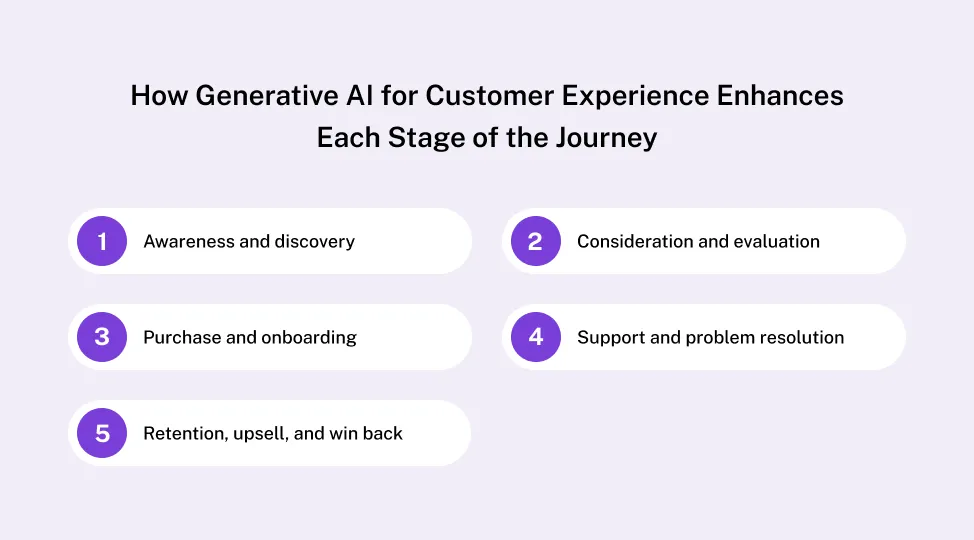
Awareness and discovery
At the top of the funnel, AI can:
-
Power smart FAQs that answer long tail questions
-
Adjust page content to match visitor intent
-
Suggest guides, videos, or tools that match the problem
This gives prospects faster clarity and reduces drop offs.
Consideration and evaluation
During evaluation, generative AI for cx can:
-
Compare products or plans side by side based on user needs
-
Translate technical details into plain language
-
Answer follow up questions without sending users to long documents
Customers feel supported, not pushed.
Purchase and onboarding
At purchase and onboarding, AI can:
-
Guide users through checkout with real time help
-
Explain payment errors and next steps
-
Offer tailored onboarding flows based on role or use case
Faster onboarding means faster time to value, which directly affects retention.
Support and problem resolution
This is where most teams start.
-
24 by 7 virtual agents solve common issues end to end
-
Smart triage routes complex cases to the right queue
-
Support copilots suggest responses and next steps to agents
Studies show that mature AI adopters in service functions see clear improvements in satisfaction and speed. (Source: IBM)
Retention, upsell, and win back
Finally, generative AI for customer experience can:
-
Spot churn risk patterns based on behavior and sentiment
-
Trigger proactive check ins with at risk customers
-
Draft personalized offers for upsell or cross sell
-
Build win back campaigns based on past usage and feedback
Here is a simple view.
| CX Stage |
AI Use Case Example |
Impact on Experience |
| Onboarding |
AI-guided setup flow |
Faster time to value |
| Support |
Contextual AI agent plus human handoff |
Lower wait time, higher resolution rate |
| Retention |
AI-driven churn risk alerts and outreach |
Earlier intervention, better retention |
To make this even more concrete, let us zoom into specific generative AI for cx use cases that show measurable value.
Practical Generative AI for CX Use Cases
Intelligent virtual agents and support copilots
-
AI agents handle common questions, status checks, and simple changes
-
Support copilots suggest replies and next best actions to human agents
-
Agents approve, edit, or add nuance in seconds
This reduces handle time and lets people focus on tricky issues.
Personalized messaging and campaigns
With AI customer experience tools:
-
Marketing and lifecycle teams generate email and in app messages tailored to behavior
-
AI creates variations for segments and runs controlled experiments
-
Copy stays on brand but becomes more relevant to each user
You get better engagement without manually writing every variation.
Smart self-service and knowledge experiences
Instead of forcing users to read long articles:
-
AI search finds answers across FAQs, docs, community posts, and past tickets
-
The system returns a short, clear answer with links to detail
-
Customers solve issues faster, and ticket volume falls
Voice of customer analysis
Generative models can:
-
Summarize call transcripts, chat logs, and survey comments
-
Tag sentiment and recurring themes
-
Surface top drivers of satisfaction and frustration
Leaders get a clearer picture of reality without reading thousands of lines.
Proactive retention and churn prevention
Using historical data and signals:
-
Models identify accounts at high risk
-
AI drafts tailored outreach scripts or offers
-
Agents or automated flows follow up before the customer leaves
A quick summary.
| Use Case |
AI Output |
Benefit for CX and Retention |
| Support copilot |
Suggested replies and next steps |
Faster resolution, less agent fatigue |
| Personalized campaigns |
Segment-specific messages |
Higher engagement and conversions |
| Knowledge experience |
Short, relevant answers |
Fewer tickets, better self-service |
| Voice of customer analysis |
Theme and sentiment summaries |
Better CX decisions |
| Churn prediction and outreach |
Risk alerts and tailored outreach ideas |
Higher save rates and loyalty |
To unlock these gains at scale, you need a clear view of cost, effort, and expected returns.
💡Suggested Read: Top Use Cases of Generative AI Across Industries
Cost, Effort, and ROI: Planning Generative AI for CX Investments
What shapes generative AI development cost
Several factors shape your budget:
1. Scope and channels
Web, mobile, email, messaging, voice, and in app flows
2. Data and integrations
CRM, helpdesk, product analytics, order systems, and authentication
3. Security, compliance, and geography
Data residency, sector rules, and privacy policies
4. Model choices
Hosted models, fine tuned domain models, or hybrid setups
Most teams start by estimating their generative AI development cost based on a small pilot, then expand once they see clear results.
Time and effort to go from pilot to production
A usual path looks like:
-
Step 1. Discovery and use case selection
-
Step 2. Data and systems mapping
-
Step 3. Build and integrate a narrow pilot
-
Step 4. Internal testing and tuning
-
Step 5. Gradual rollout to real customers
Quokka Labs helps compress this timeline by reusing patterns and integrating generative AI for customer experience directly into your existing tools, instead of building everything from scratch.
Measuring ROI for generative AI for customer experience
Useful metrics include:
-
Average handle time
-
First contact resolution rate
-
CSAT and NPS
-
Ticket deflection and self service rate
-
Retention, churn, and lifetime value
With cost and ROI in view, the next step is choosing the right implementation strategy.
Choosing an Implementation Strategy for Generative AI for Customer Experience
Map your CX goals and use cases
Start with your journey, not technology.
-
List pain points across awareness, purchase, support, and retention
-
Score each by impact and effort
-
Choose a small set of use cases where generative AI for cx can help most
Good early candidates include:
-
High volume, repeat questions in support
-
Onboarding journeys where many users drop off
-
Retention issues in specific segments or regions
Decide where to start: support, marketing, or lifecycle
Different entry points work for different brands.
-
Support gives clear metrics like handle time and resolution
-
Marketing focuses on engagement and conversion
-
Lifecycle work aims at activation and retention
The best starting point is where pain is high and data is ready.
Design a phased rollout plan
A simple plan might be:
-
Phase one: single use case in one channel
-
Phase two: extend to more channels or segments
-
Phase three: advanced personalization and proactive outreach
Quokka Labs helps teams develop custom generative AI models that fit their stack, data, and goals, rather than pushing one size fits all tools.
Governance, privacy, and risk management
From the start, define:
-
What data AI can access
-
Which cases need human review
-
How to log and audit interactions
-
How to update prompts and policies over time
At this point, many CX leaders ask whether to build in house, rely on platforms, or work with a partner.
💡Suggested Read: Generative AI Implementation Strategy: From Concept to Deployment (Step-by-Step Guide)
Build, Buy, or Partner: Where Generative AI Development Services Fit
When internal teams can start alone
You can start on your own when:
-
You use built in AI features in your existing CX and marketing tools
-
You run low risk experiments on a limited set of FAQs
-
You have clear guidelines and small, motivated teams
This is good for learning and building skills.
When to work with a specialist partner
A partner adds value when:
-
You need to connect many systems and channels
-
You have complex flows, segments, or regions
-
You need custom workflows and observability
-
You have strong compliance requirements
In these cases, partnering with a team that offers end-to-end generative AI development services helps you move from small experiments to reliable, production grade CX systems.
To make this even more concrete, let us walk through a step-by-step blueprint for launching generative AI for customer experience.
Step-by-Step Blueprint: Launching Generative AI for Customer Experience
Step 1: CX discovery and goal setting
-
Map your journey and pain points
-
Choose a small set of clear metrics
-
Align leadership on scope and success criteria
Step 2: Data and systems mapping
-
List core tools and data sources
-
Decide what data AI can safely use
-
Identify gaps in logs, tags, or events
Step 3: Pilot design and use case selection
-
Pick 1 to 3 high impact use cases
-
Define guardrails and human in the loop rules
-
Design flows, escalation paths, and fallbacks
Step 4: Build, integrate, and test
-
Connect models to your stack
-
Run tests with internal teams and friendly users
-
Tune prompts, responses, and workflows
Step 5: Soft launch and iteration
-
Launch in one region, channel, or segment
-
Monitor performance and feedback
-
Adjust design and settings in short cycles
Step 6: Scale across channels and journeys
-
Reuse what works across more flows
-
Extend to new touchpoints and products
-
Improve both AI customer experience and agent tools over time

As with any powerful technology, success also depends on avoiding common pitfalls.
Common Pitfalls and How to Avoid Them
Treating AI as a full replacement for human support
Good CX blends AI and people.
-
Use AI for speed and coverage
-
Let humans handle complex, emotional, or high value issues
-
Make escalation easy and visible to customers
Launching without clear metrics
If you do not define success, you cannot know if a generative AI for customer experience is working.
Ignoring training and change management
Agents need:
-
Training on how AI tools work
-
Clear expectations about when to trust or override suggestions
-
Processes that reflect new ways of working
Without this, adoption stalls.
Underestimating data quality and integration
AI depends on data.
-
Incomplete or messy data gives weak answers
-
Poor integration forces agents back into manual work
-
Plan time for data cleanup and API work
Once you understand and manage these risks, you can look ahead to the future of AI powered CX.
Conclusion: Turning AI into a Real CX and Retention Advantage
The real risk is not adopting generative AI too early. It is continuing to run fragmented, reactive CX systems while customer expectations quietly reset. Teams that move deliberately now—starting with clear use cases, strong governance, and measurable outcomes—will compound gains in speed, satisfaction, and lifetime value. Teams that delay will spend the next two years explaining churn instead of preventing it.
The real advantage comes from clear goals, careful design, and a strong partner.
Quokka Labs brings product thinking, CX design, engineering, and AI expertise together so you can move from ideas to working systems with less risk and more focus.
If you are ready to discover how generative AI for cx can upgrade your customer journeys, support your teams, and boost retention, share your goals with Quokka Labs and we will help you turn them into a concrete, actionable roadmap.


 Facebook
 Twitter
 LinkedIn
 Pinterest