Planning to build a restaurant app in 2026? Then the first thing you need is not a feature list. It is a realistic view of restaurant app development cost. Many restaurant businesses underestimate how quickly costs rise once bookings, online ordering, loyalty features, payment systems, real time tracking, and backend integrations enter the picture.
Whether you run a single outlet or a growing restaurant chain, the right app can improve customer experience, increase repeat orders, and reduce operational friction. But the cost of developing an app for a restaurant can vary widely based on app type, feature depth, platform choice, design quality, and long term maintenance needs.
Here, we break down restaurant mobile app development cost in 2026 so you can budget smarter and invest with confidence.
Cost of Developing a Restaurant Reservation App in 2026
A restaurant reservation app does not have a fixed price. Its cost depends on how far you want to go beyond basic table booking. A simple reservation app with core features like table availability, time slot selection, booking confirmation, and a lightweight admin panel typically falls between $10,000 and $40,000.
Once you add more advanced capabilities such as customer profiles, loyalty programs, POS integration, analytics dashboards, multi location management, and deeper backend workflows, the cost usually moves into the $40,000 to $150,000+ range. For large restaurant groups building a broader digital operations platform, the budget can go higher depending on customization, integrations, security requirements, and scale.
Overview of Features
The complexity of features and functionalities integrated in an application increases the overall cost of developing your restaurant reservation app.
Here are the features that a typical restaurant reservation app must include:
-
Reservation Management: Allow customers to book a table for a specific time and date. This feature needs to handle available seating, time slots, and capacity limits.
-
Waitlist Management: For fully booked times, customers should be able to join a waitlist and receive notifications when a table is free.
-
Customer Profiles: Customers can create accounts to save preferences, view past reservations, and receive personalised recommendations based on their dining history.
-
Real-time Notifications: Customers should be notified of reservation confirmations, reminders, cancellations, or delays. These notifications can be sent through SMS or email.
-
Integration with Google Calendar: Allow customers to easily add their reservation to their calendar, which adds convenience and reduces no-shows.
-
Loyalty Programs: Some reservation apps integrate loyalty features, allowing customers to earn points or rewards for frequent reservations or spending.
Estimated Restaurant Reservation App Cost
- Basic Reservation App: For a basic reservation system with essential features such as booking and waitlist management, the cost may range between $10,000 and $40,000+. These apps will have a simple user interface, a straightforward backend, and limited integrations.
If you want to build a scalable restaurant app with the right balance of performance, usability, and long term value, partner with Quokka Labs, a trusted Restaurant App Development Company, to turn your idea into a business ready product.

Benefits for Customers and Restaurants
-
For Customers: A reservation app makes booking a table more convenient, helping customers avoid long wait times and ensuring they can dine at their desired times. The addition of loyalty programs or special offers adds extra value.
-
For Restaurants: An efficient reservation app reduces manual booking errors, enhances customer experience, and helps restaurants manage their seating capacity. It can also gather valuable data on customer preferences and peak dining times, aiding in operational decisions.
Food Industry Insights You Need to Know
- The market is projected to grow at a 9.4% compound annual growth rate between 2025 and 2030, showing strong long-term momentum for restaurant digital platforms.
- The platform-to-consumer category generated over 71% of total revenue in 2024, highlighting the growing role of apps in restaurant ordering and delivery journeys.
- Mobile applications continue to lead the market, supported by rising demand for convenience, secure payments, real time tracking, and personalized user experiences. (source)
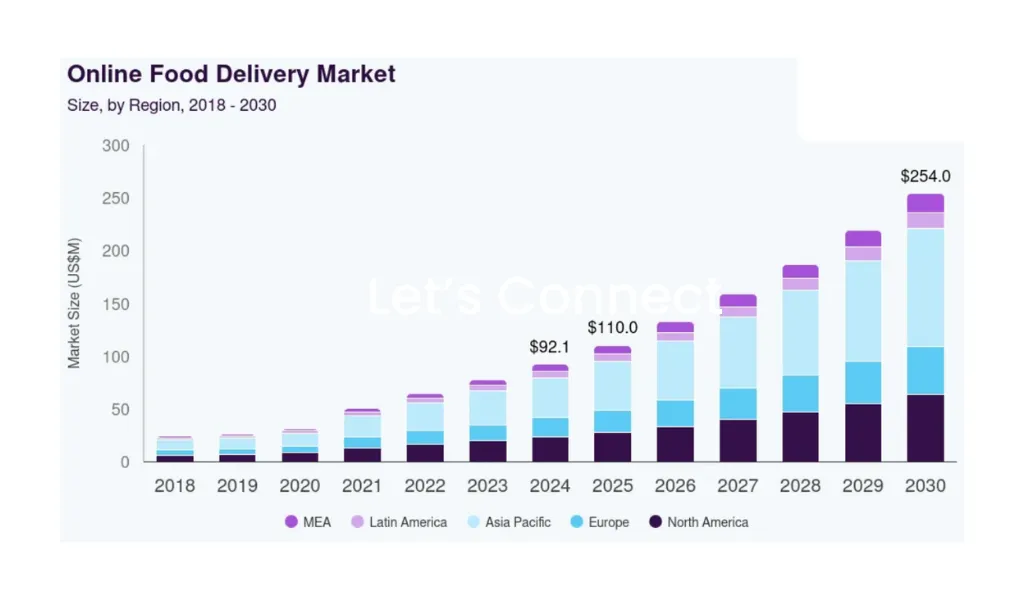 Source: Grand View Research
These numbers show why restaurant businesses are investing more aggressively in digital products. From direct ordering and table reservations to loyalty systems and branded customer experiences, restaurant apps now influence both revenue growth and operational control. That is exactly why understanding restaurant app development cost matters before you commit to features, platforms, and long-term product decisions.
Also Read: A Step-by-Step Guide to Develop a Custom Restaurant App
Restaurant App Development Cost Breakdown by Complexity
Understanding the different levels of complexity in restaurant app development is key to estimating costs. The more features and customizations you want, the higher the price, which is why working with an experienced restaurant app development company can help define the right level of complexity from the start.
Here’s a detailed breakdown of the different cost tiers based on app complexity:
1. Basic App (MVP): $10,000 – $40,000
An MVP is the most cost-effective way to launch a restaurant app. It includes essential features for running a restaurant app without the advanced functionalities of more complex solutions. These features typically include:
-
Simple menu display
-
Order placement: Allowing customers to view the menu and place orders for pickup or delivery
-
Payment gateway integration: Secure payment options like credit cards or mobile wallets
-
Basic loyalty cards: Offering simple rewards or discount systems for repeat customers
An MVP is perfect for small businesses or startups testing the market. It helps gauge customer interest without a significant upfront investment. The development timeline for an MVP usually ranges between 2 and 4 months.
2. Mid-Complexity App: $40,000 – $150,000
For restaurants looking to offer a more personalised and engaging user experience, a mid-complexity app is ideal. These apps include custom user interfaces and some added functionalities to make the app stand out:
-
Custom UI/UX design: A more tailored and visually appealing design aligned with your restaurant’s branding
-
Real-time tracking: For order status updates, delivery tracking, and more
-
User accounts and profiles: Enabling customers to save preferences, past orders, and payment information
-
Third-party integrations: Integrating with services like food delivery partners, reservation systems, or social media for promotions
This level of complexity is suitable for restaurants that want to scale and improve customer loyalty through added features. Development time typically ranges from 4 to 6 months, depending on the complexity of features.
3. Advanced App: $150,000 – $300,000+
Advanced apps incorporate premium features like AI-driven recommendations and real-time tracking to elevate customer experience. These apps are ideal for restaurants looking to integrate cutting-edge technology and deliver highly personalized, engaging interactions.
-
AI-powered features: Personalised recommendations based on customer behavior, predictive analytics for inventory management, or automated customer support using chatbots
-
3D or interactive menus: Engaging and visually-rich experiences that showcase menu items in an interactive format
-
Complex loyalty programs: Multi-tier rewards systems with advanced tracking and customization options
-
Real-time kitchen and inventory management: Syncing orders with kitchen staff, tracking inventory in real time
Ideal for established restaurants or chains that are aiming to stand out in a competitive market, these apps are typically developed in 6 to 9 months and come with a higher price tag due to the advanced technologies and custom features.
4. Enterprise App: $300,000 – $500,000+
Enterprise-level restaurant apps are the most complex and expensive. These apps are designed for large restaurant groups or franchises that require scalability, advanced security, and multiple integrations:
-
Multi-platform support: Apps available on iOS and Android through robust iOS and Android app development, and extended to browsers through strategic web app development, with full functionality across all devices.
-
Robust backend: A powerful server-side architecture to handle a large volume of users, orders, and data
-
Advanced security: Enterprise apps require high-level security features such as encryption, multi-factor authentication, and compliance with privacy regulations (e.g., GDPR, PCI-DSS)
-
Custom admin panels: Offering restaurant managers and staff advanced tools for managing orders, customer data, inventory, and more
This type of app is typically built for large-scale operations and can take anywhere from 9 to 12 months or longer to develop. The investment is significant, but the app’s capabilities and support for business growth make it worthwhile.
Expert insight from Quokka Labs
Most restaurant app budgets do not fail because the core app is expensive. They fail because teams underestimate backend logic, POS integration, staff side workflows, and post launch maintenance. A realistic estimate starts with business operations, not just customer screens.
Key Factors Affecting Restaurant App Development Cost
Understanding the various factors that contribute to the overall cost of developing an app for a restaurant is essential for budgeting effectively.
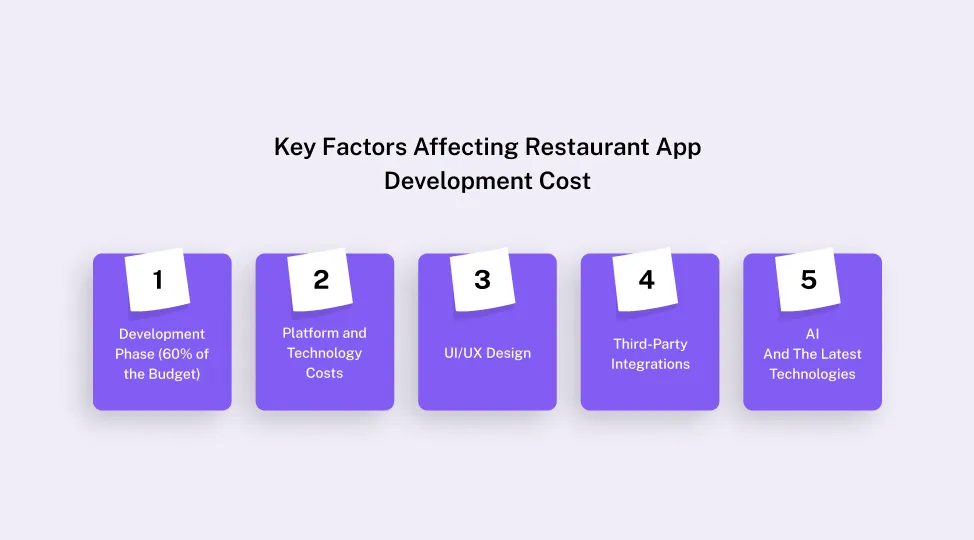
Here’s a deeper dive into the key factors of restaurant app development cost:
1. Development Phase
The development phase typically takes up the largest portion of your budget, ranging from $15,000 to $60,000+, depending on the complexity of your app. This phase includes the actual coding of the app, as well as:
-
Design: This includes both the UI/UX design, which determines the look and feel of your app, and the user journey, which affects how easy and intuitive it is to use. Custom designs naturally cost more than using pre-made templates.
-
Development: Writing the code to bring the app to life. The price here varies depending on the platform (iOS vs. Android vs. cross-platform).
-
Testing: Ensuring that the app works seamlessly across different devices and operating systems is critical. Extensive testing ensures that the app runs smoothly, bugs are fixed, and security issues are addressed.
2. Platform and Technology Costs
The platform you choose to develop your app for, iOS, Android, or both, impacts the total restaurant app development cost.
-
Native Apps (iOS/Android): Native apps are developed separately for each platform. As a result, they are generally more expensive because two separate codebases need to be maintained, leading to higher development time and costs. The average cost of native iOS or Android app development typically ranges from $25,000 to $150,000, depending on complexity.
-
Cross-Platform Apps (Flutter/React Native): These frameworks allow you to create a single codebase that works on both iOS and Android, making them a cost-effective option for restaurants on a budget. However, this comes at the cost of potential performance issues or limitations in some advanced features. Cross-platform development generally costs between $20,000 and $100,000.
3. UI/UX Design
Good design isn’t just about aesthetics, but also about creating a seamless and intuitive experience for the user. The design is a crucial component that can heavily influence how users engage with your app.
-
Custom Designs: Tailored designs that reflect your brand and user needs will always cost more than using templates. These designs are often built with the user journey in mind and require the expertise of skilled designers.
-
Template Designs: A pre-built template can be a cost-saving option, but it may not offer the level of customization and user experience that custom designs do. Template designs generally cost much less but may not align perfectly with your restaurant’s branding.
Custom UI/UX design for restaurant apps can cost anywhere between $5,000 to $25,000+, depending on the complexity and number of screens involved.
4. Third-Party Integrations
Most restaurant apps will need to integrate with third-party systems to function optimally. These can include:
-
POS Systems: Integrating with point-of-sale systems to manage orders and inventory is essential for many restaurant apps.
-
Payment Gateways: Secure payment systems like Stripe, PayPal, or Square must be integrated into the app to handle transactions.
-
Delivery Services: For apps with delivery features, integrating third-party services like UberEats, GrubHub, or DoorDash may add to the cost.
-
Social Media and Marketing: Integrating with social media platforms like Instagram or Facebook for marketing and promotions can also add to the development cost.
Each of these integrations comes with its own set of restaurant app development costs, which can range from $1,000 to $20,000+, depending on the complexity and number of integrations.
5. AI And The Latest Technologies
Incorporating AI and other trending technologies can significantly increase the restaurant app development cost. Some of the most impactful and expensive technologies include:
-
AI-powered personalization: Using AI to recommend menu items based on user preferences, order history, or even weather conditions can elevate the user experience, but it comes at a cost.
-
Predictive Analytics: Predictive features like demand forecasting or inventory optimisation rely on advanced data models and can significantly impact your budget.
-
Automated Customer Support: Integrating AI-powered chatbots to handle customer queries 24/7 is a popular feature, but it adds to development costs.
These advanced technologies can increase the restaurant app development cost by $20,000 to $300,000+, depending on their complexity and the data involved.
Regional Differences Affecting Restaurant App Development Costs
The cost of developing an app for a restaurant can vary significantly depending on where the development team is located. Understanding these regional differences can help you make an informed decision and potentially save costs without compromising on quality.
Here’s the detailed breakdown of the global restaurant app development cost variations:
1. United States
-
In the U.S., app development costs tend to be higher due to labor rates and living costs.
-
On average, you can expect to pay $50 to $250 per hour for skilled developers.
-
For a complex restaurant app, this can add up to $50,000 to $450,000+ depending on the features and complexity.
2. Europe
-
In countries like the UK, Germany, or France, hourly rates for app developers are generally in the range of $60 to $150 per hour.
-
European developers can deliver high-quality apps at a lower cost than in the U.S., with development costs typically ranging from $30,000 to $300,000.
3. India and Eastern Europe
-
Countries like India, Ukraine, and Poland offer more affordable development options.
-
Hourly rates in these regions typically range from $20 to $50, offering substantial savings compared to more expensive regions like the U.S. and Europe.
-
For the same level of app complexity, development costs could range from $10,000 to $150,000.
-
While outsourcing to these regions can help save money, it’s important to ensure the development team has the right expertise and experience to handle your project.
Choosing the Right Development Partner
While restaurant app development cost is an important consideration, quality and reliability are paramount when selecting a development partner. When outsourcing internationally, be sure to:
-
Check the company’s portfolio and client reviews.
-
Ensure they have experience building restaurant apps.
-
Understand their communication process and time zone compatibility.
By selecting the right development partner, you can balance cost with quality and achieve the desired results for your restaurant app.
Which Platform to Choose for Your Restaurant App (iOS vs. Android vs Cross-Platform)
One of the most important decisions you'll make when developing a restaurant app is choosing which platform(s) to build for: iOS, Android, or both. The platform you choose affects your budget, timeline, and user reach.
Restaurant App Development Cost Difference: iOS vs. Android
iOS App Development Costs:
Developing an app for iOS generally tends to be a bit more expensive compared to Android. This is primarily due to the closed ecosystem of Apple devices, which requires adhering to strict guidelines. iOS app development costs can range between $25,000 to $150,000+, depending on the complexity and features.
Android App Development Costs
Android apps tend to be less expensive to develop because of the open-source nature of the platform. The cost typically ranges from $20,000 to $100,000+ for similar features compared to iOS. However, Android app development may require more extensive testing due to the wide variety of devices and screen sizes in use.
Market Considerations
-
iOS Users: iOS apps generally have a more affluent user base, and Apple users often show stronger in app spending behavior in premium mobile ecosystems. If your restaurant app includes premium features or in-app purchases, iOS users might be more likely to engage.
-
Android Users: Android has a larger global market share, especially in regions like Asia, Africa, and South America. If your restaurant caters to a global audience or a region with a high Android user base, you may want to prioritize Android development.
Cross-Platform Development
-
If you want to save on restaurant app development cost and build time, cross-platform tools like Flutter and React Native are excellent options.
-
These frameworks allow you to develop one app that works on both iOS and Android, offering the best of both worlds.
-
Cross-platform restaurant app development costs generally range from $15,000 and $100,000+, depending on the level of complexity and the features added.
-
However, there may be some compromises in terms of performance and access to native features.
Custom vs. Pre-Built Restaurant App Development Solutions
When deciding to build a restaurant app, you’ll face the choice between custom app development and opting for a pre-built solution. Both have their advantages and trade-offs, and the right choice depends on your business needs, budget, and long-term goals.
Custom App Development
Custom restaurant app development involves creating a solution tailored to your restaurant’s specific needs and business model. And here, partnering with a custom app development company ensures the architecture, integrations, and user experience are designed around your operational workflows rather than adapted from a generic template.
Benefits of Custom Restaurant App Development
-
Unique Features: You can integrate exactly what you need, whether it's a complex loyalty program, AI-powered recommendations, or multi-location support.
-
Branding: A custom app ensures your brand is fully integrated into the design and user experience, creating a more personalised experience for your customers.
-
Scalability: As your restaurant grows, a custom-built app can evolve with your business, adding new features or scaling up to accommodate more users.
Custom Restaurant App Development Costs
Custom apps require a larger initial investment. Restaurant app development cost typically ranges from $20,000 to $300,000+, depending on the complexity. You’ll also need to plan for ongoing maintenance and updates, which are not included in the initial cost.
Custom development is best for businesses with specific needs that can’t be met by off-the-shelf apps. It’s a significant investment, but it often pays off in the long term through better customer retention and brand loyalty.
Pre-Built Solutions
Pre-built solutions are off-the-shelf platforms that can be branded with your logo and colors, offering basic features, but with limited flexibility for customization. They’re typically designed for quick launches and cost less than custom solutions.
Benefits of Pre-Built Restaurant App Development Solutions
-
Lower Initial Restaurant App Development Cost: Pre-built apps typically cost $5,000 to $25,000 and are ready to launch much faster. However, highly customized pre built solutions with significant integration or white label changes can still exceed $100,000 in total cost.
-
Quick Launch: Since these apps are already developed, you can have your app up and running within weeks, making them ideal for startups or businesses needing fast entry into the mobile space.
-
Simplicity: If your restaurant’s needs are basic, such as menu display, order placement, and simple loyalty programs, pre-built solutions may work just fine.
Pre-Built Restaurant App Development Costs
-
Limited Customization: Pre-built solutions are less flexible and may not offer the advanced features you need as your business grows.
-
Licensing Fees: Some platforms charge ongoing licensing or subscription fees, which can add up over time.
Pre-built solutions are ideal for small restaurants or those with budget constraints. However, they may not be the best choice if you need custom features or expect to scale quickly.
Which Option Is Right for You?
Choosing between custom and pre-built depends largely on your restaurant’s goals:
-
If you’re looking for a simple app to manage orders and reservations, a pre-built solution is cost-effective.
-
If you need unique features or want to future-proof your app as your restaurant grows, custom development is the better option.
Hidden Restaurant App Development Costs You Should Be Aware Of
While initial development costs are a key focus, ongoing expenses such as maintenance, updates, and platform fees should also be factored into your overall budget.
These hidden restaurant app development costs can add up over time, so it’s crucial to factor them into your budget for a more accurate estimate.
1. Ongoing Maintenance
After launching your app, it’s essential to keep it up to date. Ongoing maintenance typically accounts for 15% to 25% of the initial restaurant app development cost per year. For a standard mid-level restaurant app, ongoing maintenance typically ranges from $5,000 to $20,000 or more per year. This includes:
-
Bug fixes: Ensuring the app runs smoothly and addressing any technical issues that arise.
-
App updates: Making sure the app is compatible with new iOS and Android versions, and adding new features or enhancements based on customer feedback.
-
Security updates: Regular updates to maintain the app’s security, especially for apps handling sensitive customer data.
2. App Store Fees
Both Apple and Google charge fees for in-app purchases, which can range from 15% to 30%. If your app allows customers to make payments through the app, you’ll need to account for these fees, which can impact your revenue. Be sure to factor these fees into your app’s pricing model and overall restaurant app development cost structure.
-
Apple App Store: Requires enrollment in the Apple Developer Program at $99 per year.
-
Google Play Store: Requires a one-time developer registration fee of $25.
-
Commission Structure: As mentioned above, Apple and Google typically charge a 15% to 30% commission on in-app digital purchases. Small businesses generating under $1 million in annual revenue may qualify for reduced commission rates, such as Apple’s 15% Small Business Program.
3. Hosting & Cloud Storage
Many restaurant apps rely on cloud services for storing data, processing transactions, and hosting backend services. These restaurant app development costs can vary depending on the app’s usage, but typically range from $5,000 to $50,000+ per year. This includes:
-
Cloud infrastructure: Hosting servers and data storage for customer data, orders, and other app-related information.
-
Analytics services: Tools for tracking user behavior, order patterns, and other analytics to improve customer experience and operations.
4. Security & Compliance
Security and compliance represent a significant investment in restaurant app development, particularly for apps handling sensitive customer data such as payment information and personal details.
Ensuring compliance with regulations like GDPR, CCPA, and PCI DSS typically costs between $10,000 and $40,000+ or more as a dedicated phase, depending on application complexity and regional requirements. Engaging legal and cybersecurity experts to validate data protection standards and secure payment workflows can further increase the upfront budget.
Ongoing monitoring, updates, and threat mitigation for these security measures can add approximately $1,000 to $10,000 per month in maintenance costs.
Conclusion
Restaurant app development cost in 2026 depends on what you are really trying to build. A simple MVP for ordering or reservations will cost far less than a fully custom platform with loyalty systems, POS integration, real time tracking, advanced analytics, and multi platform support. That is why smart budgeting starts with business clarity, not guesswork.
The best approach is to define your must have features, choose the right platform strategy, and account for hidden costs like maintenance, hosting, compliance, and future updates from the beginning. If you want to build a scalable restaurant app with the right balance of performance, usability, and long term value, partner with Quokka Labs, a trusted Restaurant App Development Company, to turn your idea into a business ready product.
Frequently Asked Questions
Q. What is the average cost of developing a restaurant app in 2026?
Ans. Restaurant app development costs in 2026 range from $10,000 to $500,000+, depending on features and complexity, with basic apps costing less and advanced apps with AI or real-time tracking being more expensive.
Q. What features should I include in a basic restaurant app?
Ans. A basic restaurant app typically includes a menu display, order placement, payment integration, and loyalty cards, with costs starting from $10,000 for a simple MVP.
Q. How do platform choices affect restaurant app development costs?
Ans. iOS apps generally cost more due to Apple's strict guidelines, while cross-platform solutions (like Flutter or React Native) are more cost-effective, allowing you to develop for both platforms at once.
Q. How long does it take to develop a restaurant app?
Ans. The development time varies: MVPs take 2 to 4 months, mid-complexity apps take 4 to 6 months, and advanced apps can take 6 to 9 months, with enterprise apps requiring 9 to 12 months.
Q. Can I integrate a POS system with my restaurant app?
Ans. Yes, POS system integration is common and allows seamless order processing, payment handling, and inventory management within the app.
Q. Is it better to build a custom app or use a pre-built solution?
Ans. Custom apps offer tailored features but come at a higher cost, while pre-built solutions are more affordable and quicker to launch, but less flexible.


 Facebook
 Twitter
 LinkedIn
 Pinterest