Your app looks amazing in screenshots. The UI is clean, colors are on point, and the features list feels strong. But if the app stutters when users scroll or freezes for even one second, they don't care – they just close it and probably never come back.
Various studies keep saying the same thing: a big chunk of users uninstall apps that feel slow or crash too often. Even a small delay of 1–2 seconds in key flows can hurt signups, orders, and retention. In 2026, people expect mobile apps to just work and feel smooth, even on mid-range phones.
That’s where react native performance optimization comes in. It isn’t just about a few random tweaks at the end of a sprint. It’s about how you design screens, write code, measure behavior, and ship releases over time. With the right mindset, react native performance can get very close to “native-feeling” in real world usage.
In this guide from Quokka Labs, we’ll walk through:
-
The best react native performance tools and monitoring options
-
Practical tips you can use this week to improve react native app performance
-
Realistic benchmarks so you know what “good enough” means for performance react native in production
Before we jump into tools and tricks, we need a clear picture of what “good performance” means for a React Native app.
What React Native Performance Optimization Really Means in 2026
React Native performance optimization means making your app feel fast, smooth, and stable for real users. That includes:
-
UI that animates and scrolls without jank
-
Startup that doesn't drag forever
-
Screens that respond quickly when someone taps
-
An app that doesn’t randomly crash in the middle of a task
Under the hood, react native performance is about avoiding long JavaScript tasks, cutting down frame drops, and keeping communication between JS and native (the “bridge”) under control.
Core dimensions of performance react native
You can think about performance react native across a few key dimensions:
-
Startup time / time to first screen
-
UI responsiveness – frame rate (FPS), touch latency, navigation speed
-
Stability – crash rate, serious error rate, “white screen” moments
-
Memory and battery – how heavy the app feels during long sessions
If one of these is bad, users will feel it, even if they can’t name what went wrong.
Why it matters so much for product and business
Strong react native app performance optimization leads to:
-
Better app store ratings and reviews
-
Higher session length and user engagement
-
Better conversion in key flows like signup, checkout, booking
This matters just as much in iOS app development, where users expect instant feedback, smooth animations, and native-like responsiveness. On iOS especially, performance issues are noticed fast—and reflected just as fast in reviews.
Ignore it, and you’re basically building performance debt. That debt becomes tech debt, support requests, and user frustration later.
By 2026, the ecosystem matured a lot:
-
Patterns and react native performance tools are more stable
-
Users expect smooth behavior even on older devices
-
Competitors are only a few taps away
So, react native improve performance is not a “nice to have”. It’s part of product-market fit now.
How to Measure and Monitor React Native Performance
You can’t really do react native performance optimization if you don't know what’s slow. Guessing “feels fine on my device” is not a strategy. You need a way to react native measure performance both in development and in production.
Built-in and ecosystem react native performance tools
Some tools you should know and actually use:
React Native Performance Monitor (dev menu)
Flipper + React Native plugins
-
Inspect logs, network calls, and layouts
-
See component trees, state changes, and perf timelines
-
Very useful for hands-on react native performance monitoring
React DevTools
These react native performance tools are where most teams should start.
Platform-level profilers
When issues go deeper, you use native tools:
Xcode Instruments (iOS)
-
Time Profiler, Allocations, Energy usage
-
Great for catching CPU hogs and memory leaks
Android Studio Profiler
-
CPU, Memory, Network tabs
-
Shows if some part of the app or JS engine is doing too much work
Together, these reveal hidden react native performance bottlenecks that you wont see in just browser-like tools.
Production monitoring and crash tools
Dev tools are not enough. You also need real-world insight via:
-
Crash reporting and performance tools (Crashlytics, Sentry, etc.)
-
In-app analytics to see where people drop off
-
Error logs for key user flows
This is the backbone of serious react native performance monitoring.
Simple “measurement-first” workflow
A simple loop we like at Quokka Labs:
-
Pick 2–3 critical flows (onboarding, home feed, checkout).
-
Use tools to get a baseline: startup time, FPS, CPU, crash stats.
-
Apply targeted fixes.
-
React native measure performance again.
-
Keep what works, roll back what doesn’t.
Every react native performance optimization sprint should follow some version of this loop.
Once you can see what’s slow and where, you can actually fix the right things instead of just guessing.
Key Benchmarks: What “Good” React Native Performance Looks Like
Benchmarks are not rules, but they give you useful targets for performance react native.
Frame rate and UI smoothness
For most business and consumer apps, aim for:
-
Around 60 FPS for main screens and core animations
-
No visible jank on the home feed, product list, or key task screens
This is particularly important in Android app development, where device diversity (different chipsets, RAM, and OS versions) makes performance drops more noticeable. If FPS dips below ~40 often on common devices, users will feel it.
Startup time benchmarks
For react native performance at startup:
You dont have to load everything at once, but you do have to look alive.
Crash rate and stability
For stability:
Strong stability is as important as visual react native app performance optimization.
Simple benchmark table
| Metric |
Basic target for solid UX |
| UI frame rate |
~60 FPS on common mid-range devices |
| Time to first meaningful screen |
~2 seconds or less where possible |
| Crash-free sessions |
99%+ sessions without a crash |
| Long list scroll behavior |
Smooth scroll, minimal dropped frames |
These targets are not universal. A simple content app and a heavy data dashboard wont behave exactly the same. But they’re useful anchor points when you react native measure performance and discuss goals with product teams.
Now that we know what we’re aiming for, lets look at what usually breaks performance first.
Common Performance Bottlenecks in React Native Apps
Most slow React Native apps suffer from a few repeatable patterns. If you want react native performance optimization to work, you need to spot these early.
Over-rendering and heavy component trees
-
Components re-render too often because props or state change constantly
-
Anonymous inline functions and new objects passed on every render
-
Huge components doing too much in one place
All of that keeps the JS thread busy and hurts overall react native performance.
Poorly optimized lists
This one is classic:
-
Using ScrollView for large lists instead of FlatList or SectionList
-
Missing virtualization, wrong windowSize, or too much data at once
The result: janky scroll and high memory, killing performance react native especially on Android.
Large images and media
-
Full-resolution images when only thumbnails are needed
-
No caching or lazy loading
-
Multiple big images loading all at once
These issues slow down loading and hurt react native app performance optimization badly.
Chatty JS–native bridge
-
Lots of small calls across the bridge per frame
-
Animations that depend on JS updating every tick
-
Heavy logging or debug calls still active in production
This can burn CPU and battery, and reduce react native performance even if screens look “fine” in simple tests.
Memory leaks and uncleaned subscriptions
Over time, this kills memory and makes the app crash after long usage.
Once you know where things usually go wrong, you can design your app and codebase to avoid these traps from the start.
Code-Level Techniques to Improve React Native App Performance
Now let’s get practical and talk about specific code-level changes to improve react native app performance.
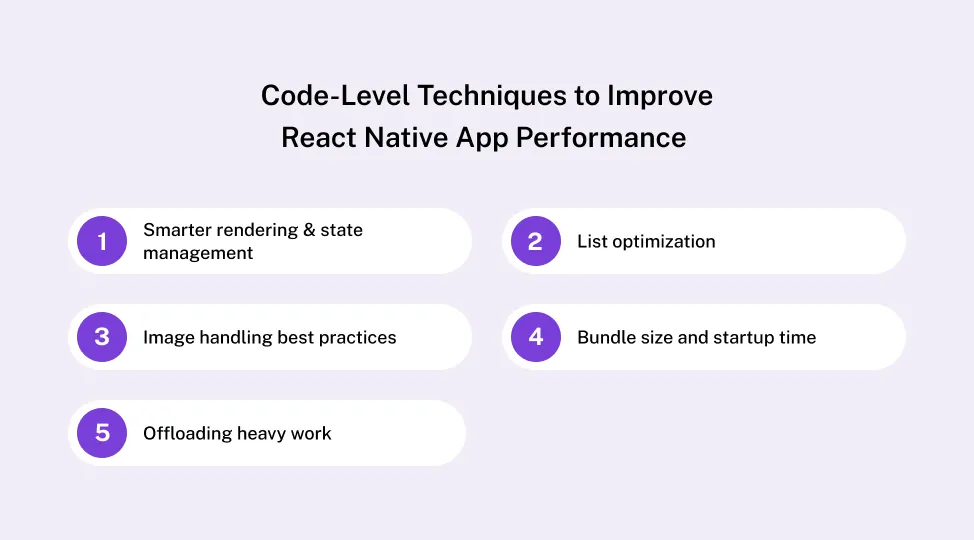
1. Smarter rendering & state management
Some quick but powerful practices:
-
Use React.memo for components that receive the same props most of the time
-
Use useCallback and useMemo so you don’t pass new function or object instances on every render
-
Keep state as local as possible; avoid giant global objects that trigger many re-renders
On complex screens, these steps alone can make react native improve performance in a very visible way.
2. List optimization
For big data sets, always:
initialNumToRender
maxToRenderPerBatch
windowSize
- Implement getItemLayout when your row height is fixed or predictable
This reduces layout work and makes react native performance optimization easier on long lists.
3. Image handling best practices
Some habits that pay off:
-
Serve correctly sized images from your backend or CDN
-
Use caching libraries or built in caching where possible
-
Lazy load images below the fold
-
Show placeholders or skeleton loaders to keep UI responsive
These steps reduce memory and help react native app performance optimization a lot, especially in feeds and galleries.
4. Bundle size and startup time
To speed up startup:
-
Split code so non-critical modules load later
-
Remove unused libraries and legacy code
-
Consider Hermes or other JS engines when they benefit your targets
Smaller bundles and less work at launch both support react native performance optimization at the moment users care most – first open.
5. Offloading heavy work
If you have heavy calculations or data processing:
-
Move them off the main JS/UI thread
-
Use native modules where it makes sense
-
Batch bridge calls rather than sending many small ones
This reduces pressure on the app and helps react native performance tools show a cleaner profile.
Code-level fixes are powerful, but architecture and process also decide how your app behaves over the long term.
Architectural and Process Patterns That Boost Performance
Designing for performance from day one
Performance is easier to protect than to fix. So:
-
Plan navigation flows to avoid deep unnecessary stacks
-
Think about when and where you load data
-
Decide on caching strategy early
Also, plan react native performance monitoring as part of the architecture: which metrics, from which screens, and how often you review them.
Server/API and data strategy
Backend choices have a big impact on react native performance:
-
Paginate large lists at the API level
-
Avoid over-fetching huge payloads when only a small part is needed
-
Use caching, ETags, and delta updates where useful
Smart data strategies mean the app does less work and feels faster.
CI/CD and performance budgets
You can treat react native performance optimization like any other quality metric:
-
Track startup time and FPS for key flows in CI/CD (even basic logging helps)
-
Set “budgets” and alert when they get worse across builds
-
Add simple automated tests that measure important timings
Regular performance reviews
Plan regular react native performance checkups, for example every X sprint:
If you do that, performance becomes a habit, not a panic button you hit the week before release.
If your team doesn't have deep performance experience or time, you don't have to fight all of this alone.
When to Bring in a React Native Performance Partner
You might want outside support when:
-
Users complain about slowness even after you “optimized”
-
Crash reports and bad reviews keep mentioning lag or freezes
-
You aren't confident using react native performance tools or reading profiler output
What a good partner does
A good performance partner will:
-
Run a structured react native performance audit of your app
-
Set up or refine react native performance monitoring tools and metrics
-
Map bottlenecks and give a clear prioritized list of fixes
-
Work with your in-house devs so they can keep improving later
At Quokka Labs, we treat performance as a core part of product quality, not an optional add-on. We’ve helped teams rescue slow apps, redesign heavy flows, and ship smoother versions without rewrites.
If you’d like a specialist team to review your app and tune it with you, partnering with a React Native App Development Company like Quokka Labs can speed up your performance journey and remove a lot of guesswork.
Example Performance Stories and Micro-Case Patterns
Let’s look at some anonymized patterns we’ve seen while doing react native performance optimization for clients.
Case 1 – Fixing a laggy feed
-
Problem: Home feed felt sticky on scroll. Users complained in reviews about “laggy” behavior.
-
Tools: Performance Monitor, Flipper, Android Profiler.
-
Findings: ScrollView was used with hundreds of items. Large images loaded at full resolution. No memoization in row components.
-
Fixes: Switched to FlatList, added virtualization tuning, optimized image sizes, and wrapped rows in React.memo.
-
Result: Scroll became smooth on mid-range phones, and engagement on the feed increased.
Case 2 – Reducing startup time
-
Problem: Cold starts taking 4–5 seconds on common Android devices.
-
Tools: Profilers and simple timing logs.
-
Findings: Too many modules loaded on startup, heavy logic in root component, multiple API calls before first screen.
-
Fixes: Lazy loaded non-essential modules, pushed heavy work after first render, simplified initial data fetch.
-
Result: Time to first screen almost halved, and user drop-off during startup went down.
Case 3 – Lowering crash rates and memory issues
-
Problem: Crashes after long sessions; memory usage kept climbing.
-
Tools: Crashlytics, Xcode Instruments, Android memory profiler.
-
Findings: Uncleaned timers, event listeners kept alive, large images kept in memory.
-
Fixes: Cleaned up subscriptions and timers in useEffect, improved image handling and caching strategy.
-
Result: Crash-free sessions improved, support tickets around “app keeps closing” dropped.
These stories show how performance react native issues usually come from a mix of code, data, and process – not just one line of code.
Conclusion – Make Performance a Habit, Not a Panic Button
Great UX is impossible without strong react native performance. Users don't separate design and speed in their minds – they just feel whether the app is pleasant or painful to use.
The teams that win in 2026 will treat react native performance optimization as a habit. They measure, they adjust, they keep an eye on benchmarks, and they build performance into code, architecture, and process. Not as a last minute checklist.
If your app already feels slow or you just want to avoid future pain, now is the right time to take performance seriously.
Share your app and goals with Quokka Labs – A Native AI Engineering company, and get a focused performance review plus clear next steps.


 Facebook
 Twitter
 LinkedIn
 Pinterest