The oil and gas industry is the backbone of the world economy. It powers transportation, manufacturing, and power generation. However, over the last few years, this trillion-dollar industry has been facing many challenges: unstable markets, increased operational expenses, safety and compliance issues, and the constant need to be sustainable. It is not easy to remain agile, efficient, and competitive in such a dynamic environment with legacy systems and manual processes.
To eliminate these challenges, major energy enterprises are now transitioning to digital transformation. Technology is reshaping the discovery, production, and delivery of energy, whether it is through real-time monitoring and predictive maintenance or through data-driven exploration and optimization of production.
Collaborating with an oil and gas software development company helps organizations create custom applications that help with streamlining operations, minimizing downtime, and improving decision-making.
In this blog, we will discuss why the oil and gas industry must have their own digital solutions, what makes them effective, real-life use cases, what kind of challenges are involved in the development, and what is the key to increasing long-term growth and scalability with the help of the right technology partner.
Why the Oil and Gas Industry Needs Software Development
The oil and gas industry functions in one of the most data-heavy and operationally complex ecosystems. However, most companies still rely on old systems and fragmented processes that restrict visibility and scalability. This is why software development has become necessary in this industry:
- Operational Complexity and Data Fragmentation
Discovery, extraction, refining, and distribution of oil are all activities that produce huge amounts of data. The absence of centralized digital systems causes significant information to be scattered in most cases, which results in inefficiencies, duplication, and slower decision-making.
- Need for Real-Time Monitoring and Control
Software solutions help track assets, production, and logistics in real-time. When connected to IoT, field equipment will be able to send live operational information to help the teams with forecasting failures in advance and minimizing downtime.
- Increased Safety and Compliance
Safety and regulatory compliance are constant priorities. Inspections, incident reporting, and audit trails can be automated using custom-built applications to ensure that they meet the changing local and global standards.
- Optimized Production and Resource Management
Predictive analytics helps detect performance bottlenecks, optimize resource allocation, and enhance production forecasting.
- Cost Efficiency Through Automation
Manual processes like maintenance scheduling, documentation, and inventory management can be automated to limit human error and operational expenses.
- Data-Driven Decision-Making
High-end analytics and visualization enable the management to have full visibility, both in the field operations and financial performance, to make faster and informed strategic decisions.
- Scalability and Future Readiness
A dedicated oil and gas software development company will be able to design flexible, cloud-based solutions that can be easily expanded as operations grow. They can also be easily integrated with existing legacy systems.
Simply put, digital transformation is not a modernization project but a competitive edge. By collaborating with an oil and gas software development company, energy enterprises will be able to simplify their workflow, enhance safety, and grow sustainably in a more dynamic market.
Core Features of Software Solutions for Oil and Gas
Creating effective software solutions for oil and gas requires more than just technical skills; they demand a good understanding of how energy works in real life. From exploration to downstream logistics, every process requires accuracy, compliance, and real-time intelligence. This is the reason why major businesses collaborate with an oil and gas software development company that will provide tailor-made platforms in line with their business objectives.
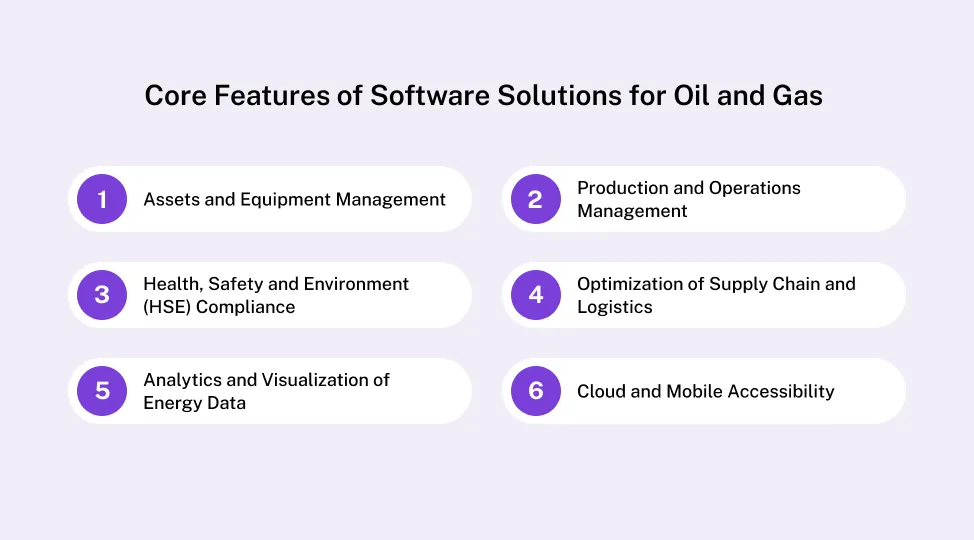
Some of the most important features of high-performing software solutions are:
Assets and Equipment Management
In-depth asset tracking and IoT-based monitoring can help companies keep the equipment in good condition and minimize unforeseen failures. Predictive maintenance algorithms can be used to examine usage patterns and identify anomalies at an early stage, reducing downtime and increasing the life of assets.
Production and Operations Management
Software solutions centralize production data across rigs, refineries, and plants. Real-time dashboards help engineers and managers track important metrics, predict production levels, and detect inefficiencies which optimize resource utilization.
Health, Safety and Environment (HSE) Compliance
The integrated HSE modules assist the organizations in recording, monitoring, and preventing incidents. Automated compliance reports and training management tools guarantee compliance with global environmental and safety standards.
Optimization of Supply Chain and Logistics
Logistics management is a problem if operations are located in various regions. Smart routing, fleet monitoring, and stock management enable companies to optimize transportation and minimize the cost of delivery.
Analytics and Visualization of Energy Data
Insights based on data help businesses make better operational and financial decisions. Centralized dashboards combine SCADA system, sensor, and ERP platform inputs in order to provide real-time actionable analytics and performance trends.
Cloud and Mobile Accessibility
Cloud integration guarantees flawless accessibility to information everywhere, and mobile applications enable field technicians to note, synchronize, and handle tasks remotely.
Moreover, oil and gas software consulting services assist the organizations in determining the right digital roadmap to follow before the development process starts, matching business goals and technical implementation.

Use Cases of Software Solutions for Oil and Gas
Oil and gas software is changing the way energy businesses conduct their day-to-day operations, from exploration facilities to retail distribution channels. This is how different segments of the industry can use specialized digital systems:
AI and geospatial analytics process seismic data and find prospective drilling locations and enhance the accuracy of resource estimations. This helps reduce exploration risk and optimize field planning.
Real-time monitoring devices connect SCADA systems and IoT monitors to monitor production output, identify anomalies and automate equipment control, enhance productivity, and reduce waste.
- Transportation and Storage
Logistics software provides total pipeline visibility, optimal route planning, and inventory control. Computerized notifications make the transportation of fuels more controlled and avoid expensive leakages or time wastage.
Custom software enhances customer experience and faster delivery through order tracking and automated billing and pricing.
- Sustainability and ESG Tracking
Now, digital platforms have the ability to measure carbon footprints, monitor emissions, and produce sustainability reports. Enterprises can comply with global environmental standards easily.
These real-life applications show what an oil and gas software development company brings to the table: domain expertise, integrated technologies, and scalable applications to meet the key issues of the energy industry.
Overcoming Development Challenges in the Energy Sector
Developing and implementing digital systems in the oil and gas sector is not easy. Every project comes with its own set of technical, operational, and regulatory challenges that demand deep industry knowledge. Partnering with an experienced oil and gas software development company can help businesses overcome these obstacles.
Here are the most common challenges, and how the right expertise helps overcome them:
Legacy Systems and Integration Issues:
Most organizations are still using old on-premise software that fails to connect with new tools. The developers, who are skilled in API-based and cloud-native architecture, will be able to upgrade old systems without interfering with the day-to-day activities.
Cybersecurity and Data Protection:
As sensitive operational and financial data gets transferred across various platforms, cybersecurity becomes a significant issue. Implementing secure access measures, data encryption, and threat monitoring will help prevent any external breach.
Regulatory and Compliance Complexity:
There are tough regulations in the oil and gas industry with regard to environmental management and safety. Audit reporting, incident documentation, and certification tracking are automated through software with in-built compliance modules to minimize administrative overhead.
Scalability and Performance Under Heavy Loads:
Energy operations generate huge volumes of information. Cloud-based infrastructure and optimized databases will ensure stable performance.
Moreover, oil and gas software consulting services usually begin with a thorough assessment stage, i.e. finding gaps in the technology, setting quantifiable objectives, and a well-defined implementation roadmap.
The Future of Digital Transformation in Oil & Gas
The oil and gas industry is facing massive digital transformation. As energy requirements grow, sustainability targets become more stringent, and operations become more complex. Thus, businesses are turning to technology not only to optimize but to reinvent.
This is what the digital transformation of this industry will look like in the future:
- AI and Machine Learning for Predictive Insights
AI can be used to transform reactive operations to proactive ones for companies in the energy industry by predicting equipment failures and optimizing drilling performance.
- Digital Twins for Operational Simulation
Creating virtual replicas of rigs, refineries, and pipelines enables teams to simulate, test, and refine strategies without interfering with actual operations.
- IoT-based Real-Time Monitoring
Connected sensors and smart devices will guarantee that all processes, including extraction and transportation, are followed in real-time to ensure maximum safety and efficiency.
- Blockchain for Transparent Supply Chains
Traceability and trust across the global energy network are enhanced with secure data sharing and transaction verification.
- Cloud Computing for Scalability
Cloud-based infrastructure offers the flexibility to scale business, centralize information, and enhance teamwork across geographically distributed teams.
These technologies are enabling oil and gas companies to create smarter and more sustainable ecosystems. Collaborating with an experienced software development company guarantees that such innovations are customized to your business objectives.
How Partnering with an Oil and Gas Software Development Company Accelerates Growth
Digital transformation in oil and gas does not come with the implementation of technology as such but rather collaborating with the right people who can match innovation with business returns. That is where partnering with an oil and gas software development company becomes one of the strategic benefits.
This is why this partnership would help take your business to a higher level:
- Industry-Specific Solutions
A development company is aware of the unique workflows of exploration, production, and logistics. It develops tailored applications that can fit perfectly within your existing infrastructure, from field operations to enterprise systems.
- Scalable and Future-Ready Architecture
Energy companies are developing rapidly. The appropriate partner will develop such solutions that will expand with your increasing data, users, and operations, making sure that it will remain stable even under the most challenging conditions.
A full-service partner offers technical expertise, industry knowledge, and agile development services from the initial consulting stage to post-deployment optimization.
- Long-term Cost and Risk Optimization
Rather than dealing with numerous vendors, collaborating with a web and mobile app development company is a good way of being accountable, minimizing risks, and ensuring ROI in the long term due to continuous innovation.
Driving Efficiency and Innovation in the Energy Future
The oil and gas industry is going into an era where data, automation, and digital intelligence are reshaping the way enterprises operate. From optimizing drilling productivity to ensuring safety compliance and predictive maintenance, software-led innovation has become a necessity.
Working with an established oil and gas software development company is useful in assisting energy businesses to close the gap between complex operations and innovative technology. These partnerships enable businesses to optimize operations and reduce expenses and ensure sustainability in the long term with tailored solutions, real-time data visibility, and scalable infrastructure.
The next groundbreaking move in the energy industry will not be a deeper well or a larger rig, but rather a smarter and more interconnected system that will bring measurable impact. And with the right development partner, that transformation can begin today.


 Facebook
 Twitter
 LinkedIn
 Pinterest