Choosing the right cross-platform framework can shape your product’s speed, user experience, development cost, and long-term maintainability. Two common options teams still evaluate are Ionic and React Native.
At a high level, Ionic is a web-first framework that lets teams build apps using web technologies and ship them across mobile and web, typically using Capacitor for native deployment. React Native, on the other hand, is designed for building mobile apps with React using native UI capabilities and native platform integration.
There is no universal winner. The right choice depends on what you are building, how much native functionality you need, what skills your team already has, and how important performance and native feel are for the product. That is why the ionic vs react native debate is still highly relevant for product teams in 2026.

Quick Answer
Choose Ionic when:
- your team is strong in web development,
- you want to ship across web, iOS, and Android from a shared foundation,
- your app is content-driven, form-heavy, internal, or PWA-friendly,
- development speed and code reuse matter more than fully native interaction patterns.
Ionic supports cross-platform delivery from one codebase and can run as a mobile app or PWA.
Choose React Native when:
mobile UX is central to the product,
you need stronger native feel and closer platform integration,
your app includes more complex interactions, animations, or device-intensive behavior,
you want a mobile-first stack based on React and native components.
For many teams comparing react native vs ionic, the decision often comes down to whether they need stronger web reuse or a more native mobile experience.
Need help choosing the right framework? Talk to Quokka Labs to find the best fit for your product, team, and roadmap. Contact us!
Also Read:- Mobile App UI Design: An Expert's Complete Guide for 2023
Introduction to Ionic App Development?
The Ionic framework is an UI toolkit for developing PWAs Progressive Web Apps and used for developing mobile apps through web technologies such as HTML, CSS, and JavaScript.
It allows developers to create cross-platform apps (apps that can run on both Android & iOS devices) using a single codebase. Ionic uses Apache Cordova, a platform for building native mobile app development using technologies, to access native device features, cameras, and GPS.
Additionally, With Ionic, you can create a hybrid mobile app utilizing JavaScript, Angular, React.
When teams start comparing ionic framework vs react native, Ionic usually stands out for its web-first approach, faster onboarding for frontend developers, and strong support for shared design systems across web and mobile.
If you are exploring Ionic app development, Quokka Labs helps businesses build scalable mobile and web products aligned with modern product and engineering goals.
Advantages & Disadvantages of using Ionic App Development
Each coin has double faces; similarly, the Ionic framework has advantages and disadvantages. The below section will discuss the advantages and disadvantages of using the Ionic framework for mobile app development.
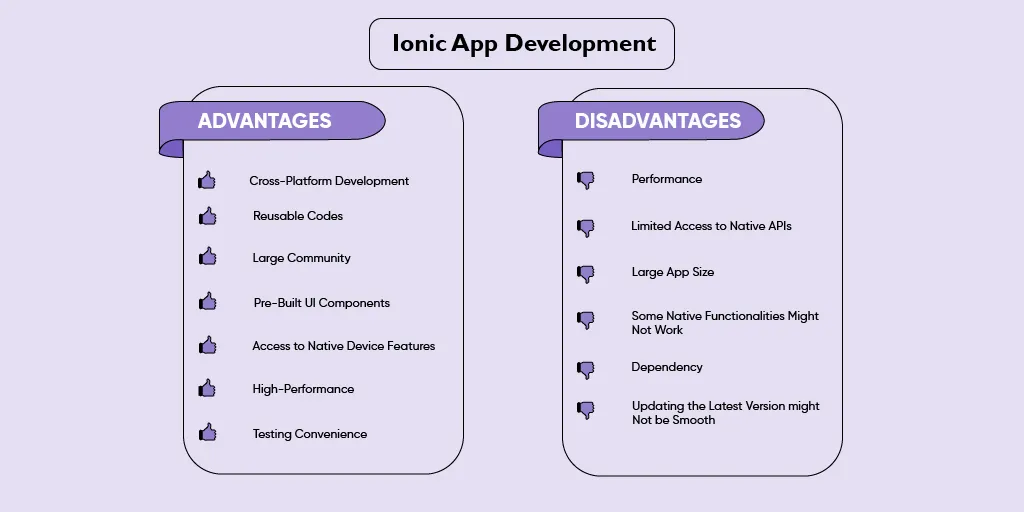
Advantages of Using Ionic
Cross-Platform Development
Build for iOS, Android, and the web from one core codebase.
Strong web reuse
Existing web skills, components, and workflows carry over more easily.
PWA-friendly
Ionic naturally fits projects where browser and mobile experiences both matter.
Pre-Built UI Components
Teams can move faster with ready-made interface elements.
Faster prototyping
It is often easier to validate an MVP or internal product quickly.
Consistent UI layer
A shared design system is easier to maintain across platforms.
Native access when needed
Capacitor supports plugins and custom native code for device capabilities.
Disadvantages of Using Ionic
Native edge cases
Some advanced platform-specific features may require custom Capacitor plugins or more native work.
Plugin dependency management:
Native functionality can depend on plugin maturity and compatibility.
Platform polish may need effort
You can create a polished mobile UI, but some use cases require more tuning than a native-first framework.
Upgrade planning matters
Framework, plugin, and dependency updates should be tested carefully across platforms.
Dependency
The framework’s performance and functionality depend on the Cardova plugins and other dependencies.
Updating the Latest Version Might Not be Smooth
Updating the Ionic Framework to the latest version might cause compatibility issues with the existing codebase.
This is where the ionic native vs react native comparison becomes useful. If your product needs deeper mobile behavior and tighter platform alignment, React Native may offer more flexibility. If web delivery and speed matter more, Ionic often remains a strong option.
Introduction to React Native App Development?
React Native is a framework for building mobile apps using JavaScript and the React library. It allows developers to build apps for iOS and Android using a shared codebase, helping reduce development time and improve code reuse across platforms.
React Native also allows the use of native components and APIs, which can provide a more seamless mobile user experience than many traditional cross-platform approaches.
For teams evaluating react ionic vs react native, React Native usually appeals more to businesses building mobile-first products where native-like interaction and stronger device integration are important from the start.

Also Read:- What's New in React Native 0.69?
Advantages & Disadvantages of using React Native App Development?
React Native app development is a well-known and popular open-source software UI framework. It is nowadays the preferred framework for mobile app developers to develop mobile app development in 2023. However, it also has a few advantages & disadvantages. Let’s find out a few of them in the below section.
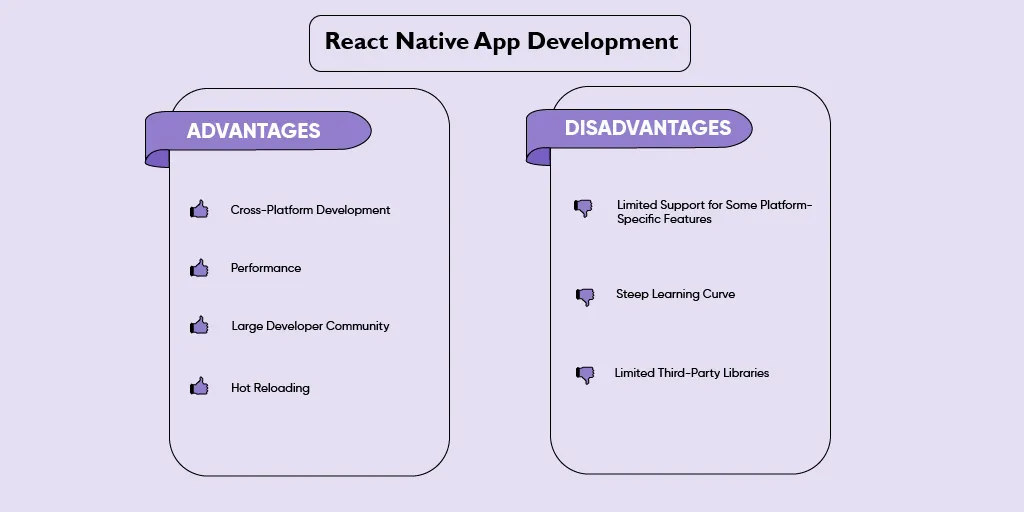
Advantages of Using React Native
Native-backed UI
React Native uses platform-backed native components.
Stronger native feel
It is often a better fit for apps with richer interactions and more demanding UX.
Code sharing across platforms:
Teams can still share a large portion of the codebase.
Fast iteration:
Fast Refresh helps developers see changes quickly during development.
Platform-specific flexibility:
You can add native modules and write platform-specific code where necessary.
Good fit for React teams:
Existing React knowledge transfers well to mobile workflows.
For teams that want to move faster with production-grade implementation, working with a React Native app development company can help streamline architecture, development, and release planning.
Disadvantages of Using React Native
Not zero-native in practice:
Many production apps still need native setup, native debugging, or custom native modules.
More mobile-specific complexity:
Teams may still need to work with Xcode, Android Studio, and native build pipelines.
Cross-platform consistency takes work:
Since it uses native components, exact UI behavior can vary between iOS and Android.
Learning curve for web-only teams:
React knowledge helps, but mobile concepts still matter.
Dependency management can be sensitive:
Before choosing between Ionic and React Native, it helps to understand the broader difference between native and cross-platform development.
Native app development means building separately for each platform using platform-specific languages and tools. This usually gives the most control over performance, APIs, and device behavior.
Cross-platform development means building once and reusing much of the app across platforms. This usually improves speed, reduces duplicate effort, and helps teams manage releases more efficiently.
Businesses comparing native and cross-platform approaches often consult a mobile app development company to align framework selection with product goals, budget, and long-term scalability.
Also Read:- Which Is Best In 2022: Native or Cross-Platform Development?
Advantages of Native Apps
Advantages of Native Apps
- Better access to platform-specific APIs and SDKs
- Greater control over performance-sensitive experiences
- Easier alignment with platform-specific UI behavior
- Stronger fit for highly custom, hardware-intensive apps
Advantages of Cross-Platform Apps
- Faster development cycles
- Lower cost of maintaining multiple platforms
- Better code reuse
- Easier feature parity across platforms
- More efficient team collaboration for shared product roadmaps
Now, let’s proceed further and compare Ionic and React Native frameworks for developing mobile applications.
Ionic vs React Native in 2026: Quick Comparison
| Criteria |
Ionic |
React Native |
| Core approach |
Web-first |
Native-component-first |
| Best team fit |
Web-heavy teams |
React/mobile product teams |
| Performance profile |
Good for many business apps, portals, dashboards, and PWAs |
Better fit for interaction-heavy or native-feeling apps |
| Native integrations |
Good with Capacitor plugins and custom plugins when needed |
Stronger for deeper native modules and platform-specific work |
| Web/PWA support |
Excellent |
Limited by default compared with Ionic |
| UI consistency |
Easier to keep a shared UI layer across platforms |
More platform variation, often closer to native behavior |
| Time to first release |
Usually faster for web-first teams |
Strong, but can involve more mobile setup |
This comparison reflects Ionic’s web-first, Capacitor-powered deployment model and React Native’s native-component model, plus the New Architecture that is enabled by default in React Native from 0.76 onward.
If you are looking for ionic react vs react native, the practical answer is that Ionic is often better for web-first delivery, while React Native is often better for mobile-first UX.
If you are comparing more than two frameworks, you may also want to review kotlin vs flutter vs react native before making a final product decision.
When to Use Ionic for Mobile App Development
React Native is a strong choice when:
- you want a more native-feeling mobile experience,
- your app relies on richer gestures, transitions, or platform-specific interactions,
- you expect to use more native modules or platform-specific code,
- your team already works with React and is comfortable with mobile build pipelines,
- the app itself is a core product experience, not just an additional channel,
- you want a cross-platform approach that stays closer to native UI patterns.
For many consumer-facing apps in 2026, React Native remains the stronger fit when UX quality, device integration, and long-term product depth matter more than maximum web reuse.
In some enterprise evaluation cycles, teams also compare react native vs angular ionic when deciding between a mobile-first React stack and a web-first Angular-based Ionic setup.
Teams leaning toward React Native can also explore the top benefits of React Native for app development to better understand where it performs well in real product scenarios.
Ionic vs React Native: Which One Should You Choose?
Choose Ionic if your priorities are:
- faster delivery,
- web skill reuse,
- PWA compatibility,
- simpler cross-platform rollout,
- a consistent UI layer across mobile and web.
Choose React Native if your priorities are:
- native-backed UI,
- more advanced interactions,
- stronger long-term native flexibility,
- closer alignment with iOS and Android behavior,
- deeper mobile product investment.
**A simple rule of thumb is this: **
Choose Ionic when your strategy is web-first, speed-first, and reuse-first.
Choose React Native when your strategy is mobile-first, UX-first, and native-feel-first. Also, if your team already has experience in mobile app development with React and wants to extend those skills into cross-platform mobile app development.
Put simply, the react native vs ionic decision should be based less on trend and more on the experience your product actually needs to deliver.
Final Thoughts
In 2026, Ionic remains a strong choice for teams that want web-first, cross-platform efficiency with the flexibility to support mobile and PWA experiences from a shared codebase. React Native remains the stronger choice for mobile-first products where performance, native feel, and deeper platform integration matter more.
If your app is centered on speed, web reuse, and broad cross-platform delivery, start by evaluating Ionic.
If your app is centered on mobile UX, native feel, and richer app behavior, React Native is usually the better fit. If your product requirements point toward another cross-platform route, working with a Flutter app development company like Quokka Labs may also be worth evaluating alongside Ionic and React Native.
The best framework depends on your product goals, team skill set, timeline, and the kind of user experience you want to deliver. If you define those clearly first, the right choice becomes much easier.
Quokka Labs, As an AI-native engineering company, builds scalable digital products across mobile, web, cloud, and AI-powered systems - helping teams choose the right technology stack for long-term performance, speed, and maintainability.
Tags
React Native vs Ionic platform
React Native vs Ionic
Ionic vs React
Ionic vs React Native
Cross-Platform App Development
React Native Framework app dev
React Native Framework
React Native app development
Ionic Progressive Web App deve
Progressive web app support
hybrid app development
Mobile app Development