Supply chains rarely break because people stop working hard. They break because teams work across too many spreadsheets, too many emails, and too many delayed updates. That is where logistics software for supply chain operations changes the game.
The global supply chain management market was valued at USD 25.67 billion in 2024 and is projected to reach USD 48.59 billion by 2030.
McKinsey also reports that digital logistics adoption is rising fast, with most surveyed shippers and providers expecting to add many more digital use cases over the next three years. Better logistics systems now directly support speed, control, and cost reduction. (Source: Grand View Research)
What is Logistics Software for Supply Chain Operations?
Logistics software for supply chain operations is software that helps businesses manage the movement of goods from one point to another with better control, visibility, and speed. It connects transportation, inventory, warehouses, orders, and delivery tracking into one working system. (Source: Grand View Research)
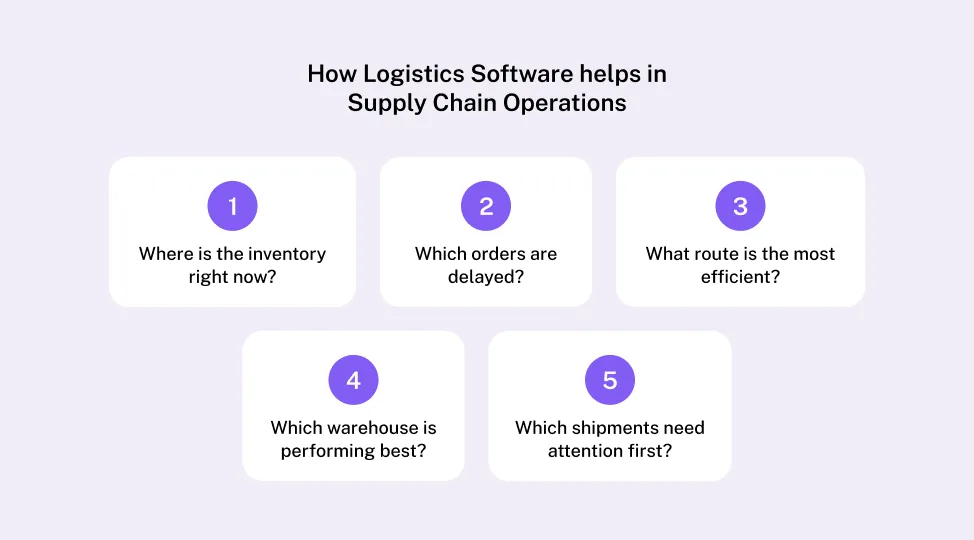
In simple terms, it helps companies answer important questions fast:
-
Where is the inventory right now?
-
Which orders are delayed?
-
What route is the most efficient?
-
Which warehouse is performing best?
-
Which shipments need attention first?
Most logistics platforms include:
-
Transportation planning
-
Shipment tracking
-
Warehouse coordination
-
Inventory visibility
-
Carrier management
-
Route optimization
-
Reporting and analytics
This matters more now because supply chains are more connected, more complex, and more exposed to delays than before. Customer expectations are also stricter. Faster delivery, better tracking, and fewer errors are no longer a bonus. They are expected.
Before looking at the gains, it helps to see where inefficiency usually starts.
Why Supply Chain Efficiency Has Become a Business Priority
Supply chain efficiency is not only about moving boxes faster. It affects cost, cash flow, planning accuracy, and customer trust. When logistics is slow, the entire business feels it.
A weak process often leads to:
For startups, the problem is usually manual work. A small team may be handling orders, stock, dispatch, and reporting in separate tools. That works for a while, then breaks as volume grows.
For SMEs, the common issue is fragmented visibility. Inventory may sit in multiple locations, but the team cannot see movement clearly in real time.
For enterprises, the bigger challenge is scale. More suppliers, more carriers, more facilities, and more regions create more room for delays and data gaps.
This is why supply chain efficiency improvement has become a business priority. McKinsey has noted that supply chain disruptions can cost the average organization the equivalent of 45% of one year’s profits over a decade, which shows how expensive weak systems can become. (Source: McKinsey & Company)
That pressure is pushing companies to invest in software that can reduce friction across the full logistics cycle.

How Logistics Software for Supply Chain Efficiency Improvement Works
The biggest value of logistics software is simple. It replaces disconnected operations with connected workflows.
First, it centralizes data. Instead of getting updates from email, calls, spreadsheets, and separate dashboards, teams work from one source of truth. That alone reduces confusion.
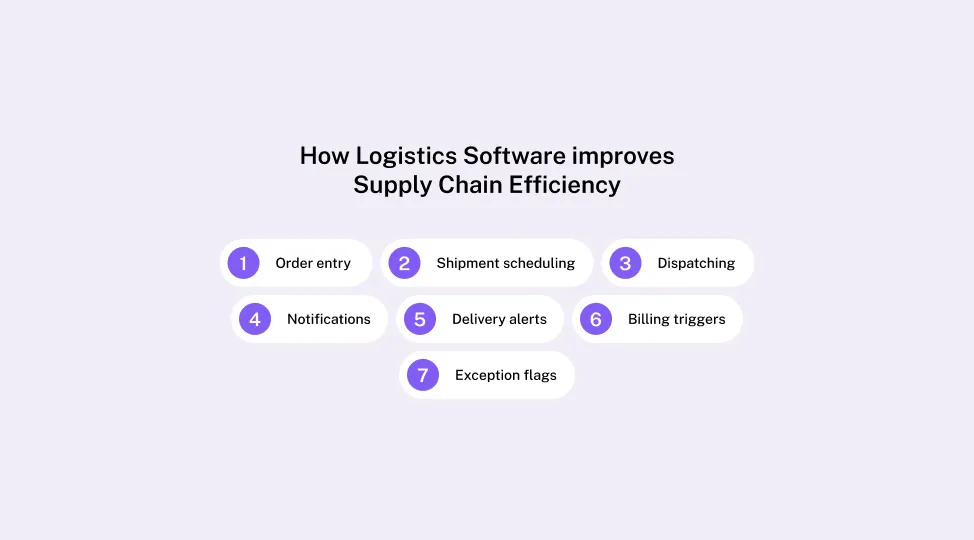
Second, it automates repetitive work. Good logistics automation software can automate:
-
Order entry
-
Shipment scheduling
-
Dispatching
-
Notifications
-
Delivery alerts
-
Billing triggers
-
Exception flags
That saves time, but more importantly, it reduces mistakes.
Third, it improves real-time visibility. Managers can see stock positions, route progress, missed milestones, and warehouse activity as it happens. Gartner describes real-time transportation visibility platforms as tools that provide real-time location and status insights into orders after they leave the warehouse. That type of visibility is now central to faster logistics decisions. (Source: Gartner)
Fourth, it helps teams respond faster. If a route changes, a vehicle is delayed, or a shipment misses a scan, the system can alert the right people right away. That means issues are handled before they become larger service failures.
In practical terms, logistics software for supply chain efficiency improvement works by making operations easier to see, easier to manage, and easier to improve.
Top Benefits of Logistics Software
The benefits of logistics software are easier to understand when tied to day-to-day operations.
Better Inventory Accuracy
When stock data updates in real time, businesses reduce stock mismatches and counting errors. That leads to fewer stockouts and less dead inventory.
Faster Order Fulfillment
Orders move faster when picking, packing, dispatch, and delivery updates follow clear workflows. Teams spend less time chasing information and more time moving orders forward.
Lower Transportation Costs
Route optimization for Last-Mile Delivery planning, load planning, and better scheduling reduce unnecessary miles and fuel waste. McKinsey has estimated that digital interventions that improve system efficiency and asset use can reduce logistics costs by as much as 25 percent in some cases.
Stronger Delivery Performance
Tracking tools, alerts, and better coordination help businesses improve on-time delivery rates and reduce missed commitments.
Better Internal Coordination
Procurement, sales, warehouse teams, and support teams all work better when they see the same order and shipment data.
Better Customer Experience
Customers care about accuracy, delivery windows, and updates. Logistics software improves all three.
Here is a quick view:
| Benefit |
Operational Impact |
Business Result |
| Real-time visibility |
Faster issue detection |
Better service reliability |
| Automation |
Less manual work |
Lower operating cost |
| Inventory accuracy |
Fewer stock errors |
Better working capital use |
| Route optimization |
Smarter delivery planning |
Lower transport spend |
| Better reporting |
Stronger decisions |
Easier scaling |
The value becomes clearer when you look at the exact parts of the supply chain that software improves.
Key Areas Where Logistics Software Improves Supply Chain Efficiency
Transportation Planning
Transportation planning becomes more accurate when dispatch teams can compare routes, assign vehicles better, and track carrier performance. This is one of the most visible ways logistics software for supply chain operations drive faster delivery.
Warehouse Operations
Warehouses benefit from clearer task flows, better picking accuracy, and stronger inventory movement control. The system helps managers track throughput, labor use, and bottlenecks.
Inventory Management
This is where supply chain optimization software plays a major role. It helps businesses understand where stock is, when it will run low, and how to replenish without overbuying.
Shipment Tracking and Exception Management
Real-time tracking makes delays easier to catch. Exception alerts help teams respond before customers complain.
Supplier And Partner Coordination
Supply chains do not run on one company alone. Carriers, vendors, and third-party logistics partners all affect outcomes. Shared visibility improves coordination across that network.
Reporting And Forecasting
Better data leads to better planning. Teams can track on-time delivery, order cycle time, cost per shipment, inventory turnover, and fill rate with far more confidence.
McKinsey has also reported that AI-driven forecasting in supply chain management can reduce forecasting errors by 20 to 50 percent and reduce lost sales and product unavailability by up to 65 percent, showing how data-driven logistics decisions can improve performance well beyond transport alone. (Source: McKinsey & Company)
Must-Have Features in Supply Chain Management Software Solutions
Not every platform offers the same value. The best supply chain management software solutions usually include the features below.
- Real-time tracking dashboards
- Route optimization tools
- Inventory and warehouse integration
- Order and delivery management
- KPI reporting and analytics
- Mobile access for drivers and field teams
- ERP and CRM integration
- Role-based access controls
Here is a practical comparison table.
| Feature |
What It Does |
Business Benefit |
Best Fit |
| Real-time tracking |
Shows shipment status live |
Faster issue response |
SMEs, Enterprises |
| Route optimization |
Suggests efficient routes |
Reduces fuel and delays |
Startups, SMEs, Enterprises |
| Inventory sync |
Updates stock across locations |
Improves stock accuracy |
SMEs, Enterprises |
| Analytics dashboard |
Tracks key logistics KPIs |
Supports smarter planning |
All business sizes |
| Mobile access |
Connects field teams on the go |
Improves execution speed |
Startups, SMEs |
| Integration tools |
Connects ERP, CRM, WMS |
Reduces data silos |
Enterprises, SMEs |
A system with too many features but weak usability can still fail. That is why feature depth should always be balanced with fit.
Logistics Software Use Cases by Business Size
The same software category delivers different value depending on the business stage.
Startups
Startups usually need simplicity first. They benefit from:
For a startup, logistics software for supply chain operations is often the step that stops spreadsheets from taking over.
SMEs
SMEs need better control as volume grows. They often use software for:
-
Inventory visibility across locations
-
More accurate fulfillment
-
Better cost tracking
-
Improved delivery performance
-
Cleaner reporting
Enterprises
Enterprises use logistics software at a wider scale. Their needs often include:
-
Multi-region coordination
-
ERP integration
-
Carrier performance management
-
Deep analytics
-
Governance across multiple facilities
So yes, the same core platform idea works across all three groups. The real difference is complexity, integration needs, and reporting depth.
Logistics Automation Software Vs Manual Supply Chain Processes
Manual supply chain management looks cheaper at first. In reality, it often becomes more expensive as order volume rises.
| Area |
Manual Process |
Software-Driven Process |
Efficiency Impact |
| Order updates |
Entered by hand |
Automated workflow updates |
Faster processing |
| Shipment visibility |
Phone calls and emails |
Live dashboards |
Better control |
| Inventory tracking |
Spreadsheet-based |
Real-time synced records |
Fewer stock errors |
| Exception handling |
Reactive |
Alert-based |
Faster recovery |
| Reporting |
Delayed and incomplete |
Continuous KPI reporting |
Better decisions |
Manual processes usually create delayed updates, human errors, and poor scaling. Logistics automation software improves consistency and gives teams time to focus on problem-solving instead of chasing routine admin work.
Once companies compare both models side by side, the argument for digital adoption gets easier to make.
Role Of Supply Chain Optimization Software In Smarter Decision-Making
Software does more than execute tasks. It also improves decisions.
Good supply chain optimization software supports demand planning by using historical and live data together. It helps managers allocate vehicles, warehouse space, labor, and delivery windows more effectively.
It also improves disruption response. If weather, traffic, stock shortages, or carrier issues affect movement, managers can react with better information.
This leads to stronger KPI-based management. Teams can track:
-
On-time delivery rate
-
Order cycle time
-
Cost per shipment
-
Fill rate
-
Inventory turnover
That is one reason the market keeps growing. The rise in software spending reflects a wider push toward visibility, analytics, and operational control. Grand View Research links market growth to the demand for better process visibility and shipment transparency. (Source: Grand View Research)
Digital Transformation in Logistics and Why It Matters
Digital transformation in logistics is not only about replacing old tools. It is about changing how logistics decisions are made.
Traditional systems often create blind spots. Data sits in different tools. Updates arrive late. Teams react after the damage is already done.
Modern logistics platforms change that with cloud access, API integrations, mobile tools, analytics, and automation. McKinsey’s 2024 digital logistics survey found high digital adoption rates, strong investment plans, and rising interest in next-generation technologies among shippers and logistics providers. Gartner’s 2025 logistics survey also reported that 86 percent of supply chain leaders use at least one mainstream logistics technology, while only 14 percent still rely on technology-assisted manual processes. (Source: McKinsey & Company)
That is a strong signal. Businesses are not digitizing logistics because it sounds modern. They are doing it because manual systems cannot keep up with scale, speed, and customer expectations.
How To Choose the Right Logistics Software for Supply Chain Operations
Choosing the right platform starts with clarity. Before comparing vendors, define the real problem.
Ask questions like:
-
Are delivery delays the biggest issue?
-
Is inventory visibility weak?
-
Are warehouse errors rising?
-
Is reporting too slow?
-
Are teams using too many disconnected tools?
Then review these areas:
Integration Readiness
The system should connect with ERP, CRM, ecommerce, carrier, and warehouse tools where needed.
Scalability
Startups may need flexibility. Enterprises may need multi-site complexity. The software should match both current and future needs.
Usability
If dispatchers, warehouse staff, and managers find the system hard to use, adoption will suffer. This is where strong UI UX design services often make a real difference during platform design or customization.
Reporting Depth
Dashboards should support both daily action and executive review.
Reliability And Testing
Performance matters. So does stability. Strong Manual QA testing helps reduce launch issues, workflow errors, and reporting bugs before they affect operations.
For companies building tailored systems, partnering with a capable Logistics Software Development Company can make more sense than forcing a generic tool into a unique workflow.
Internal Systems and Service Support Needed for Success
Logistics software succeeds when the ecosystem around it is solid.
Driver apps, warehouse apps, and supervisor tools often need careful mobile app development company so teams in the field can work without friction.
Admin dashboards, partner portals, and reporting interfaces may also depend on strong Web app developmentto keep data accessible and workflows clear.
This is why software success depends on more than feature lists. Performance, usability, testing, and process fit all shape whether the system actually improves supply chain efficiency.
Common Implementation Mistakes to Avoid
Even strong software can underperform if rollout is weak.
Common mistakes include:
-
Choosing software without mapping real workflows
-
Ignoring training and change management
-
Migrating bad data into the new system
-
Focusing on features instead of outcomes
-
Failing to define KPIs before launch
The fix is simple in theory. Start with process clarity, set measurable goals, and roll out in phases where possible.
Future Trends in Logistics Software and Supply Chain Efficiency Improvement
The next phase of supply chain efficiency improvement will likely come from better prediction, not just better tracking.
Important trends include:
-
Predictive analytics for demand and delays
-
AI-assisted planning
-
Better partner network visibility
-
More automation in exception handling
-
More cloud and mobile-first logistics systems
Gartner’s 2025 supply chain technology trends also point to AI and connected workforce tools as growing themes, which lines up with the direction many logistics platforms are already taking. (Source: Gartner)
Still, the goal should stay practical. Better software should reduce friction, improve decisions, and help teams act faster.
Final Words
Logistics software for supply chain operations is no longer just a support tool. It has become a direct lever for cost control, speed, visibility, and service quality. For startups, it reduces manual work before it turns into chaos. For SMEs, it improves control as operations expand. For enterprises, it helps coordinate large and complex logistics networks with greater accuracy.
The biggest win is not just automation. It is better decision-making across transportation, inventory, warehousing, and delivery. Businesses that want stronger supply chain performance now need systems that can keep operations connected, measurable, and ready to scale.
If your business is planning to modernize logistics workflows, improve visibility, or build custom supply chain platforms, working with the right engineering partner matters a lot. Quokka Labs, an AI Native Engineering Company, helps businesses design and build scalable digital products that support smarter logistics operations, better system integration, and long-term growth.
Frequently Asked Questions
How does logistics software improve supply chain efficiency?
It improves supply chain efficiency by centralizing data, automating repetitive tasks, improving inventory and shipment visibility, and helping teams respond faster to delays or disruptions. In short, logistics software for supply chain operations reduces manual work and supports better decisions.
What are the main benefits of logistics software?
The main benefits of logistics software include real-time visibility, lower operating costs, stronger inventory control, faster fulfillment, better route planning, and improved customer updates. These gains support both daily execution and long-term planning.
Is logistics software useful for small businesses?
Yes. Startups and SMEs can use logistics software to replace spreadsheets, reduce manual tracking, improve order handling, and gain better inventory visibility without needing a very large operations team.
What is the difference between logistics software and supply chain management software?
Logistics software mainly focuses on transportation, warehousing, tracking, and delivery. Broader supply chain management software may also cover sourcing, planning, supplier coordination, forecasting, and higher-level network decisions.
How do I choose the right logistics software for supply chain operations?
Start by identifying your biggest bottlenecks, such as delivery delays, poor visibility, weak reporting, or warehouse issues. Then compare systems based on integration, scalability, usability, analytics, and long-term support.
Tags
Delivery software
logistic software
custom software
software development


 Facebook
 Twitter
 LinkedIn
 Pinterest