Most teams start generative AI pilots the same way: a motivated squad, a promising proof of concept, and a demo that impresses in a meeting.
Then they try to scale. That’s when the real work shows up.
Two things quickly become obvious:
- Data work quietly consumes 60–80% of the effort in a typical AI build.
- Inference usage becomes the biggest driver of ongoing cost once adoption takes off.
These aren’t edge cases; they’re the norm. The good news: you can design for them up front.
This guide walks through how a generative AI tech stack fits together, how it differs from a traditional AI stack, and how to choose tools that scale without nasty surprises on reliability or cost.
Understanding the Generative AI Tech Stack
A tech stack is the combination of tools, services, and practices you use to build and run software.
In generative AI, the stack spans how you:
- Store and prepare data
- Access and run models
- Orchestrate prompts, tools, and retrieval
- Evaluate outputs for quality and safety
- Deploy and operate systems at scale
- Govern risk, access, and compliance
Layers you should plan for
- Infrastructure: GPUs, TPUs, CPUs, networking, autoscaling, storage, and container runtimes
- Data: lakes, warehouses, document stores, vector databases, embeddings, and data quality pipelines
- Models: hosted foundation models, open-source models, fine-tuning, and embedding models
- Frameworks and orchestration: prompt chains, retrieval, agents, tool use, evaluation harnesses
- Deployment: inference servers, gateways, caching, batch and streaming jobs, CI/CD
- Operations: monitoring, observability, feedback capture, versioning of data and models
- Security and governance: access control, PII handling, compliance, model risk reviews
Generative AI is not just “prediction at scale”. It is generation with real-time context. That changes the stack in three important ways:
- Context matters every call. Retrieval and prompt construction are first-class.
- Inference dominates cost and latency. Token counts and caching become daily levers.
- Evaluation extends beyond accuracy. You measure helpfulness, safety, and traceability—not just precision or recall.
How It Differs From a Traditional AI Stack
| Aspect |
Traditional AI (Prediction) |
Generative AI (Creation) |
| Primary goal |
Predict a label or value |
Produce text, images, audio, or code |
| Serving pattern |
Fixed features to model |
Prompt + retrieved context + tools |
| Key bottleneck |
Feature engineering, data drift |
Token budgets, retrieval quality, latency |
| Monitoring |
Accuracy over time |
Quality, safety, hallucination rate, user feedback |
| Storage focus |
Feature store |
Vector store + document source of truth |
Once you understand the layers and differences, the next question is:
What happens if you pick the wrong tools—or the right ones?
Why Choosing the Right Generative AI Tech Stack Is Critical for Scalability
The tools you select today will shape your cost profile, release velocity, and operational risk for years.
Pick well, and you ship faster, run cheaper, and adapt quickly. Pick poorly, and you fight bottlenecks and rising costs with every feature.
What goes wrong when choices misalign
- Bottlenecks you cannot cache away: A model with high token latency slows every flow.
- Hidden coupling: Hardwired prompts, brittle retrieval, and one-off adapters make change risky.
- Write-only observability: Logs exist, but metrics don’t drive decisions.
- Cost creep: Traffic grows and spend rises without clear unit economics.
Scalability challenges unique to generative AI
- Large model footprints and cold starts
- Token-heavy prompts that waste context
- Variable latency from tools and network hops
- Fast-growing indexes that need pruning
- Quality degradation at long-tail scale
Business impact to keep in view
- Time-to-market: Experiment-friendly stacks ship faster.
- Innovation speed: Pluggable models and modular retrieval keep options open.
- Operational cost: Smart caching and indexing can drastically reduce spend.
If cost planning is top of mind, keep a line of sight to your unit economics and your overall generative AI development cost.
Core Components of a Generative AI Tech Stack
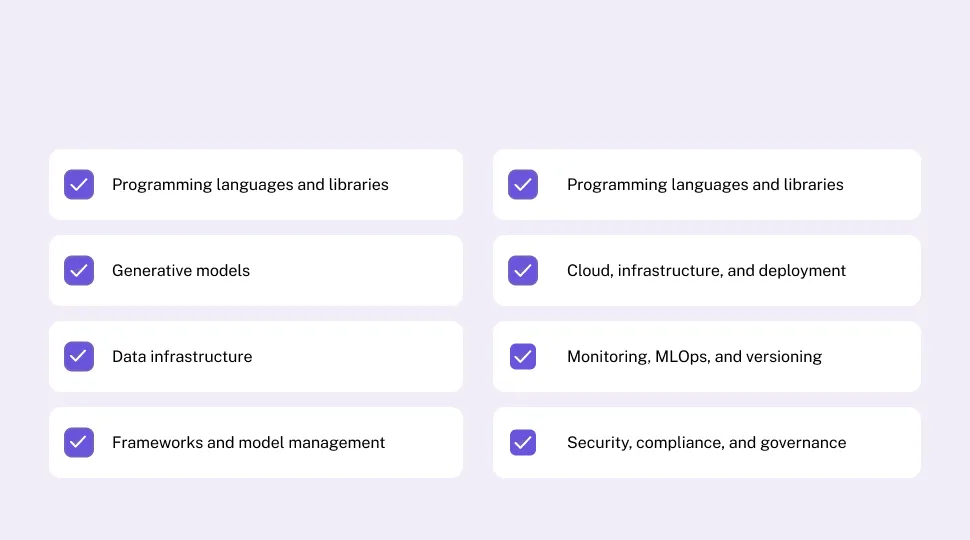
Programming languages and libraries
Most production teams use Python for orchestration and training due to its ecosystem and talent pool. TypeScript is common for front ends and edge services.
Workhorse libraries:
- Training & inference: PyTorch, TensorFlow, JAX
- Tokenization & utilities: transformers, sentencepiece
- Retrieval: FAISS, HNSWlib, managed vector store SDKs
- Data processing: pandas, Polars, Apache Spark, DuckDB
- Serving: vLLM, TGI, TensorRT-LLM, FastAPI, gRPC
Generative models
You will choose between hosted APIs, self-hosted open models, or a hybrid.
- Hosted models: fastest to market
- Open models: control and predictable cost at scale
- Hybrid: route by use case, sensitivity, or latency
Model families include LLMs for text and code, diffusion models for images, GANs for specialized media, and audio models for speech. Always test with real prompts, not synthetic ones.
Data infrastructure
Generative AI quality rides on data. You need three data paths working together:
- Source-of-truth storage: lakes or warehouses for raw data
- Indexing: vector stores with chunking, embeddings, and filters
- Governed outputs: generations, feedback, and evaluation labels
Frameworks and model management
This is where generative AI frameworks and generative AI development tools live.
You need orchestration for prompts, retrieval, tools, and evaluators—plus a registry for models and prompts.
Look for:
- Clear abstractions for chains and agents
- Built-in evaluators and offline replay
- Batch + streaming support
- Versioned prompts tied to model configs
If you lack in-house depth, partnering with a proven Generative AI development company can significantly reduce time-to-production.
Cloud, infrastructure, and deployment
- GPU pools for large models; CPUs for light transforms
- Autoscaling by tokens/sec and queue depth
- Gateway caching for repeated prompts
- Batch pipelines for enrichment
- CI/CD for safe prompt and model rollouts
APIs and integrations
- SDKs for front ends and partners
- Streaming webhooks for tokens
- Connectors to CRMs, file stores, and ticketing tools
- Standard schemas for inputs, outputs, and citations
Monitoring, MLOps, and versioning
- Telemetry: latency, throughput, cache hit rate, token usage
- Quality: automated evals, human feedback, safety checks
- Versioning: data snapshots, index hashes, prompt IDs
- Playbooks: incident response and rollbacks
Security, compliance, and governance
- Role-based access control
- PII detection and redaction
- Safety policies and blocked outputs
- Audit trails for changes
- Model risk reviews with documented mitigations
Criteria for Selecting the Right Tools and Platforms
Use a simple framework: align to your use case, match team skills, integrate cleanly, and keep future options open.
Selection checklist:
- Use-case fit
- Team skills
- Ecosystem maturity
- Integration with existing stack
- Measured performance and cost
- Flexibility and portability
- Built-in governance
When compliance pressure or audit needs are high, engaging specialists offering generative AI consultancy services can help you move fast without cutting corners.
Building for Scalability: Patterns and Best Practices
- Modular services for retrieval, orchestration, and serving
- Autoscale by tokens per second
- Hybrid search with re-ranking
- Pre-compute embeddings and summaries
- Multi-layer caching with TTLs
- Guardrails baked into code
Common Pitfalls and How to Avoid Them
- Over-engineering: Prove value with one slice before platformizing
- Heavy models everywhere: Route by task complexity
- Ignoring ops: Set SLOs before launch
- Poor data hygiene: Normalize, dedupe, and tag content
- Vendor lock-in: Abstract providers and own prompts
- No cost visibility: Track cost per feature and call
💡 Recommended reading
Learn how teams operationalize generative AI at scale in this
Generative AI implementation strategy guide.
Real-World Style Use Case: Knowledge Assistant for Support Teams
A production-ready internal assistant that answers “how do I” questions with citations, sub-2s latency, and predictable cost—powered by hybrid retrieval, streaming LLMs, and continuous evaluation.
When executed well, teams see faster responses, fewer escalations, and clear audit trails for every answer.
Final Word
A scalable generative AI tech stack is simple in principle and demanding in practice.
Treat retrieval, prompts, and evaluation as first-class citizens. Keep models pluggable and costs observable. Measure real user value—not just offline scores. Choose generative AI frameworks and generative AI development tools that align with your team, data, and regulatory environment—not hype.
If you need delivery muscle to move from plan to production, a seasoned AI Development company like Quokka Labs can help you design, build, and operate a platform that scales with your business.
 ")
")
Frequently Asked Questions (FAQs)
1. What is a generative AI tech stack?
A generative AI tech stack is the complete set of technologies used to build, deploy, and operate generative AI applications at scale. It typically includes data infrastructure, foundation models, generative AI frameworks, orchestration layers, deployment infrastructure, monitoring tools, and security controls. A well-designed stack ensures reliability, cost efficiency, scalability, and governance across production workloads.
2. How is a generative AI tech stack different from a traditional AI stack?
Unlike traditional AI stacks focused on prediction and classification, a generative AI tech stack is designed for real-time content generation. It emphasizes prompt orchestration, retrieval-augmented generation (RAG), token management, latency control, and continuous evaluation of output quality, safety, and traceability. Inference cost and context handling are significantly more critical in generative AI systems.
3. What are generative AI frameworks, and why are they important?
Generative AI frameworks provide abstraction layers to manage prompts, retrieval, tools, agents, and evaluations. They help teams standardize workflows, version prompts and models, run experiments, and monitor performance. Mature frameworks reduce engineering overhead, improve reproducibility, and accelerate the transition from prototype to production.
4. How do you choose the right generative AI frameworks for production?
The right generative AI frameworks should align with your use case, team expertise, and compliance requirements. Key factors include support for retrieval and agents, built-in evaluation tooling, batch and streaming capabilities, model portability, and integration with your existing data and infrastructure stack. Always evaluate frameworks using real production workloads.
5. What are generative AI development tools?
Generative AI development tools support the full AI lifecycle, including data preparation, model training or fine-tuning, orchestration, deployment, monitoring, and governance. Examples include vector databases, embedding pipelines, inference servers, observability platforms, and safety or compliance tools. Together, they enable scalable and maintainable AI systems.
6. Which components are essential in a scalable generative AI tech stack?
A scalable generative AI tech stack typically includes reliable data ingestion and vector indexing, flexible model hosting (hosted, open-source, or hybrid), prompt and retrieval orchestration, cost-aware inference infrastructure, monitoring for latency, quality, and safety, and strong security, access control, and auditability. Each component should evolve independently to prevent bottlenecks as usage grows.
7. How do generative AI development tools help control cost and latency?
Generative AI development tools help manage cost and latency through prompt compression, caching, batch inference, reranking, and autoscaling based on token usage. Monitoring tools provide visibility into cost per request and per feature, enabling informed trade-offs between quality, speed, and spend.
8. What are the biggest mistakes teams make when designing a generative AI tech stack?
Common mistakes include over-engineering too early, using large models for simple tasks, ignoring observability, indexing data without governance, and locking into a single vendor or framework. These issues often result in rising costs, unreliable outputs, and slower iteration as systems scale.
9. How do you evaluate output quality in generative AI systems?
Output quality evaluation goes beyond accuracy. Teams assess relevance, helpfulness, factual consistency, safety, and citation traceability. Strong stacks combine automated evaluations, human feedback loops, and replay of real user interactions to continuously improve quality at scale.
10. When should companies involve experts or consultants for generative AI implementation?
Companies should consider expert support when moving from pilot to production, operating in regulated environments, or scaling across multiple use cases. Experienced practitioners can audit the existing generative AI tech stack, recommend proven generative AI frameworks, and implement development tools that balance speed, safety, and cost.
Tags
model management
Tech Stacks
Generative ai
AI development
frameworks


 Facebook
 Twitter
 LinkedIn
 Pinterest