Backend development is a vast field and has plenty of tools you can use to finish tasks. As a mobile and web app development company, we use many tools to complete client projects.
And the backend developers and programmers at Quokka Labs can vouch for it; looking for the right tool for their needs can be a headache. And so, the best tool for you is the one you are most familiar with!
The first and foremost step is determining what kind of data you'll need to handle. Web developers often take requests, including user submissions, API responses, and more.
That's why it's essential to choose a backend development solution to handle the requests they receive and the amount of data requested.
Quick Glimpse Of Popular Best Backend Development Tools
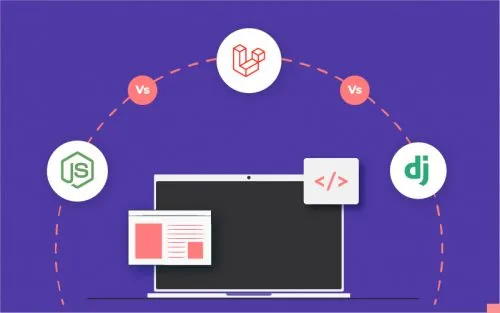
As you may know, Nodejs, Laravel, and Django are all modern frameworks for web development, especially backend development. The one you choose can significantly impact your project, so it's essential to understand the pros and cons of each to make the right decision.
But let's try to look at the core strengths and flaws of these best back end development tools so that you can decide which one is the most suitable option for your next project:-
Node.js
Nodejs is a JavaScript framework used for backend development, released in 2009. It's a platform for building websites, web apps, and other digital services. One of the reasons Nodejs was made is to handle single-threaded and real-time applications easily.
Advantages of Node.js
Node.js is a platform built on Chrome's JavaScript runtime for quickly building fast, scalable network applications for Nodejs development. It uses an event-driven, non-blocking I/O model that makes it lightweight and efficient, perfect for data-intensive real-time applications that run across distributed devices.
There are several benefits to using this platform for top-notch Nodejs development for your upcoming projects. First, it's a cross-platform, open-source platform for building fast and scalable network apps. It's perfect for creating real-time apps and highly scalable server-side web apps. This JavaScript runtime environment is also straightforward to set up and learn.
Plus, it's backed by a robust community of developers constantly building and sharing packages and modules to expand functionality and improve the user experience.
Disadvantages Of Node.js
Nodejs development company uses this excellent tool for handling simple computing tasks. Still, its shortcomings can be troublesome when using it to develop something more advanced. While Node.js' API can be unstable and asynchronous programming models seem convenient at times, they also make your code incomprehensible for other developers and endanger the maintenance of modules, primarily if libraries don't support them.
Django
Django was designed in 2003 and 2013 to fully support the Django development company. It was made open-source. It's known as a Python framework for larger-scale projects.
Advantages of Django
Django is a free and open-source web framework written in Python. It follows the model-view-template architectural pattern. Django is also straightforward to use and can handle high-traffic sites efficiently.
It uses the concept called 'pluggable apps' that make adding features to the framework easy. It also has an active community that develops new features, making it easier for developers to use. Django is used by many companies today and is one of the top options for developers.
In a nutshell, the Django development company is rapidly growing in popularity
because:-
- Full-stack framework and great for beginners.
- Excellent development experience.
- Effective Model View Template (MVT)
- Rapid development
- Powerful admin site
- Tons of third-party apps
Disadvantages Of Django
Regarding Django web development company's daily processes, it's a relatively beginner-friendly tool, making it an ideal option for first-time web developers.
However, the learning curve is steep, especially for developers new to Python. If you can work to learn Django development, there's a good chance you'll be pleased with it.
Laravel
The Laravel framework is similar to Django in many ways and is a PHP framework released in 2011. There's a reason why so many people use Laravel, and that's because it's so easy to use. It's free and open-source, and the community supports it.
Advantages of Laravel
The primary advantage of Laravel and Laravel development company is its compatibility with the popular Model View Controller (MVC) design pattern implemented as a web application framework using the Apache PHP web server, Nginx, or both collectively. Another advantage is its file structure. Laravel has a simple design that makes it easy to follow and understand.
- Laravel's main advantage is the Eloquent ORM. It makes it easy to write database queries cleanly and securely, preventing any SQL injection attacks and keeping things simple at the same time.
- Every laravel development company uses a simple file structure. Its directory structure is clear and straightforward, making it easy to navigate
- Laravel is a free, open-source PHP web framework for creating all types of applications using the MVC (Model-View-Controller) architecture.
- You can also use various tools like migrations, models, events, etc.
- When you use the Laravel framework, you can write simple PHP code without worrying about your code contradicting the framework's structure.
- You can also keep track of the changes you have made to your code with the help of a changelog.
- You can move to a new application with the help of the migrations feature. This feature also allows you to create tables without worrying about the table's existence.
Disadvantages Of Laravel
There are many benefits to using a framework like Laravel and PHP. However, there are a few caveats to using it as well. Laravel uses composer for its dependencies, which can confuse people who are new to it.
While it is easy once you understand it, but comes with a steep to moderate learning curve based on your willingness to get equipped with the platform. It would be best to learn how to use composer and run commands.
The Bottom Line
We hope you enjoyed our article about which backend development technology to choose for your next project. As you can see, many options exist for your backend development technology stack. It is hard to know what to use. But, go for the one which meets your project requirements the best!
If you plan to digitize your business by building impactful and scalable technology solutions, employ the latest backend architecture by hiring the most suited web development company. And to avail of the overall best services for your websites and mobile applications, contact us. To start your digital journey, Quokka Lab is the best mobile and web app development company.
Tags
Back end development tools
back end development


 Facebook
 Twitter
 LinkedIn
 Pinterest