Key takeaways:
- Readiness is operational, not strategic. You are not ready because your organization uses ChatGPT or has an AI roadmap. You are ready when your systems can safely support software that takes actions, not just generates text.
- The scorecard measures seven signals from 0–2 each. These cover workflow clarity, tool and API access, identity and permissions, data and context, evaluation, observability and recovery, and governance.
- A high score does not mean full autonomy. It means your environment is better prepared to control an agent. Human oversight should still match the risk of each action.
- A zero on a safety-critical signal is a hard stop. Identity, observability, or governance at 0 caps readiness regardless of your total score.
- Most agent risk comes from what the system can do, not what it says. Tool permissions, write validation, transaction limits, and approval gates matter as much as prompts.
- Agent evaluation must test actions and paths. Multi-turn systems that call tools and modify state need evaluation sets that test behavior, not only final responses.
- Governance is an authority map. Define what the agent may do, which actions require approval, who owns the system, and where autonomy must stop.
Turn your readiness score into an implementation plan.
Quokka Labs can help you prioritize high-value use cases, harden the agent foundation, and design a safe path from pilot to production.
AI agents can do more than answer questions. They can update systems, trigger workflows, make decisions, and act without constant human input. But if your data, APIs, permissions, or processes are not ready, even a promising AI agent can quickly become unreliable, risky, and expensive.
So, how do you know if your business is ready for AI agents? This agentic AI readiness assessment uses seven clear signals to help you identify gaps before starting an agentic AI implementation.
How To Know If You Are Ready for AI Agents?
The short answer: you are ready when an AI agent can understand a bounded goal, access the right data and tools, act with least-privilege permissions, be tested before release, be monitored after release, and hand risky decisions back to a human.
You are not ready simply because your company already uses ChatGPT, has an AI strategy, or has completed a proof of concept.
Agentic AI readiness is operational.
Your systems need to support software that can take a sequence of actions—not just generate text.
Organizations still deciding which AI opportunities are worth pursuing can begin with generative AI consulting before introducing autonomy where it may not yet be necessary.
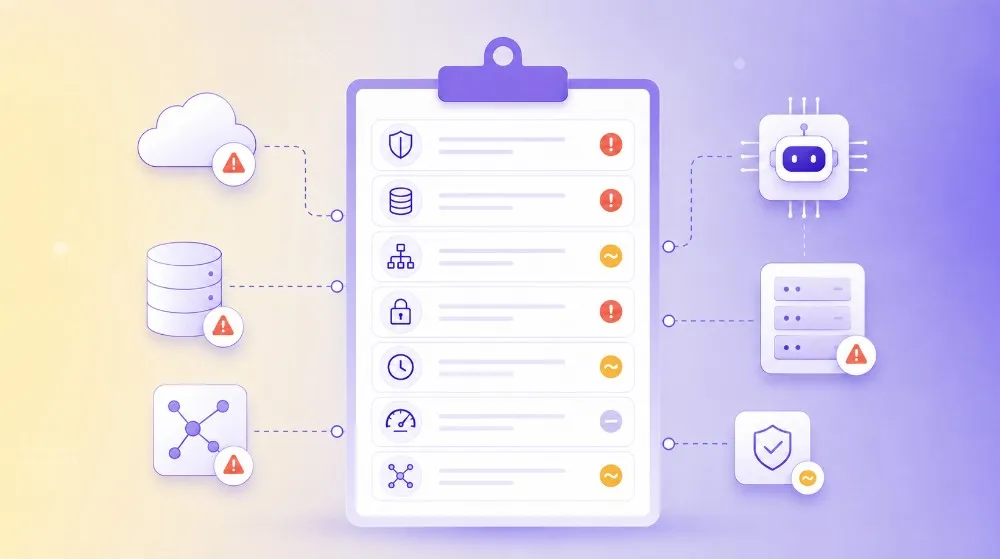
The Agentic Readiness Scorecard: 7 Signals to Check
Use this scorecard as a fast agentic AI readiness assessment.
Give each signal a score from 0 to 2.
| Signal |
0 points |
1 point |
2 points |
| 1. Workflow clarity |
Process is informal or constantly changing |
Main steps known, but exceptions unclear |
Steps, outcomes, exceptions, and owners are documented |
| 2. Tool and API access |
Work depends on manual screens or fragile access |
Some APIs exist, but coverage is incomplete |
Required systems have stable, controlled interfaces |
| 3. Identity and permissions |
Shared accounts or broad credentials are common |
Some role controls exist |
Agent-specific identity and least-privilege access are possible |
| 4. Data and context |
Data is scattered, stale, or untrusted |
Useful data exists but needs cleanup |
Trusted sources, access rules, and ownership are clear |
| 5. Evaluation |
Success is judged by demos or opinions |
Basic tests exist |
Repeatable evals cover quality, actions, and failure cases |
| 6. Observability and recovery |
You cannot reconstruct what happened |
Partial logs exist |
Actions, tool calls, errors, cost, and rollback paths are visible |
| 7. Governance and human control |
No clear owner or approval rules |
Policies exist but are not operational |
Owners, approvals, escalation, and risk limits are enforced |
Maximum score: 14.
This is a practical decision tool, not an industry certification. Its purpose is to expose the gaps that make enterprise agents unreliable, unsafe, or expensive.
A zero on signals 3, 6, or 7 is a hard gate. Identity, observability, and governance are safety-critical: a 0 on anyone caps you at "narrow experiment" no matter how high your total, because a well-built agent with no accountability, no audit trail, or no off switch is more dangerous than a weak one.
Sign 1: Your Workflow Is Not Clear Enough to Delegate
The first readiness problem is often not AI. It is the workflow.
An agent needs a goal it can act on. If employees complete the same process in five different ways, business rules live in people's heads, and exceptions are solved through private messages, the agent has no stable operating map.
What This Looks Like in a Real Business
A sales team may say, "Let the agent qualify leads." But qualification may depend on deal size, account history, product fit, capacity, and manager-approved exceptions. If those rules are invisible, the agent has to guess.
Readiness Test
For one candidate workflow, can you write down:
- The trigger that starts the work
- The expected final outcome
- The systems used at each step
- The decisions the agent is allowed to make
- The exceptions that require human help
- The person accountable for the result
If you cannot do this, do not start with model selection. Start with process discovery.
A strong agentic AI implementation begins with a workflow that can be observed, measured, and bounded.
Sign 2: Your Tools Are Not Safe or Stable Enough for an Agent to Use
Enterprise AI agents create value by doing work across software: reading a CRM, updating an ERP, creating a ticket, checking inventory, sending a message, or calling an internal service.
That means your AI agent infrastructure is only as dependable as the interfaces behind those actions.
Warning Signs
You may not be ready if the target workflow depends on:
- Manual copy-and-paste between systems
- Unofficial scripts with no owner
- APIs that change without version control
- Missing rate limits or timeout handling
- Production tools with no sandbox or test environment
- Actions that cannot be reversed
An agent that uses a tool repeatedly can turn a small integration weakness into a large operational problem.
Readiness Test
For the three most important actions the proposed agent will perform, ask:
- Is there a controlled interface?
- What happens if it fails halfway through?
- Can we retry without creating duplicates?
- Can we validate the change before committing it?
- Can we reverse it afterward?
If the answer is no, strengthen the integration before adding autonomy.
Quokka Labs' agentic AI development services cover agent orchestration, enterprise integrations, tool access, approval workflows, evaluations, and production controls for teams moving beyond prototypes.
You can also review how to build an agentic AI system to understand the broader architecture behind production agents.
Sign 3: Your Access Model Was Designed for People, Not Autonomous Agents
A human user usually signs in, sees an interface, and acts under a known identity. An AI agent may call several systems in seconds, act for different users, or continue a workflow after the original request.
That makes identity a core part of enterprise AI agent readiness.
The Risky Pattern
The fastest prototype often uses one shared service account with broad access. It works in a demo because permissions rarely block the agent. It becomes dangerous in production because the agent can reach more data and actions than the task requires.
The key question is simple: Can you tell who or what performed every action, and was that identity allowed to perform it?
Readiness Test
Your access layer should support:
- A distinct identity for the agent or agent workload
- Least-privilege permissions per task
- Secrets stored outside prompts and application code
- Short-lived or revocable credentials where possible
- Clear delegation when the agent acts for a user
- Access reviews and automatic removal when the agent is retired
If your only practical option is "give the agent an admin token," stop there. Your system is not ready for production autonomy.
Giving an Agent Write Access Soon?
Before connecting an agent to production CRM, ERP, healthcare, or operational systems, validate the permission model and failure boundaries.
Sign 4: Your Data is Available, but the Agent Cannot Trust It
Many teams pass a data-readiness check because they have a warehouse, documents, dashboards, or a vector database. That is not enough.
Agents need decision-ready context: information that is current, relevant, permitted, and traceable to a source.
What Breaks in Production
Imagine a support agent that can issue replacements but reads an outdated policy or conflicting account status. The model may be capable. The context is not.
Readiness Test
For every important data source, verify:
- Who owns it
- How current it is
- Which version is authoritative
- Who may access it
- Whether sensitive fields need masking
- How the agent should handle conflicting sources
- Whether the source can be cited or traced during an audit
This is why an AI readiness assessment should examine data governance and retrieval behavior, not just data volume. Where readiness surfaces scattered or untrusted data, the fix is upstream: see how data modernization builds the trusted foundation agents depend on.
If you want to understand the engineering layers that come after readiness, see Quokka Labs' guide on how to build an agentic AI system.
Sign 5: You Cannot Test Agent Behavior Before It Reaches Users
Traditional software testing asks whether a function produces the expected result.
Agents are harder to validate because they can:
- Take different paths toward the same goal
- Call tools in different orders
- Interpret ambiguous context differently
- Encounter dynamic external systems
- Modify state
- Make decisions across multiple turns
That makes evaluation one of the most important components of an agentic AI readiness assessment.
"It Worked in the Demo" is Not a Test Plan
Before launch, you need repeatable scenarios that measure both the final answer and the actions taken along the way.
Multi-turn agents that modify state and use tools need evaluation methods built around those behaviors, not only final text quality. This is the same evaluation discipline described in what an AI-native development team actually builds, applied specifically to agents.
Your Minimum Evaluation Set Should Include
- Normal tasks the agent should complete
- Edge cases and incomplete inputs
- Tool failures and unavailable systems
- Conflicting instructions
- Permission-denied scenarios
- Prompt-injection or malicious-content attempts
- High-risk actions that should trigger escalation
- Regression tests after model, prompt, tool, or policy changes
Also define success numerically where possible: task completion rate, incorrect-action rate, escalation rate, latency, cost per completed task, or human correction rate.
If your team cannot say how an agent will be evaluated before launch, the pilot is still an experiment, not a production candidate.
Sign 6: You Cannot See What the Agent Did or Recover When It Goes Wrong
When conventional software fails, engineers inspect logs, traces, metrics, alerts, and system state.
Agentic applications need the same discipline with additional visibility into reasoning paths, tool execution, permissions, and autonomous actions.
This is where many prototypes fail an enterprise AI agent readiness checklist.
They record the final response.
They do not record what happened before it.
What You Should Be Able to Reconstruct
For an important agent run, your team should be able to answer:
- What goal was the agent given?
- What context did it use?
- Which tools did it call?
- Which records did it change?
- Which identity and permissions were used?
- What failed or retried?
- How much did the run cost?
- Was a human approval requested or bypassed?
Recovery Matters as Much as Monitoring
Observability tells you what happened.
Recovery limits the damage.
Production systems should consider:
- Retry limits
- Timeouts
- Kill switches
- Circuit breakers
- Fallback workflows
- Idempotent operations
- Rollback procedures
- Human escalation paths
If one bad tool call can silently create 5,000 duplicate records, send hundreds of incorrect messages, or overwrite production data, the problem is not simply the model.
The operating system surrounding the agent is incomplete.
When the agent itself is part of a broader SaaS product, customer portal, internal tool, mobile experience, or enterprise platform, the surrounding application must also be production-ready. Quokka Labs' AI app development services combine AI capabilities with backend, API, UX, cloud, security, and observability layers.
Sign 7: No One Has Defined Where Agent Autonomy Must Stop
The most important readiness question is not:
"How autonomous can the agent become?"
It is:
"Where should autonomy end?"
High-risk, regulated, financial, security-sensitive, or irreversible actions should have controls that match the potential impact.
Repeated failures should trigger escalation rather than unlimited retries.
You Need an Authority Map, Not a Vague AI Policy
A useful policy should define what the agent may do at different risk levels.
| Action type |
Example |
Suggested control |
| Low risk |
Summarize internal notes |
Agent can act automatically |
| Medium risk |
Update a CRM field |
Agent can act with logging and validation |
| High risk |
Issue a large refund |
Human approval before execution |
| Critical |
Move funds or change privileged access |
Restricted workflow with strong approval controls |
Readiness Test
Before launch, name:
- The business owner of the agent
- The technical owner
- The data or security owner where relevant
- Actions requiring approval
- Conditions that force escalation
- Incident-response responsibility
- The process for changing agent permissions or behavior
Without this, every unexpected action becomes a meeting about who was supposed to be in charge.
For organizations preparing controlled production agents, agentic AI development should include governance, approval paths, monitoring, and permission design as part of engineering, not as paperwork added after deployment.
How to Read Your Agentic Readiness Score
Add your seven scores. The result tells you what kind of next step is sensible.
| Score |
Readiness level |
What to do next |
| 0–5 |
Foundation not ready |
Fix workflow, data, access, and integration gaps before building an autonomous pilot |
| 6–9 |
Ready for a narrow experiment |
Use read-only tools, low-risk tasks, strong human review, and limited users |
| 10–12 |
Ready for a controlled pilot |
Allow selected actions with monitoring, evals, permissions, and approval gates |
| 13–14 |
Strong production foundation |
Scale gradually, measure outcomes, red-team changes, and expand autonomy only with evidence |
A high score does not mean "turn on full autonomy." It means your environment is better prepared to control it. A low score simply shows where preparation will reduce failure later. Remember the hard gate: a 0 on identity, observability, or governance overrides the total and keeps you at "narrow experiment" until it is fixed.
What to Fix First, and What a Good First Pilot Looks Like
If your score is below 10, do not try to fix everything at once. Remove the highest-risk blockers in this order:
- Make one workflow agent-ready. Pick a workflow with a clear start and finish, measurable value, frequent repetition, and manageable consequences if the agent makes a mistake. Avoid your most sensitive business process as the first pilot.
- Make actions safer than prompts. Most agent risk comes from what the system can do, not what it can say. Restrict tool permissions, add validation before writes, and require approval for high-impact actions.
- Create an evaluation baseline. Turn common tasks, difficult cases, failures, and policy boundaries into a reusable test set before deployment.
- Instrument every important action. Log agent runs, tool calls, errors, approvals, latency, and cost. If an outcome matters to the business, make it observable.
- Define the expansion rule. Do not expand autonomy because the demo looks impressive. Expand it when measured performance stays inside agreed thresholds across enough real tasks.
A strong first pilot is narrow enough to control but useful enough to prove value. Instead of "automate customer support," choose: "Classify incoming B2B support cases, collect missing account context, propose a resolution, and create a draft ticket update. Require human approval before credits or account changes." That pilot has a visible goal, bounded tools, clear human control, and measurable outcomes.
Your pilot checklist: one named business owner, one bounded workflow, approved data sources, limited tool permissions, a defined evaluation set, human approval for risky actions, full activity logging, a rollback or shutdown path, baseline metrics, and success thresholds for expanding scope.
If those are in place, you have something worth engineering. If several are missing, your fastest route to value is readiness work, not a more powerful model.
Have a Pilot but Not Enough Engineering Capacity?
Quokka Labs can work alongside it to build integrations, agent workflows, data layers, evaluations, applications, and production controls.
How to Assess Agentic AI Readiness Across Multiple Teams
Enterprise readiness is rarely uniform.
Do not give the entire company one score.
Assess each workflow or use case independently and then compare value, risk, and readiness.
| Use case |
Business value |
Risk |
Readiness |
Decision |
| Internal knowledge retrieval |
Medium |
Low |
High |
Start now |
| Support ticket enrichment |
High |
Low–medium |
High |
Pilot next |
| Automatic customer refunds |
High |
High |
Medium |
Add approval and controls first |
| Vendor payment execution |
High |
Critical |
Low |
Do not automate yet |
This approach helps leaders avoid two common mistakes: blocking every agent project because one area is risky, or scaling every agent project because one demo succeeded.
The Bottom Line: Readiness is About Control, Not AI Ambition
The question is not whether your company is "ready for AI" in general. The more useful question is: Can this agent complete this workflow, using these tools and this data, under controls your team can test, monitor, and stop?
That is the core of agentic AI readiness.
Use the seven signals before choosing a model or agent framework. If your workflows, tools, identity controls, data context, evaluations, observability, and governance are strong, you can move toward a controlled pilot with confidence. If they are weak, the scorecard shows you what to fix first.
Ready to Find Out Where Your AI Agent Initiative Stands?
We can help assess its readiness across workflow design and systems, turn the findings into a practical pilot-to-production roadmap.
FAQs About Agentic AI Readiness
How long does an agentic AI readiness assessment take?
The timeline depends on whether you are assessing one workflow or an enterprise-wide portfolio. A focused assessment should examine the workflow, systems, APIs, permissions, data sources, risks, success metrics, and required controls for a specific use case. Larger enterprises may need separate assessments across departments because a support workflow can be highly agent-ready while finance, healthcare, or privileged IT operations require significantly more preparation.
How do we estimate ROI before investing in an enterprise AI agent?
Start with the workflow rather than the model.
Measure the current baseline:
- Volume of work
- Human time per task
- Error or rework rate
- Delay created by handoffs
- Revenue impact
- Support or operations cost
- Cost of incorrect actions
Then estimate what portion of the process the agent can realistically complete or accelerate under appropriate controls.
How do I know if my company is ready for AI agents?
You are ready when an agent can complete a bounded workflow using approved tools and data, under controls your team can test, monitor, and stop. Run the seven-signal scorecard: readiness comes from workflow clarity, stable APIs, agent identity, trusted data, evaluation, observability, and governance, not from already using an AI chatbot.
What is an agentic AI readiness assessment?
It is a structured check of whether your systems can safely support software that takes actions, not just generates text. This assessment scores seven operational signals from 0 to 2 and maps the total to a next step: fix foundations, run a narrow experiment, run a controlled pilot, or scale.
What is the difference between AI readiness and agentic AI readiness?
General AI readiness often measures data and model access. Agentic AI readiness is stricter because agents act: they call tools, change records, and make decisions. It adds requirements for agent identity, permissions, evaluation of actions, observability, recovery, and human-control governance.
What should the first enterprise AI agent pilot be?
Choose a narrow, repeatable workflow with measurable value and manageable consequences, such as enriching support tickets or drafting updates with human approval before any account change. Avoid your most sensitive process first. Success is defined by baseline metrics and thresholds, not by how the demo looks.
Why can a company score high and still not be ready?
Because a total score can hide a critical gap. A 0 on identity, observability, or governance means the agent has no accountability, no audit trail, or no off switch, so readiness is capped regardless of the total. Safety-critical signals must be addressed before autonomy expands.