Every organization generates more data than ever before, but more data doesn't automatically create better decisions.
As businesses adopt AI, advanced analytics, and intelligent automation, they often discover that critical information is fragmented across legacy applications, on-premises infrastructure, cloud platforms, and departmental data silos.
Instead of creating value, inconsistent and disconnected data slows innovation, increases operational complexity, and limits the impact of modern technologies.
This challenge is becoming a strategic priority.
According to the 2024 ISG Application Development and Maintenance Study, 55% of organizations identify AI capabilities as a top application priority, while 49% are focused on improving data usage and access.
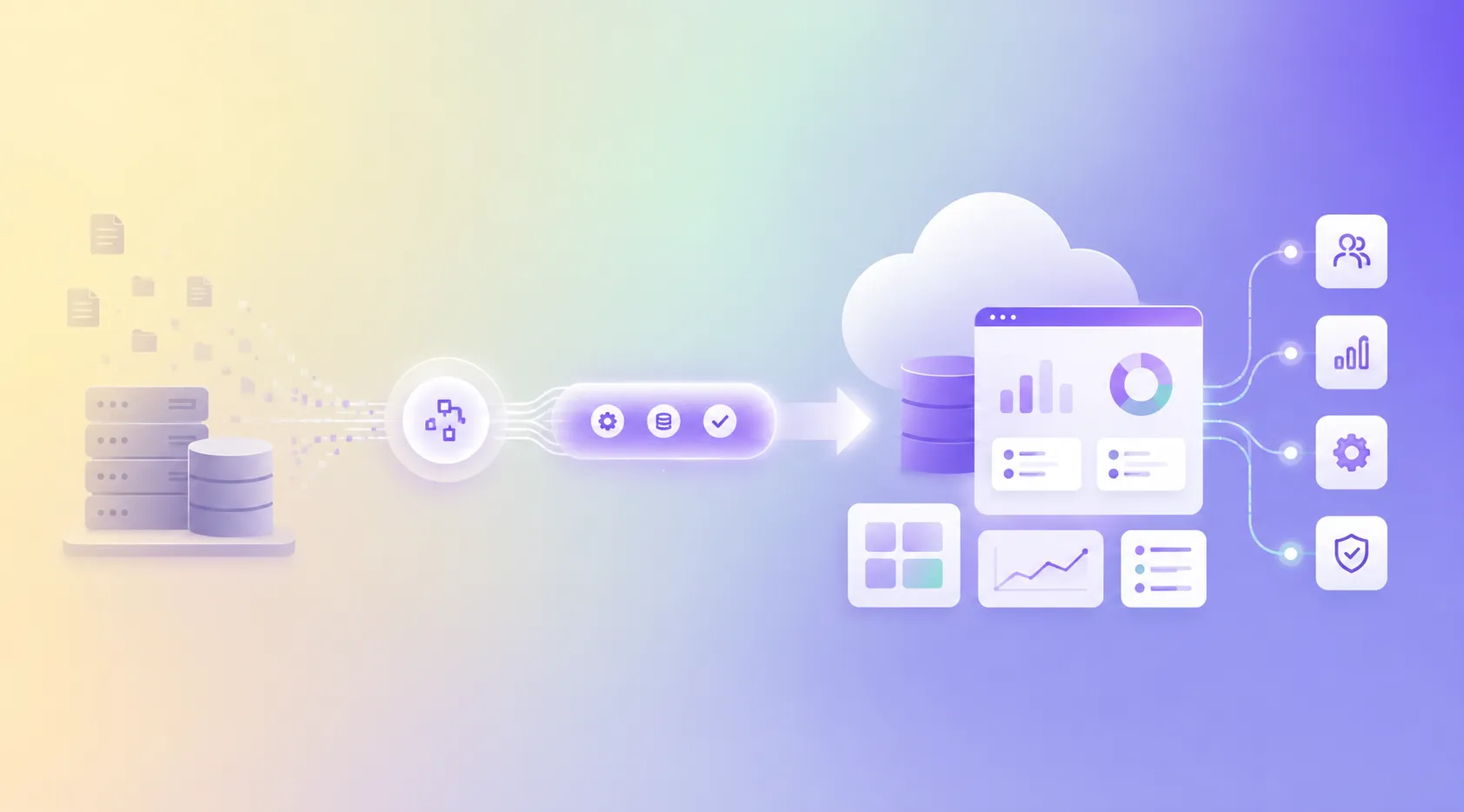
Data modernization addresses these challenges by creating a trusted, scalable, and AI-ready data foundation that supports better decisions and long-term business growth.
Modernize Your Data Platform Without Disrupting Business Operations
Quokka Labs helps modernize enterprise data platforms through secure, phased transformations that accelerate and business performance.
What Is Data Modernization?
Data modernization is the process of upgrading legacy data systems, architectures, and workflows to improve how data is integrated, managed, governed, and used across an organization. It creates a modern data foundation that supports cloud platforms, analytics, AI, and faster business decision-making.
Benefits of Data Modernization
Data modernization transforms legacy, siloed data environments into unified, cloud-enabled platforms. It improves data quality, accelerates analytics, streamlines data operations, and creates a scalable foundation for AI. This enables organizations to make faster decisions, strengthen governance and security, and deliver more personalized customer experiences.
1. Better Decisions Through Modernized Data
Every strategic decision depends on having complete, consistent, and timely information. When data is distributed across multiple applications, departments, and legacy systems, teams often spend more time consolidating information than using it to make decisions.
A modernized data environment helps organizations:
- Connect data across business systems.
- Reduce duplicate and inconsistent records.
- Access current information with greater speed.
- Improve reporting, forecasting, and operational visibility.
By making data easier to access and use across the organization, decision-makers can focus less on gathering information and more on acting on meaningful insights.
2. Faster Operations with Automated Data Modernization
Many operational delays occur because data still relies on manual extraction, reconciliation, or movement between systems. Automated data modernization replaces repetitive processes with connected data pipelines and workflow automation, reducing delays while improving operational consistency.
This enables organizations to:
- Reduce manual data processing.
- Synchronize information across platforms.
- Accelerate reporting cycles.
- Improve operational productivity.
3. Stronger Governance and Regulatory Readiness
As data volumes continue to grow, maintaining visibility over ownership, access, and usage becomes increasingly important. Modern data platforms strengthen governance by introducing standardized policies, lineage tracking, and access controls that improve transparency without slowing business operations.
This becomes especially valuable for organizations operating under regulatory frameworks such as GDPR, HIPAA, PCI DSS, and industry-specific compliance requirements.
4. Lower Infrastructure Costs and Higher Scalability
Maintaining fragmented infrastructure often requires significant investment in hardware, maintenance, software licensing, and custom integrations. Modern architecture helps organizations optimize these costs while scaling data workloads more efficiently.
Rather than continuously expanding legacy infrastructure, organizations can allocate resources toward innovation, platform improvements, and AI initiatives.
5. Improved Customer Experiences
Reliable data improves customer interaction. Whether it's personalizing recommendations, reducing service delays, or providing consistent experiences across digital channels, connected data helps teams respond with greater speed and accuracy.
It also enables product teams to better understand user behavior, prioritize enhancements, and continuously improve digital experiences using real customer insights.
6. Accelerating AI and Advanced Analytics
Modern AI initiatives depend on data that is connected, accessible, and well-managed.
By creating a unified data foundation, organizations can accelerate AI adoption, reduce the time required to develop and deploy AI applications, and generate more accurate insights through advanced analytics.
This enables teams to make faster, data-driven business decisions.
A Practical Data Modernization Strategy
A successful data modernization strategy is more than moving data to a new platform. It provides a clear plan for improving how data is connected, managed, governed, and used across the organization, helping teams support analytics, AI, and better business decisions.
Phase 1. Understand Your Current Data Environment
Every modernization initiative starts with understanding how data supports the business today and where existing challenges exist.
This includes reviewing data sources, existing infrastructure, integrations, system performance, and business goals. A data modernization assessment helps identify what needs to change before creating a modernization roadmap.
Phase 2. Identify and Organize Your Data
Once the current environment is understood, the next step is identifying where data lives and how it moves across the organization.
This includes cataloging structured, semi-structured, and unstructured data, mapping data flows between systems, and identifying duplicate, outdated, or unused datasets that increase complexity.
Phase 3. Build the Right Data Architecture
With a clear understanding of the existing environment, organizations can design an architecture that supports future business needs.
This phase focuses on selecting the right cloud strategy, defining integration patterns, planning data storage, and choosing platforms that can support future growth, analytics, and AI initiatives.
Phase 4. Modernize Data Pipelines and Integrations
After the architecture is defined, the focus shifts to improving how data moves across systems.
Organizations modernize ETL or ELT processes, strengthen API integrations, implement Change Data Capture (CDC) where needed, and automate data pipelines to improve speed, consistency, and reliability.
Phase 5. Improve Data Quality and Governance
Once data is moving through modern systems, organizations can improve its quality and establish consistent governance.
This includes standardizing data definitions, reducing inconsistencies, defining ownership, and implementing governance policies that support reporting, analytics, compliance, and everyday business operations.
Phase 6. Migrate Data to Modern Platforms
With the right architecture and integrations in place, organizations can begin moving data to modern platforms in a phased and controlled manner.
This phase focuses on validating data accuracy, minimizing disruption to business operations, and maintaining continuity across existing applications and workflows. A gradual migration approach helps reduce risk while allowing modern and legacy environments to operate together until the transition is complete.
Phase 7. Enable Analytics, Automation, and AI
With modern data foundations in place, organizations can activate advanced capabilities such as real-time dashboards, self-service analytics, workflow automation, predictive models, and AI-powered applications.
At this stage, data becomes an operational asset that continuously supports business decisions rather than simply serving as a storage resource.
Phase 8. Continuously Improve Your Data Platform
Data modernization is an ongoing business capability, not a one-time initiative. As business priorities, technologies, and data continue to evolve, organizations should continuously refine and optimize their data platforms.
Regularly monitoring data quality, pipeline performance, platform usage, security, governance, and compliance help maintain a reliable data environment. Continuous improvement also strengthens AI enablement, supports analytics, and ensures the platform remains ready for future business and technology initiatives.
Ready to Execute Your Enterprise Data Modernization Strategy?
Our engineering team modernizes complex data ecosystems with secure architectures that drive innovation, agility, and measurable business outcomes.
How Does Data Modernization Improve Business Performance?
Data modernization improves business performance by making enterprise data easier to integrate, govern, and use across the organization. It enables faster decision-making, improves operational efficiency, strengthens security, enhances customer experiences, and creates a scalable foundation for AI, analytics, and long-term business growth.
1. Faster Decision-Making with Real-Time Intelligence
Modern data platforms replace delayed, batch-based reporting with real-time data pipelines that provide continuous visibility into business operations. With faster access to accurate information, leadership teams can respond quickly to market changes, improve forecasting, identify new opportunities, and make more informed strategic decisions.
2. Greater Operational Efficiency and Cost Optimization
Data modernization streamlines enterprise data operations by automating data integration, transformation, quality validation, and governance. Cloud-native architectures and scalable data pipelines reduce manual effort, eliminate redundant processes, optimize infrastructure costs, and improve the overall efficiency of managing enterprise data.
3. Better Customer Experiences Through Unified Data
By connecting customer data across CRM, ERP, marketing, and support platforms, data modernization creates a unified customer view. This enables organizations to deliver personalized experiences, improve customer engagement, strengthen retention, and make more informed decisions across every stage of the customer journey.
4. Stronger Security, Governance, and Compliance
Modern data platforms strengthen enterprise security through centralized governance, role-based access control (RBAC), data lineage, encryption, and audit trails. These capabilities improve regulatory compliance, increase data transparency, reduce operational risk, and help organizations manage sensitive business information with greater confidence.
5. Accelerated AI Adoption and Innovation
High-quality, well-governed, and connected data is the foundation of successful AI initiatives. Data modernization improves AI readiness by creating reliable data pipelines that support machine learning, predictive analytics, Retrieval-Augmented Generation (RAG), and AI agents, enabling organizations to deploy AI solutions faster and scale innovation with confidence.
How Different Industries Apply Data Modernization
While the principles of data modernization remain consistent, implementation priorities vary across industries. Each sector manages different data types, regulatory requirements, operational workflows, and customer expectations, making modernization initiatives highly dependent on business objectives and technology landscapes.
Healthcare
Healthcare organizations manage electronic health records (EHRs), medical imaging, laboratory systems, wearable device data, and clinical applications across multiple platforms.
Data modernization helps integrate these disconnected sources to improve care coordination, accelerate clinical decision-making, strengthen interoperability through standards like HL7 and FHIR, and support AI-assisted diagnostics while maintaining regulatory compliance.
Financial Services
Banks, insurers, and fintech companies process millions of transactions while managing strict compliance requirements.
Modernizing data enables institutions to unify customer, transaction, and risk data for real-time fraud detection, credit risk assessment, AML monitoring, regulatory reporting, and personalized financial services without compromising security or governance.
Logistics & Supply Chain
Logistics providers rely on data from transportation systems, warehouses, fleet management platforms, e-PODs, GPS devices, and supplier networks.
Data modernization helps synchronize these systems to improve shipment visibility, optimize route planning, forecast demand, monitor fleet performance, and respond more effectively to supply chain disruptions.
Final Talk
Data modernization is no longer about replacing legacy systems or migrating data to the cloud, but about creating a connected, trusted, and scalable data foundation that supports how organizations operate, innovate, and compete.
As AI, analytics, and intelligent applications become integral to business strategy, the ability to manage and activate data effectively will increasingly define long-term success.
Organizations that invest in a well-planned data modernization strategy today will be better positioned to improve decision-making, accelerate innovation, and adapt to changing business and technology demands with greater confidence.
Frequently Asked Questions
What is data modernization, and why is it important?
Data modernization is the process of transforming legacy data systems, architectures, and management practices into modern, scalable environments that support cloud technologies, analytics, automation, and AI. It helps organizations improve data quality, accessibility, governance, and operational efficiency while creating a reliable foundation for future innovation.
What are the biggest signs that an organization needs data modernization?
Organizations should consider data modernization when they experience slow reporting, disconnected business systems, increasing infrastructure costs, inconsistent data, compliance challenges, or AI initiatives that struggle because data is fragmented or difficult to access. These indicators often suggest that the existing data architecture can no longer support evolving business and technology requirements.
Explain the role of cloud platforms in data center modernization.
Cloud platforms provide the scalability, flexibility, and computing resources needed to modernize traditional data centers. They simplify data storage, integration, disaster recovery, and workload management while supporting modern services such as analytics, AI, and automation. Rather than replacing existing infrastructure overnight, many organizations adopt hybrid or multi-cloud environments to modernize progressively while maintaining operational continuity.
Explain the benefits of data center modernization.
The benefits of data center modernization include improved infrastructure scalability, lower maintenance costs, better system performance, stronger security, higher availability, and greater operational flexibility. Modernized data centers also support cloud-native applications, advanced analytics, and AI workloads, enabling organizations to respond faster to changing business and technology demands.
How to measure the success of a data modernization initiative?
The success of a data modernization initiative is measured through business and operational outcomes rather than technology adoption alone. Common metrics include faster reporting, improved data quality, reduced manual effort, higher platform availability, better compliance, shorter product delivery cycles, and increased adoption of analytics and AI across the organization.