AI adoption is no longer the hard part. Building AI that survives real users, messy data, security reviews, and production pressure is. McKinsey's 2025 global survey found that 88% of organizations now use AI in at least one business function, yet only 23% report scaling an agentic AI system, and another 39% are still experimenting.
That gap between using AI and shipping it is where an experienced AI-native development company earns its place. This guide breaks down the 8-Layer AI-Native Stack, the connected set of systems that turns a promising demo into a secure, measurable, production-ready product.
Key takeaways:
- AI-native development is an 8-layer system, not a model API. Real value comes from connecting product, data, knowledge, model, agent, operations, and governance layers around one measurable outcome.
- The product layer comes first, not the model. Define the use case, user, decision, and success metric before choosing a model. Picking the model first is the most common and costly mistake.
- Keep deterministic rules out of the model. Balances, limits, permissions, and calculations belong in conventional software; use AI for language, prediction, and reasoning.
- RAG is a system, not a database feature. Reliable retrieval needs ingestion and serving flows, permission-aware access, citations, and retrieval-quality tests, not just uploaded documents.
- A real agent is constrained by design. Giving a model tool access is not an agent. Production agents need scoped permissions, approval gates, validation, logging, and rollback paths.
- Evaluation and monitoring are continuous. Quality drifts silently when models, data, or policies change. Regression tests and tracing catch it before customers do.
- Governance runs across every layer, not at the end. Ownership, access control, audit logs, and human review are built in from day one, sized to the impact and reversibility of each AI action.
What Does an AI-Native Development Team Build?
An AI-native development team designs, builds, integrates, deploys, and improves software in which artificial intelligence supports a clear user or business outcome. The distinction that matters: it does far more than connect an application to a model API. It decides how intelligence interacts with users, company data, business rules, workflows, tools, security controls, and human reviewers. And it engineers every one of those connections to hold up in production.
In practice, that work spans:
- AI-powered web, mobile, SaaS, and enterprise products
- Employee copilots and customer-facing assistants
- Search and knowledge systems built on retrieval-augmented generation (RAG)
- Agents that complete multi-step work across approved business tools
- Predictive models, recommendation engines, and decision-support systems
- Data pipelines, evaluation systems, monitoring, and governance controls
- The application and cloud foundations that keep AI reliable at scale
An AI-native engineering team works across strategy, product engineering, data, models, integrations, security, deployment, and continuous improvement, the complete delivery lifecycle, not model access alone. That full-lifecycle scope is what separates AI-native engineering from generic [AI development services](https://quokkalabs.com/ai-development-services).
The 8-Layer AI-Native Stack at a Glance
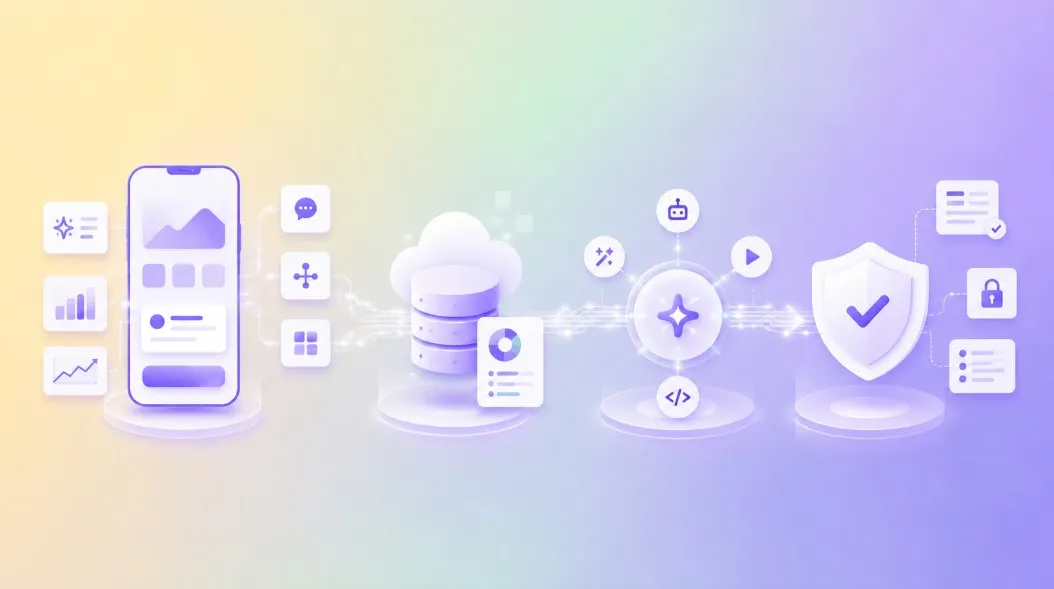
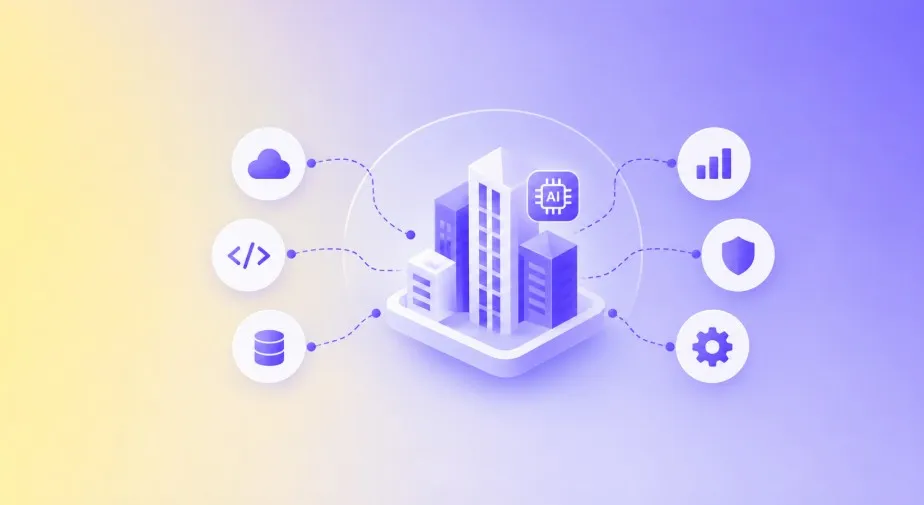
The 8-Layer AI-Native Stack shows everything AI native development has to connect for a system to work in production.
| Layer |
What it answers |
What gets built |
| 1. Product and Experience |
Who uses it, and what value do they get? |
Journeys, interfaces, workflows, feedback, and human handoffs |
| 2. Application and Integration |
How does it work with existing software? |
Frontend, backend, APIs, permissions, services, and system integrations |
| 3. Data Foundation |
What reliable information feeds the system? |
Pipelines, storage, cleaning, access rules, metadata, and quality checks |
| 4. Knowledge and Context |
How does AI find the right business facts? |
RAG, search, embeddings, vector stores, ranking, citations, context assembly |
| 5. Model and Intelligence |
Which AI capability performs each task? |
Model selection, prompts, structured outputs, classifiers, specialized models |
| 6. Agent and Workflow |
How can AI plan and act safely? |
Tools, orchestration, memory, approvals, retries, state, escalation paths |
| 7. AI Engineering and Operations |
How is quality maintained in production? |
Evaluations, tracing, monitoring, versioning, cost controls, release gates |
| 8. Governance, Security, Human Control |
How is risk managed? |
Policies, identity controls, audit logs, guardrails, reviews, incident response |
The value doesn't come from any single layer. It comes from connecting all eight around a measurable outcome.
Layer 1: Product and Experience
The first layer defines the problem, the user, the decision, and the desired result. Without this clarity, even a technically impressive system becomes a feature nobody trusts or uses.
What gets built at this layer:
- A clear use case and success measure
- User journeys showing where AI appears
- Conversation, screen, and workflow designs
- Rules for when AI should answer, recommend, act, or stop
- Confidence, source, correction, and feedback controls
- Human review and escalation paths
A practical example. A logistics company does not simply need "an AI chatbot." It may need a disruption assistant that reads shipment events, explains the likely reason for a delay, suggests the next action, prepares a customer update, and asks a manager to approve an expensive route change.
The experience has to show evidence, support correction, and make the next step clear. AI may power the interaction, but usability, trust, speed, and task completion still decide whether it succeeds.
Layer 2: Application and Integration Architecture
AI needs dependable software around it. This layer turns an intelligent capability into a usable, scalable product. A strong AI-native engineering team builds the application architecture that manages users, permissions, transactions, workflow state, failures, and connections to existing systems.
What gets built at this layer:
- Web, mobile, desktop, or embedded interfaces
- Backend services, APIs, and event-driven workflows
- Authentication, authorization, roles, and tenant isolation
- Connections to CRM, ERP, ticketing, payment, and analytics systems
- Queues, retries, rate limits, fallback paths, and cloud deployment
The architecture has to keep exact business rules separate from probabilistic AI behavior. A bank balance, payment limit, tax calculation, or permission check should be executed by deterministic services, not guessed by a language model. This is where product engineering discipline matters: the product has to stay maintainable even when models, prompts, vendors, or business processes change.
A practical architecture rule. Use AI where language, pattern recognition, prediction, summarization, or flexible reasoning creates value. Use conventional software where exact rules, transactions, access control, and repeatability are required. The best AI-native systems combine both.
Layer 3: Data Foundation
AI quality depends on the data the system can access and the rules around that access. A business may own valuable data and still be unready for AI, because the information is scattered, duplicated, outdated, poorly labeled, or hard to retrieve.
What gets built at this layer:
- Batch and real-time data pipelines
- Data lakes, warehouses, operational stores, or lakehouse platforms
- Cleaning, validation, deduplication, metadata, and lineage
- Access, retention, and regional controls
- Feature pipelines and data quality alerts
- Redaction or tokenization for sensitive information
Why this is different from "uploading documents." A production system has to know which source is current, who may access it, and what happens when records disagree. It often needs to combine structured data, orders, transactions, with unstructured data such as contracts, emails, manuals, and support conversations.
Example. A healthcare assistant may draw on appointment data, care instructions, policies, and patient messages. Those sources carry different privacy rules and levels of authority, and the architecture has to preserve every one of them.
Layer 4: Knowledge and Context
Models do not automatically know a company's latest policies, customer records, product catalog, contracts, or internal decisions. The context layer retrieves and assembles the information a specific task needs.
Retrieval-augmented generation combines information retrieval with a generative model so the response can use approved, current knowledge. It's one of the most common capabilities an AI-native development team delivers.
What gets built at this layer:
- Content ingestion, processing, chunking, and metadata
- Embeddings, vector indexes, and hybrid search
- Query rewriting, filtering, ranking, and reranking
- Permission-aware retrieval and context assembly
- Source citations, freshness rules, and re-indexing
RAG is a system, not a database feature. Strong RAG tests whether retrieval found the correct source, whether that source actually supports the answer, whether permissions were respected, and whether evidence is shown clearly. The engineering work covers two connected flows:
- Ingestion flow: collect, clean, split, enrich, embed, store, and update knowledge.
- Serving flow: understand the question, retrieve evidence, assemble context, generate a response, and show sources.
Google's own reference architectures separate ingestion, serving, and quality evaluation for the same reason, that separation reflects the real operational work behind reliable RAG.
Build an AI product, not a model demo. Connect the product, data, workflow, and control layers from day one. Talk to our engineers →
Build an AI product, not a model demo.
Connect the product, data, workflow, and control layers from day one
Layer 5: Model and Intelligence
The model layer provides the capability: language understanding, generation, classification, prediction, vision, speech, recommendation, or anomaly detection. An AI-native engineering team may work with large language models, smaller specialized models, traditional machine learning, computer vision, speech systems, or a combination.
What gets built at this layer:
- Model selection and routing
- Prompts, instructions, templates, and structured outputs
- Classification, extraction, forecasting, or specialized models
- Fine-tuning when the evidence supports it
- Fallback, failover, cost, latency, and version controls
Why one model rarely does everything. A larger model may handle complex reasoning while a smaller one handles extraction, classification, or high-volume requests. Some tasks need no generative model at all. A disciplined team evaluates models against real prompts, real data, edge cases, languages, latency needs, and risk conditions before committing.
Prompting is one engineering component, not the system. Prompts matter, but they don't replace product logic, data controls, retrieval quality, testing, or security. A production system also needs structured outputs, validation, retries, fallbacks, and defined behavior when the model is uncertain or unavailable.
Layer 6: Agent and Workflow Orchestration
An AI assistant produces information. An AI agent can also choose and use approved tools to make progress toward a goal, search a knowledge base, inspect an account, create a ticket, update a record, prepare a document, or request approval. This is where agent development means designing the workflows, permissions, state, and controls that make action safe.
What gets built at this layer:
- Tool definitions and secure API wrappers
- Workflow orchestration and state management
- Planning, routing, and task decomposition
- Short-term context and approved long-term memory
- Permission checks before each action
- Human approval for high-impact steps
- Timeouts, retries, idempotency, and rollback paths
- Escalation when confidence is low
- Multi-agent patterns only where they add clear value
A real agent is constrained by design. Giving a model CRM access does not create a production agent. The system has to define which records the agent can read, which actions it can take, which fields it can change, which actions need approval, how tool inputs are validated, what happens after a partial failure, and how every action is logged and reversed.
Example. A customer-service agent may verify identity, retrieve an order, explain policy, and prepare a refund. Policy services, limits, and approval rules (not persuasive user language) control the action.
Agent complexity should match workflow complexity. Use a fixed workflow when the process is known, an agent when it must choose tools or steps, and multiple agents only when the roles are genuinely separate and testable. Every extra agent adds cost, latency, handoffs, and failure points.
Layer 7: AI Engineering, Evaluation, and Operations
AI systems need tests for output quality, groundedness, safety, tool selection, and behavior across varied inputs. Uptime alone does not prove a system is useful or correct.
What gets built at this layer:
- Evaluation datasets built from real and difficult cases
- Rubrics for quality, safety, and task completion
- Retrieval, citation, and agent tool-use tests
- Regression suites for prompts, models, and workflows
- Tracing and monitoring across the full system
- Version control, release gates, rollback, and incident review
What should be evaluated? Evaluation happens at several levels:
| Level |
Example checks |
| Component |
Did retrieval find the correct document? Did the classifier choose the right label? |
| Response |
Is the answer accurate, grounded, complete, safe, and clear? |
| Workflow |
Did the agent choose the correct tool and complete the task? |
| Business |
Did resolution time, conversion, cost, or error rate improve? |
Successful LLM applications start with measurable success criteria and evaluations designed around them, not an informal review of a few good-looking outputs.
AI engineering is continuous. A model, policy, document, or API change can quietly reduce quality without ever causing a technical outage. Regression tests and monitoring are what surface that behavioral drift before a customer does.
Layer 8: Governance, Security, and Human Control
Governance is not a final approval document. It's the control system that defines acceptable use, ownership, risk, evidence, and accountability across all the other layers.
What gets built at this layer:
- AI policies, risk classes, inventories, and named owners
- Identity, least-privilege access, encryption, and secrets management
- Audit logs for retrieval, models, tools, and approvals
- Human review, retention, deletion, and consent processes
- Red-team tests, incident response, kill switches, and documentation
Security has to cover the whole AI application. AI security is not limited to blocking harmful text. Controls have to protect prompts, business data, retrieved context, model outputs, tools, APIs, identities, and downstream applications.
An agent that drafts a reply carries less risk than one that approves a payment or deletes a record. Permissions and review should match the impact and reversibility of each action.
Human control should be designed, not assumed. Human review works only when reviewers have evidence, authority, and clear controls. The product has to show what the AI did, which evidence it used, and what can be approved, edited, rejected, or reversed.
How the Eight Layers Work Together: A Worked Example
Consider an AI-native insurance claims assistant. The goal is to reduce manual work without letting AI make uncontrolled financial decisions.
| Stack layer |
What the company builds |
| Product and Experience |
A guided claims journey, evidence checklist, status explanations, and adjuster review screen |
| Application and Integration |
Connections to policy, customer, document, payment, and case-management systems |
| Data Foundation |
Clean policy, claims, customer, and historical-decision data with access controls |
| Knowledge and Context |
Retrieval over current policy wording, procedures, exclusions, and approved guidance |
| Model and Intelligence |
Document extraction, claim classification, summarization, and recommendation components |
| Agent and Workflow |
A workflow that requests missing evidence, checks systems, drafts a recommendation, and routes exceptions |
| AI Engineering and Operations |
Evaluation sets, trace logs, quality monitoring, cost tracking, and release tests |
| Governance and Security |
Role limits, audit trails, sensitive-data controls, human approval, and incident procedures |
The user sees one assistant. Underneath it is an integrated product and operating system. That is the core of AI native development.
What an AI-Native Development Team Does Not Build
A credible AI-native development team does not treat every problem as a generative AI problem. It will not:
- Add AI without a measurable user or business need
- Put confidential data into an unrestricted model workflow
- Let agents take high-impact actions without controls
- Choose a model before testing the use case and the data
- Claim that prompting removes the need for software engineering
- Launch without evaluations, monitoring, ownership, and a rollback plan
- Build a multi-agent system when a simple workflow is safer
Good AI engineering includes saying no to unnecessary AI, and using conventional automation when it's more reliable.
What You Should Receive from AI Development Services
A serious engagement produces more than source code. The client should receive everything needed to understand, operate, improve, and govern the system.
Discovery and definition
- Prioritized use cases and business outcomes
- User journeys and workflow maps
- Data, integration, risk, and feasibility assessment
- Success metrics and baseline measurements
Architecture and delivery
- Product and technical architecture
- Data and knowledge design
- Security and governance controls
- Working product increments with documented decisions
Production readiness
- Evaluation datasets and quality thresholds
- Automated tests and release pipelines
- Monitoring, tracing, alerts, and cost controls
- Runbooks, ownership, rollback, and incident procedures
- Team training and a roadmap for improvement
For teams still deciding where to begin, Quokka Labs' guide to an AI implementation strategy explains how to move from use-case selection and data readiness through to governance and scale.
The Bottom Line
So, what does an AI-native development team actually build? It builds a complete, controlled system for intelligence: the product experience, application architecture, data foundation, knowledge layer, models, agents, evaluation and operations, security, governance, and human oversight.
The model is only one layer. Lasting value comes from connecting all eight around a real outcome, then operating them reliably after launch.
Turn AI ambition into a production system.
Build the product, data, agent, operations, and governance layers as one roadmap.
Quokka Labs is an end-to-end AI-native engineering and solutions company that helps startups, enterprises, and government institutions build, modernize, and scale secure, future-ready digital products. Our AI development services connect strategy, software, data, generative AI, agents, cloud engineering, governance, and measurable business outcomes.
Frequently Asked Questions
What does an AI-native development company do?
An AI-native development team designs, builds, integrates, deploys, and improves software where AI supports a clear business outcome. Its work spans eight connected layers, product, application, data, knowledge, model, agent, operations, and governance, not just access to a model API.
What is the difference between AI-native development and regular software development?
Regular software development builds deterministic applications. AI-native development engineers systems around probabilistic AI behavior, adding data foundations, retrieval, evaluation, agent controls, and governance that traditional software does not require.
What does an AI-native development team build first?
It starts at the product layer, defining the use case, the user, the decision, and a measurable success metric, before selecting a model. Choosing a model before testing the use case and data is one of the most common and costly mistakes.
How much does AI development cost?
Cost depends on how many of the eight layers a system needs and how much control each requires. A single-layer prototype is far cheaper than a governed, production-grade agent with audit trails and human review. A scoping and discovery engagement produces a realistic estimate against your specific use case.
Do you need all eight layers for every project?
No. A credible AI-native development team builds only the layers a use case genuinely needs, and says no to unnecessary AI. A simple workflow is often safer and cheaper than a multi-agent system.