Key takeaways:
- The model is rarely the problem; the architecture is. Enterprise AI stalls when it cannot connect to trusted data, existing systems, governance, and workflows, not when the model is too weak.
- Production-ready patterns share one trait: they extend AI beyond conversation. RAG, prompt routing, guardrailed agents, fine-tuned SLMs, human-in-the-loop, and API-first integration all connect AI to real operations.
- Stall patterns share the opposite trait. Unbounded agents, raw prompt chaining, shadow AI, and disconnected deployments all skip integration, governance, or control.
- A production system needs six layers. Data foundation, model, knowledge and retrieval, workflow and agent, security and governance, and operations and observability, working together.
- Governance belongs in the architecture from day one. Access controls, audit logs, and compliance policies added after deployment are far harder to retrofit than to design in.
- Proprietary data is the differentiator, not the model. Per IBM's 2025 CEO Study, 72% of CEOs say proprietary data is key to GenAI value; the architecture is what lets AI reach it securely.
- Measure business outcomes, not model performance. Turnaround time, automation rate, cost savings, and adoption decide whether AI is working, not benchmark scores.
Build An Architecture That Scales, Not Another Pilot.
Talk to our AI engineering team about a secure, production-ready foundation for your next AI initiative.
Generative AI has moved beyond experimentation, and organizations across industries are investing heavily in AI-powered assistants, copilots, and intelligent workflows. Yet building a successful proof of concept is very different from deploying AI across enterprise operations.
While AI models continue to improve, many initiatives still struggle to scale because the underlying architecture is not designed for production. The challenge is rarely the model itself; it is how AI connects with enterprise data, existing systems, governance, security, and business workflows.
This is where enterprise AI architecture becomes the deciding factor.
In this guide, we will explore the GenAI patterns that consistently reach production, the architecture decisions that stall progress, and the layers behind building AI systems that deliver long-term business value.
What Is Enterprise AI Architecture?
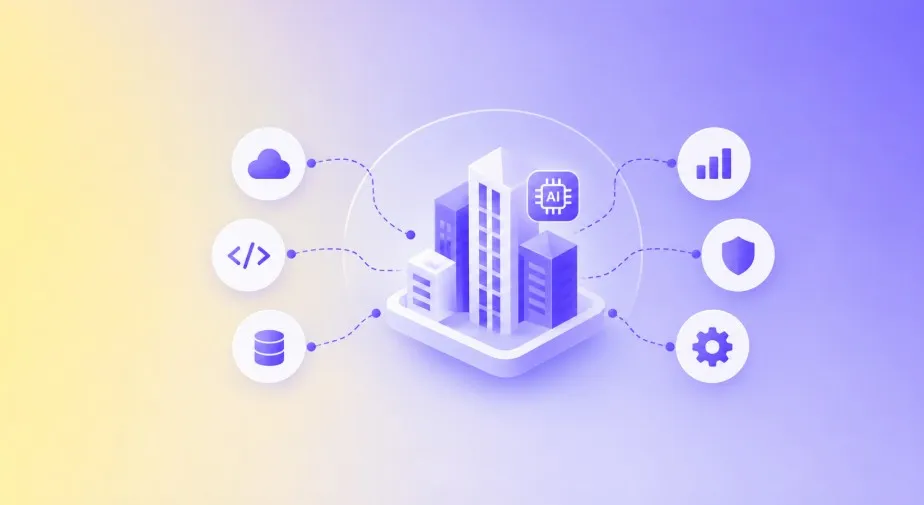
Quick answer: Enterprise AI architecture is the blueprint that enables AI systems to operate securely, reliably, and at scale across an organization. It connects AI models with enterprise data, business applications, governance, security, and operational workflows so AI can support real business processes instead of functioning as an isolated application. Without this architecture, most AI initiatives struggle to move beyond pilot projects.
Building an AI application is only one part of enterprise AI adoption. The real challenge is designing an architecture that allows AI to access trusted business data, integrate with enterprise systems, enforce governance, and support day-to-day operations.
According to IBM's 2025 CEO Study, 68% of CEOs say an integrated enterprise-wide data architecture is essential for collaboration, while 72% believe proprietary data is the key to realizing the value of Generative AI.
Simply put, enterprise AI performs best when it can securely access the right business data, not when organizations rely only on powerful AI models. For teams whose data is scattered or untrusted, data modernization is the foundation that has to come first.
Why Enterprise AI Systems Reach Production or Stall
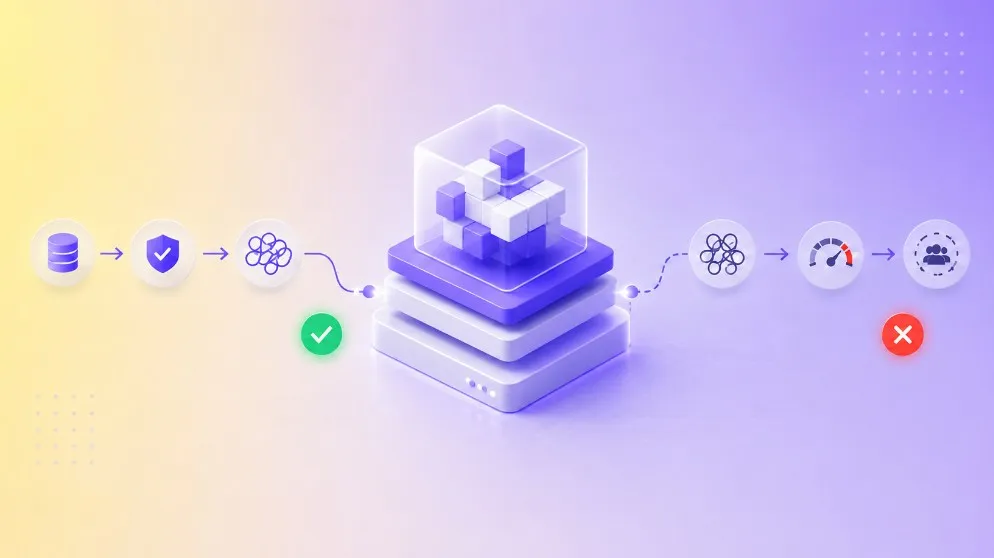
Quick answer: Enterprise AI systems reach production when they are engineered around trusted data, controlled workflows, enterprise integrations, security, governance, and continuous monitoring. They stall when AI is treated as an isolated technology experiment rather than as part of the organization's production software architecture.
A successful proof of concept answers:
Can AI perform this task?
A production AI system must answer several harder questions:
- Can it perform the task reliably thousands or millions of times?
- Can it access only the data each user is authorized to see?
- Can it interact safely with ERP, CRM, WMS, TMS, HRMS, finance, or support systems?
- Can it recover when an API, agent, tool, or model fails?
- Can administrators understand why an action occurred?
- Can engineering teams monitor quality, latency, and cost?
- Can the system support enterprise security reviews?
- Can models be replaced without rebuilding the application?
- Can humans stop, approve, or override high-impact actions?
- Can the system evolve as the business grows?
This is especially important for funded startups and scale-ups.
After a new funding round, major product launch, or enterprise customer win, the architecture suddenly has to support more integrations, larger datasets, additional users, stronger SLAs, security questionnaires, new workflows, and enterprise-specific requirements.
At that point, an AI feature starts becoming an engineering platform.
Organizations building AI directly into the core product experience increasingly need AI-native development practices in which intelligence is designed into the data model, UX, workflow logic, backend, and feedback loops rather than attached as a separate chatbot.
Common reasons AI initiatives stall
Enterprise AI programs commonly slow down because:
- AI operates outside existing enterprise applications.
- Data is incomplete, stale, poorly governed, or fragmented.
- The architecture assumes every request requires the same model.
- Permissions do not propagate into retrieval or agent actions.
- Integration work is underestimated.
- Security and governance begin only after the pilot succeeds.
- Latency makes the application unpleasant to use.
- Agent actions are too autonomous for the business risk involved.
- Engineering ownership becomes unclear after deployment.
- Teams lack observability across prompts, retrieval, model calls, tools, and workflows.
- Technical success is measured without measurable business outcomes.
The difference between pilot and production is therefore not simply model accuracy.
It is an enterprise AI system design.
Which GenAI Patterns Reach Production?
Quick answer: Enterprise GenAI systems consistently reach production when they use architecture patterns that improve data accuracy, security, governance, scalability, and operational efficiency. Common production-ready patterns include Retrieval-Augmented Generation (RAG), cached prompt routing, guardrailed AI agents, fine-tuned Small Language Models, and API-first integrations that connect AI with enterprise workflows.
1. Retrieval-Augmented Generation (RAG)
RAG connects AI to trusted enterprise knowledge instead of relying only on what the model already knows. This improves response accuracy while reducing hallucinations.
Example: an HR assistant retrieves the latest leave policy from the company's knowledge base before answering an employee's question.
2. Cached prompt routing
Not every request needs the most powerful or expensive AI model. Prompt routing directs simple tasks to smaller models and complex reasoning to advanced LLMs, improving both speed and cost efficiency.
Example: password reset questions are handled by a lightweight model, while contract analysis is routed to a larger language model.
3. Guardrailed AI agents
AI agents become more reliable when they operate within predefined rules, permissions, and approval workflows instead of making unrestricted decisions. This is the same discipline covered in Quokka Labs' guide on how to build an agentic AI system.
4. Fine-tuned Small Language Models (SLMs)
Smaller models trained on domain-specific knowledge often deliver faster responses, lower operational costs, and better data privacy for specialized business tasks.
Example: a legal team uses a fine-tuned SLM to summarize contracts instead of relying on a general-purpose model.
5. Human-in-the-loop
Enterprise AI performs best when humans review high-impact decisions rather than allowing AI to operate completely autonomously.
Example: an AI system drafts an insurance claim assessment, while the final approval remains with a claims specialist.
6. API-first integration
Production AI delivers greater business value when it connects with existing enterprise systems instead of operating as a standalone application.
Example: a customer support assistant retrieves order details from the CRM, updates the ticketing platform, and notifies the customer, all within a single workflow.
These patterns share one common characteristic: they extend AI beyond conversation and integrate it into enterprise operations. That is what enables organizations to move from promising pilots to scalable, production-ready AI systems, the same lifecycle described in what an AI-native development team actually builds.
Which Patterns Cause Enterprise AI to Stall?
Quick answer: Enterprise AI initiatives commonly stall because the underlying architecture cannot support production workloads. Patterns such as unbounded AI agents, raw prompt chaining, disconnected AI deployments, and weak governance reduce reliability, increase operational risk, and prevent organizations from scaling AI across business functions.
Unbounded AI agents
Agents that operate without defined limits, approvals, or guardrails can make unpredictable decisions, consume excessive resources, and introduce operational risks.
Fix: set clear execution limits and include human approval for critical business actions.
Raw prompt chaining
Long chains of AI prompts become fragile. A small error or inaccurate response early in the process can affect every step that follows.
Fix: use structured workflows with validation and error handling between AI tasks.
Querying the vector database on every request
This increases latency and operational costs, especially at enterprise scale.
Fix: combine semantic caching with intelligent retrieval to improve speed and reduce infrastructure costs.
Shadow AI
When teams build AI solutions without IT oversight, organizations lose visibility into security, compliance, and data usage.
Fix: adopt centralized governance, monitoring, and security policies for every AI deployment.
Weak governance
Without clear access controls, audit logs, and compliance policies, enterprise AI becomes difficult to trust and even harder to scale.
Fix: build governance into the architecture from the beginning rather than adding it after deployment.
Disconnected deployments
AI that operates outside existing business systems creates disconnected experiences and delivers limited operational value.
Fix: integrate AI with enterprise applications, business processes, and approval workflows so it becomes part of everyday operations.
Measuring the wrong things
Organizations often measure technical performance while overlooking business outcomes, making it difficult to justify continued investment.
Fix: track metrics such as turnaround time, automation rate, cost savings, user adoption, and decision accuracy alongside AI performance.
The most common reason enterprise AI initiatives stall is not the language model; it is an architecture that is not designed for integration, governance, and operational scale.
Is Your AI Pilot Stuck Between Demo and Deployment?
Quokka Labs provides AI development services that connect model capabilities with the engineering layers required for production systems.
The Six Layers of Production-Ready Enterprise AI Architecture
Quick answer: A production-ready enterprise AI architecture typically consists of six layers: an enterprise data foundation layer, AI model layer, knowledge and retrieval layer, workflow and agent layer, security and governance layer, and operations and observability layer. Together, these layers ensure AI systems remain accurate, secure, integrated, and scalable.
| Layer |
What it does |
| 1. Enterprise Data Foundation |
Gives AI access to trusted business information from ERP, CRM, document repositories, APIs, and both structured and unstructured data |
| 2. AI Model Layer |
Where organizations choose and manage models, such as GPT, Claude, Gemini, or fine-tuned SLMs. Many enterprises use multiple models by cost, performance, and use case rather than one provider |
| 3. Knowledge and Retrieval |
Helps AI retrieve the right business information using RAG, vector databases, knowledge graphs, and semantic search |
| 4. Workflow and Agent |
Connects AI with enterprise workflows, business rules, APIs, and approval processes, so AI automates tasks while keeping humans involved where necessary |
| 5. Security and Governance |
Protects AI through identity management, access controls, guardrails, audit logs, and compliance policies |
| 6. Operations and Observability |
Tracks usage, latency, cost, model quality, user feedback, and system health after deployment, so teams can improve AI over time |
Each layer addresses a different responsibility, but they work best together. Missing even one layer, whether trusted data, governance, or monitoring, can prevent an enterprise AI system from reaching production or scaling successfully.
Enterprise AI Architecture Readiness Checklist
Quick answer: Before deploying enterprise AI, organizations should verify that their architecture can securely access enterprise data, integrate with existing business systems, enforce governance, monitor performance, support human oversight, and maintain auditability. Completing this checklist helps reduce deployment risks and improves production readiness.
Use this checklist to evaluate whether your enterprise AI architecture is ready for production:
- Can AI securely access enterprise data? Verify that AI retrieves information from trusted and authorized data sources instead of relying solely on static training data.
- Are user permissions and access controls enforced? Ensure users can only access the data and actions they are authorized to use.
- Is AI integrated with existing business systems? Confirm AI can connect with applications such as ERP, CRM, HRMS, ticketing platforms, and document repositories.
- Are AI responses monitored and evaluated? Track response quality, latency, hallucinations, and user feedback to maintain reliable performance.
- Can humans review critical decisions? Introduce approval workflows for high-impact actions such as financial transactions, compliance reviews, or customer-facing decisions.
- Are operational costs measurable? Monitor token usage, infrastructure costs, API consumption, and model performance to optimize long-term efficiency.
- Can models be updated or replaced easily? Adopt a modular architecture that allows new models to be introduced without rebuilding the entire AI system.
- Are audit logs and governance policies in place? Maintain complete visibility into prompts, responses, user actions, and system decisions to support compliance and governance.
If several answers are "no," the system may technically work but still lack production readiness.
Pressure-Test Your Enterprise AI Architecture Before Scaling It
A target-state review can expose integration, security, retrieval, scalability, and governance gaps before they become expensive production problems.
Enterprise AI Architecture Best Practices for 2026
Quick answer: The best enterprise AI architecture practices for 2026 include designing around business workflows, building on trusted enterprise data, implementing governance, choosing modular architectures, monitoring AI continuously, and keeping humans involved in high-impact decisions. These practices help organizations build AI systems that remain secure, scalable, and adaptable as technologies evolve.
As enterprise AI adoption grows, the focus is shifting from selecting the latest language model to designing an architecture that can evolve with changing business needs. These practices help organizations build AI systems ready for long-term production use:
- Design around business workflows. Start with the business process you want to improve, not the AI model you want to use. AI should solve a measurable operational challenge.
- Build on trusted enterprise data. Reliable AI depends on accurate, governed, and up-to-date enterprise data. Strong data foundations improve response quality and reduce hallucinations.
- Keep humans in critical decision loops. Use human approvals for financial, legal, compliance, and other high-impact decisions where accountability is essential.
- Choose modular architecture. Build loosely coupled AI systems so models, retrieval layers, and integrations can be updated without redesigning the entire architecture.
- Secure and govern from the start. Implement identity management, access controls, audit logging, and governance policies from the beginning instead of treating security as a post-deployment activity.
- Continuously monitor performance. Track response quality, latency, operational costs, user adoption, and business outcomes to identify issues before they affect production.
- Optimize for cost and performance. Not every task requires the largest language model. Route workloads to the most appropriate model to balance performance, speed, and cost.
- Build for future adoption. AI technology is evolving rapidly. Design an architecture that lets new models, tools, and capabilities be adopted without disrupting existing operations.
How Quokka Labs Approaches Enterprise AI Architecture
Quick answer: Quokka Labs helps organizations design and engineer production-ready enterprise AI architecture by integrating AI with enterprise systems, trusted data, governance frameworks, and operational workflows. The focus is on building AI systems that scale securely and deliver measurable business outcomes rather than isolated AI applications.
Building enterprise AI is not just about selecting the right language model. It requires an architecture that securely connects AI with enterprise data, existing applications, governance policies, and operational workflows. That is where engineering discipline becomes critical.
As an AI-native engineering company, Quokka Labs helps organizations design enterprise AI architectures built for production from day one. Our approach focuses on solving business problems first, then engineering the architecture required to support long-term AI adoption. Whether you are modernizing existing systems or building new AI-powered products, we help you:
- Design scalable enterprise AI architecture aligned with business goals
- Integrate AI with ERP, CRM, HRMS, APIs, and enterprise knowledge sources
- Build Retrieval-Augmented Generation (RAG) systems for trusted enterprise knowledge
- Engineer secure agentic AI workflows with governance and human oversight
- Implement AI security, access controls, and compliance-ready architectures
- Monitor, optimize, and continuously improve AI performance after deployment
Rather than building isolated AI applications, Quokka Labs engineers connected AI systems that integrate into enterprise operations and create measurable business value.
Ready To Build an Enterprise AI Architecture That Scales?
CTA
Ready To Build an Enterprise AI Architecture That Scales?
Talk to our AI engineering team to design a secure, production-ready foundation for your next AI initiative.
Let's connect →
Conclusion
Enterprise AI architecture is what transforms Generative AI from a promising prototype into a dependable business capability.
Models will continue to improve. New providers will emerge. Agent frameworks will change. Retrieval technologies will evolve.
But the fundamental production requirements remain consistent.
AI needs trusted data.
It needs secure access to enterprise systems.
It needs controlled workflows.
It needs governance.
It needs observability.
And it needs an architecture that allows every one of those components to evolve without destabilizing the complete system.
The enterprises and AI product companies that move successfully from pilots into production will therefore not necessarily be the ones using the newest model.
They will be the ones that build the strongest system around it.
Frequently Asked Questions
What is enterprise AI architecture?
Enterprise AI architecture is the blueprint that lets AI systems operate securely, reliably, and at scale across an organization. It connects AI models with enterprise data, applications, governance, security, and workflows, so AI supports real business processes instead of running as an isolated app.
Why do most enterprise AI projects fail to reach production?
Most fail on architecture, not the model. Common causes are AI running in isolation from enterprise systems, weak data foundations, limited governance, high latency, and no clear ownership after deployment. A production system needs integration, governance, and monitoring designed in from the start.
What are the layers of an enterprise AI architecture?
Six: an enterprise data foundation, the AI model layer, knowledge and retrieval, workflow and agent orchestration, security and governance, and operations and observability. Each handles a distinct responsibility, and a system missing any one of them often stalls before scaling.
What is the difference between a GenAI pilot and a production system?
A pilot proves AI can generate a result. A production system must deliver secure, reliable, governed outcomes across daily operations, connected to real data and systems, with monitoring, human oversight, and clear ownership. The gap between the two is architecture.
How should enterprises measure AI success?
By business outcomes, not benchmark scores. Track turnaround time, automation rate, cost savings, user adoption, and decision accuracy alongside technical metrics such as latency and cost per task. If AI is not moving a business number, the architecture is not yet delivering value.