In 2026, buyers, sellers, brokers, and property investors expect more than basic listings, they expect a fast, intuitive, and conversion-focused digital experience. The best property app does more than showcase homes; it simplifies discovery, communication, and decision-making. Whether you're exploring Ui Ux design for real estate, comparing property apps India, the right app strategy can turn traffic into qualified leads and long-term customers.
The shift is backed by market data too. According to Statista, real estate apps continue to benefit from growing mobile-first user behavior and rising digital property discovery trends, showing how strongly the market is moving toward app-based engagement. Source: Statista
In this blog, we reveal the top 10+ must-have real estate mobile app features that every successful real estate apps needs. These real estate app features help businesses deliver better user journeys and stronger lead generation.
We break down the features of real estate app that drive engagement, boost sales, and create lasting customer relationships. Read on to learn exactly how to build real estate mobile app that caters to modern demands while keeping your business competitive. Read on to see why these real estate app features matter in today’s market.
Get more inspiration, check out these innovative real estate app ideas to transform your Business. And get ready to turn vision into reality.
Top Reasons Your Real Estate Business Needs the Best Property App in 2026
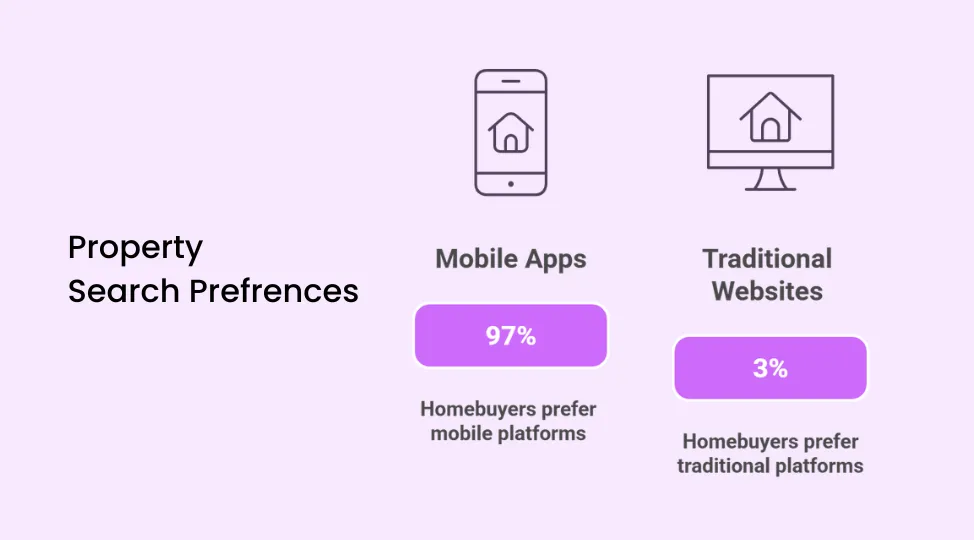
The real estate industry is going digital faster than ever, and the numbers prove it:
-
73% of buyers use mobile apps to search for properties. (Source: NAR)
-
97% of homebuyers do their property search online, with most preferring mobile platforms. (Source: Zillow)
-
Real estate apps increase engagement by 2.5x compared to traditional websites. (Source: Statista)
-
60% of millennials expect a real estate mobile app for property browsing and agent communication. (Source: NAR)
Turn this growing demand into a competitive advantage with a high-performance mobile app built specifically for your real estate business.

Top 15+ Must-Have Features for Real Estate Apps
Designing powerful real estate apps isn't just about looking good—it's about functionality, efficiency, and delivering real value to your users. Here, we explore the top features that can make your real estate apps a success.
1. User-Friendly Navigation
Why It Matters
A clean, intuitive interface is crucial. Users must quickly find what they're looking for, whether it's property listings or contact information.
-
Simple Menu Structures: Organize options clearly.
-
Quick Access Buttons: Frequently used features should be at the forefront.
-
Responsive Design: Ensure it works seamlessly on any device.
Real estate app design should focus on a user-first approach. Remember, if your users struggle to navigate your mobile apps for real estate, they won't stick around. Strong ui ux design for real estate also improves usability and lead flow.
2. Advanced Search and Filter Options
Key Points
Modern users demand precision. Your real estate mobile app features should include robust search and filter capabilities.
-
Location-Based Search: Integrate GPS and mapping.
-
Custom Filters: Price range, property type, and amenities.
-
Saved Searches: Allow users to save their preferred criteria.
These features of real estate app not only enhance usability but also empower users to quickly find properties that match their needs. They are also among the mobile features of modern property management apps users now expect.
3. Interactive Property Listings for Enhancing Engagement
Visual appeal is vital. High-quality images and interactive elements capture attention and drive inquiries.
-
Photo Galleries and 360° Views: Offer immersive visuals.
-
Virtual Tours: Integrate video walkthroughs or VR experiences.
-
Detailed Descriptions: Provide key information at a glance.
A standout real estate app design includes interactive property listings that make browsing an enjoyable experience. This is one of the key real estate mobile app features that can set you apart from the competition and help shape the best property app experience.
4. Integrated Communication Tools for Keeping the Conversation Flowing
Effective communication is essential for converting leads.
-
In-App Messaging: Instant contact between agents and clients.
-
Chatbots: Provide immediate responses to common queries.
-
Call Integration: Allow users to make calls directly from the app.
These features of real estate app ensure that your real estate app remains a one-stop solution for property inquiries and follow-ups. They also highlight key real estate sales app benefits for growing agencies and brokers.

5. Real-Time Notifications to Stay Connected
Keep your users informed and engaged with timely updates.
-
Push Notifications: Alert users about new listings or price drops.
-
Appointment Reminders: Ensure meetings and open houses aren't missed.
-
Market Updates: Provide real-time insights into market trends.
This is a must-have real estate mobile app feature that keeps users connected and increases engagement with your mobile apps for real estate. It is also one of the core mobile features of modern property management apps.
6. Interactive Maps
Maps are the most practical ways to help users explore properties based on location, commute, lifestyle, and nearby essentials.
- Map-Based Discovery: Let users browse listings directly on a live map instead of relying only on list views.
- Location Pins with Quick Info: Show pricing, property type, and key details without forcing users to open every listing.
- Proximity Insights: Highlight schools, hospitals, transit points, shopping areas, and other nearby amenities.
- This is one of the most important real estate app features because it improves property discovery and makes search more intuitive for buyers, renters, and investors.
7. Saved Searches & Favorites
Not every user is ready to make a decision in one session. Real estate apps need features that help users return, track options, and continue their search without starting over.
-
Saved Search Criteria: Let users save location, budget, property type, and amenity preferences.
-
Favorite Listings: Allow users to bookmark properties for later review.
-
Alert-Based Re-Engagement: Notify users when matching listings are added or when saved properties change in price or status.
These real estate mobile app features improve retention and give users a reason to come back, which is critical for long sales cycles and repeat engagement.
8. Property Comparisons
Users often compare multiple properties before they take the next step, so your app should make that process easier.
-
Side-by-Side Comparison: Help users compare price, size, amenities, location, and other core details.
-
Visual Comparison Layouts: Present key listing differences in a clean and easy-to-scan format.
-
Decision Support: Make it easier for buyers and renters to shortlist properties without switching between multiple tabs or screens.
This feature of real estate app improves usability and supports faster decision-making, especially for users actively evaluating multiple options.
9. Mortgage/EMI Calculator
A listing may look attractive, but users also want to know whether it fits their budget. A built-in affordability tool helps turn browsing into serious consideration.
-
Estimated Monthly Payment: Show expected mortgage or EMI costs based on property price and user inputs.
-
Down Payment Adjustments: Let users test different down payment amounts and loan terms.
-
Financial Clarity: Help users understand affordability before contacting an agent or requesting a visit.
This is one of the most practical real estate app features because it connects listing discovery with real purchase intent and improves lead quality.
10. Neighborhood Intelligence
Users are not just choosing a property, but also the area around it. That is why neighborhood context matters as much as the listing itself.
-
Local Area Insights: Show information about schools, transport, safety, shopping, and healthcare nearby.
-
Lifestyle Context: Help users evaluate neighborhoods based on their daily needs and preferences.
-
Decision Confidence: Give users a broader view of the property's real value beyond square footage and price.
This real estate mobile app feature adds depth to the user experience and helps buyers and renters make more informed decisions.
11. Scheduling Visits
Once a user finds a promising property, the next step should be simple. Real estate apps should remove friction from the visit-booking process.
-
Visit Booking Inside the App: Let users request site visits or virtual tours without leaving the platform.
-
Calendar Integration: Allow users to choose available time slots based on agent or seller availability.
-
Automated Confirmations and Reminders: Reduce missed appointments and keep both sides informed.
12. Integrated Payment and Transaction Systems to Simplify Transactions
If your app handles transactions, secure and easy-to-use payment systems are non-negotiable.
-
Secure Payment Gateways: Support for various payment methods.
-
Transaction Histories: Keep records of past interactions.
-
In-App Purchases: Enable smooth processing for fees or deposits.
This real estate mobile app feature is crucial for any real estate apps that facilitates property transactions, ensuring a seamless payment experience for users.
13. Analytics and Reporting Tools
Making Data Work for You
Track user behavior and market trends to continuously refine your service.
-
User Analytics: Track engagement and preferences.
-
Sales Reporting: Monitor conversion rates and agent performance.
-
Market Insights: Use real-time data to adjust pricing and listings.
Effective real estate app design should incorporate analytics, giving you actionable insights into how to improve your mobile apps for real estate.
14. CRM Integration
Strong CRM integration helps businesses manage inquiries, follow-ups, and lead pipelines more efficiently.
-
Lead Syncing: Push inquiries, visit requests, and user activity directly into the CRM.
-
Agent Workflow Support: Help brokers and agents track prospects, conversations, and follow-up stages.
-
Better Lead Management: Reduce manual work and improve response speed across the sales process.
This feature of real estate apps is especially important for agencies and broker teams that want better lead routing, stronger follow-up, and more organized sales operations.
15. Document Upload/E-Sign Workflows
Real estate transactions involve paperwork, approvals, and document exchange. A mobile app should help simplify that process instead of pushing it outside the platform.
-
Document Upload: Allow users to upload ID proofs, agreements, financial documents, and property-related files securely.
-
E-Sign Support: Enable digital signatures for forms, contracts, and approvals.
-
Centralized Document Handling: Keep important files accessible, organized, and easy to manage.
These real estate mobile app features improve convenience, reduce process delays, and support smoother buyer, seller, and tenant workflows.
16. Customer Support and Helpdesk
Provide Ongoing Assistance
An efficient support system can make a significant difference in user satisfaction.
-
Live Chat Support: Quick help during business hours.
-
FAQ Sections: Address common queries with ease.
-
Feedback Systems: Allow users to report issues or suggest improvements.
Reliable customer support is a critical real estate mobile app feature that ensures your users feel valued and supported throughout their journey.
17. Customization and Scalability
Adapt to Your Growing Needs
Your app should be flexible enough to evolve with your business.
-
Modular Design: Add new features as needed.
-
Custom Themes: Match your brand's aesthetic.
-
Scalable Architecture: Prepare for an expanding user base without compromising performance.
When you ask, how to build real estate mobile app that grows with your business, consider features that allow for easy customization and scalability. This is one of the most vital features of real estate apps for long-term success.
18. AR/VR Integration
Modern real estate apps can go beyond static images by offering immersive property experiences that save time and improve engagement.
-
Virtual Property Tours: Let users walk through homes remotely before booking a visit.
-
Augmented Reality Views: Help users visualize spaces, layouts, or furnishing possibilities more clearly.
-
Remote Decision Support: Make it easier for out-of-town buyers, busy professionals, or investors to evaluate listings.
This is an advanced real estate mobile app feature that can significantly improve user engagement and make property exploration more interactive.
19. Verified Listings
Trust is a major issue in digital property platforms. Verified listings help reduce fake entries, improve platform credibility, and create more confidence for users.
-
Listing Verification Processes: Confirm property ownership, availability, and listing authenticity before publishing.
-
Trust Signals: Use badges or indicators to show which properties are verified.
-
Fraud Reduction: Protect users from misleading or duplicate listings.
This feature of real estate app is critical for building trust and improving platform quality, especially in competitive markets where users are cautious about scams and inaccurate property data.
These real estate mobile app features improve retention and give users a reason to come back, which is critical for long sales cycles and repeat engagement.
Real Estate App Design: The Key to Better Engagement in a Real Estate App
A top-notch Real estate apps design is essential to attract and retain users. Let's explore some key design principles:
1. Minimalistic Layout
-
Clean Interfaces: Avoid clutter to make navigation easy.
-
Focused Content: Highlight essential information.
-
Intuitive Controls: Simplify interactions for a seamless experience.
2. Consistent Branding
-
Color Schemes: Use brand colors consistently across the app.
-
Typography: Choose fonts that are easy to read.
-
Visual Hierarchy: Prioritize key elements with size and contrast.
3. Fast Loading Speeds
-
Optimized Graphics: Ensure images load quickly without sacrificing quality.
-
Efficient Code: Minimize load times with streamlined coding practices.
-
Performance Testing: Regularly test the app to maintain high speeds.
By focusing on UI UX design for real estate that is clean, consistent, and fast, you create a better user experience that keeps clients coming back.
Remember: A great design of real estate apps is not just about aesthetics—it directly impacts how users interact with your mobile apps for real estate.

How to Build a Real Estate App: Best Practices for Real Estate Mobile App Development
Now that you know the must-have real estate mobile app features, let's discuss how to build real estate mobile app that excels in current market.
1. Define Your Goals and Audience
-
Identify Pain Points: Understand the challenges your users face.
-
Set Clear Objectives: Outline what you want your app to achieve.
-
Target User Research: Gather data on user preferences and behaviors.
2. Plan Your Features and Functionality
-
Prioritize Essentials: Start with the core features of real estate apps.
-
Create a Roadmap: Develop a timeline for adding advanced features.
-
Iterative Development: Build, test, and refine in stages.
3. Focus on Real Estate App UI/UX Design
-
User Experience: Ensure the app is intuitive and engaging.
-
Responsive Layout: Optimize for both mobile and desktop use.
-
Aesthetic Appeal: Use visuals and layouts that resonate with your audience.
4. Choose the Right Technology
-
Backend Infrastructure: Opt for reliable, scalable solutions.
-
API Integrations: Ensure seamless connections with third-party services.
-
Security Protocols: Prioritize data protection at every level.
Also Read: How Much Does It Cost to Develop a Real Estate CRM App?
5. Collaborate with Experts
For a seamless process and high-quality results, partner with a seasoned mobile app development company that specializes in real estate mobile Apps development. Their expertise will guide you on how to build real estate mobile app that meets industry standards and user expectations. A trusted real estate mobile app development company dubai can also help brands targeting the Middle East, while teams serving property apps india can localize features for regional users.
By following these best practices, you'll not only understand to build real estate apps that are feature-rich and user-friendly, but you'll also set your business up for long-term success. Trust our real estate mobile Apps development services from a leading app development company and build a high-performing realestate app with the right real estate app features.
How Quokka Labs Can Help You?
At Quokka Labs, we help real estate businesses turn product ideas into mobile experiences that are practical, high-performing, and easy to scale. Whether you are building for buyers, agents, brokers, or property managers, our team focuses on the features and workflows that matter most.
Here is how our experts can help you:
-
UI/UX design for real estate apps that make property search, listing discovery, and inquiry flows simple and intuitive
-
Custom real estate app development for buyers, renters, agents, brokers, and property management businesses
-
Advanced search and filter implementation, including location-based search, map views, and saved searches
-
Interactive property experiences with high-quality galleries, virtual tours, and rich listing pages
-
Communication and lead capture tools, such as in-app chat, call support, inquiry forms, and notification systems
-
Secure backend and user management with authentication, profile controls, and data protection best practices
-
Third-party integrations for CRM, payment gateways, maps, scheduling tools, and other business systems
-
Scalable product roadmaps to help you decide which real estate mobile app features should be part of your MVP and which can be added later
-
Ongoing optimization and support to improve performance, engagement, and long-term app usability
From concept to launch, Quokka Labs helps you build a real estate app that is aligned with user expectations and business goals. Whether you need a property listing platform, a real estate sales app, or a mobile property management solution, our team can help you create a product that is built for growth.
Final Thoughts on Real Estate Mobile App Features for a Successful Real Estate App
Developing successful real estate apps isn't just about having a pretty interface—it's about delivering the right real estate mobile app features that solve real problems. By focusing on what truly matters to your users, you can transform your business and stay ahead in a competitive market. These real estate sales app benefits also support better engagement, faster conversions, and stronger retention.
If you're ready to explore how to build real estate mobile app that captivates your audience and drives results, contact us at Quokka Labs. Our team of experts is here to help you every step of the way—from planning your Real estate app UI/UX design to launching and scaling your project.
For more insights and guidance on boosting your digital presence, be sure to visit our Real Estate App Ideas blog and discover these ideas can boost your business. More and more teams are investing in mobile features of modern property management apps to stay ahead.
Ready to transform your real estate business with result-giving mobile apps for real estate?
Contact our mobile app development company today and start your journey to success.
FAQs Real Estate Mobile App Features
1. What are the most important real estate mobile app features in 2026?
The most searched and most practical real estate mobile app features in 2026 usually include:
These features matter because today’s buyers rely heavily on digital property discovery. Zillow says 87% of home buyers use online resources during their home search, and buyers also use both apps and mobile web significantly during the journey. That makes feature quality a business issue, not just a design choice.
2. How do I choose the right real estate app features for my business model?
The right real estate app features depend on what kind of product you are building. A brokerage app, listing marketplace, landlord platform, and property management solution do not need the exact same flow.
A good way to decide is to map features by user type:
-
Buyers need search, saved listings, alerts, and virtual tours
-
Agents need lead tracking, messaging, CRM-style tools, and analytics
-
landlords or managers need payments, tenant communication, maintenance, and reporting
-
Investors need market insights, valuation tools, and portfolio tracking
Start with the core workflow your users repeat most often. Then build around that. Google’s guidance for people-first content also reflects a similar principle: create for real user needs, not just to fill pages or check boxes.
3. Why is UI UX design for real estate so important?
UI UX design for real estate is critical because users make quick decisions when browsing listings. If your app feels cluttered, slow, or confusing, they leave. In real estate, design affects trust, lead quality, and time spent in the app.
Strong design usually improves:
-
listing discovery
-
search completion
-
inquiry rates
-
saved-property behavior
-
appointment bookings
This matters even more in mobile-first behavior. Zillow reports strong mobile usage across home search, which means layout, taps, speed, and content hierarchy directly affect conversion. Great ui ux design for real estate is not just about aesthetics; it helps users move from interest to inquiry faster.
4. How much does it cost to build a real estate app in 2026?
This is one of the most searched questions on Google and ChatGPT. Cost depends on complexity, number of platforms, integrations, design quality, and whether you want advanced AI or property management features.
Typical market estimates published by app development firms in 2026 put costs roughly in these ranges:
-
basic app: about $25,000 to $45,000
-
mid-level app: about $40,000 to $100,000
-
advanced app: $70,000 to $250,000+
For broader app development, industry guides also show that app costs can scale much higher depending on complexity and infrastructure. The biggest cost drivers are backend systems, custom search, maps, chat, payments, dashboards, and third-party integrations.
5. How long does real estate app development usually take?
The timeline depends on scope, but most businesses can think in three tiers:
-
MVP or basic app: 3 to 5 months
-
mid-sized product: 5 to 8 months
-
large custom platform: 8 to 12+ months
If the app includes complex search, CRM workflows, payments, dashboards, AI recommendations, or multilingual experiences, the timeline grows. A smart launch strategy is to ship the MVP first with the most essential real estate mobile app features, then add advanced modules in phases. That approach reduces risk and gets you real user feedback earlier. Cost and timeline guides for real estate app development consistently point to phased execution as the safer route.
6. What makes the best property app stand out from competitors?
The best property app is not just the one with the most features. It is the one that makes the core journey easier, faster, and more trustworthy.
What usually sets the best property app apart:
-
fast search and filter experience
-
accurate and rich listing information
-
simple communication with agents or managers
-
personalized alerts
-
strong visual experience with tours or galleries
-
secure login and data protection
-
quick loading speed
-
localized experience for the target market
Users compare convenience more than technology jargon. If your app reduces friction and helps people act quickly, it becomes memorable. In a market where digital discovery is already dominant, usability is often the main differentiator.
7. What are the key real estate sales app benefits for agents and brokers?
The main real estate sales app benefits are better lead capture, faster response time, and stronger conversion support. For agencies and brokers, a good app can work as a sales tool, relationship tool, and retention tool at the same time.
Key real estate sales app benefits include:
-
capturing leads directly from listings
-
reducing response delays with chat and alerts
-
tracking user behavior and preferences
-
improving repeat engagement through push notifications
-
helping agents manage inquiries more efficiently
-
supporting social sharing and referral traffic
NAR also points to the importance of digital channels in lead generation. Their marketing guidance notes that social media drives a meaningful share of leads for REALTORS®, which supports the value of connected mobile experiences.
8. What are the mobile features of modern property management apps?
The most useful mobile features of modern property management apps go beyond listings and focus on ongoing operations. These are especially important for landlords, facility teams, and property managers.
Top mobile features of modern property management apps often include:
-
rent or fee payment tools
-
maintenance request tracking
-
tenant communication
-
document storage
-
booking and scheduling
-
notifications and reminders
-
user roles and permissions
-
analytics dashboards
These features are becoming more important as real estate tools move from simple browsing apps toward full-service operational platforms. If your business model includes leasing, maintenance, or recurring transactions, these features should be prioritized earlier in development.
9. Should I build for Dubai, India, or multiple markets at once?
This is a valuable strategy question, especially for brands targeting both the Middle East and Asia. A real estate mobile app development company Dubai may focus more on localization for UAE buyer behavior, premium property presentation, Arabic-English flows, and regional payment or compliance needs. For property apps india, priorities may include multilingual experiences, affordability filters, high listing volume, and broad Android optimization.
If you are targeting multiple markets, build a shared core platform first, then localize:
This keeps the product scalable without forcing a one-size-fits-all user experience.
10. How do I choose the right real estate mobile app development company?
Choosing the right partner affects cost, speed, and final product quality. Look beyond generic portfolios and ask whether the team understands real estate workflows, not just app coding.
Check for these signs:
-
experience with marketplace or real estate products
-
strong ui ux design for real estate capability
-
clear MVP and scaling strategy
-
security and backend expertise
-
transparent communication and timelines
-
post-launch maintenance support
Also ask how they handle analytics, updates, and iteration after launch. Many cost guides note that maintenance can add a meaningful annual cost after the initial build, so long-term support should be part of the decision from day one.
Tags
features of real estate app
real estate apps
Real Estate App Design
Mobile app Development