Launching a mobile app is not just a trend; it has become a necessity to stand out in the marketplace. Whether it's a startup or a global enterprise, they all want a unified solution to engage potential customers without compromising quality, performance, or experience. React native for mobile app development fits perfectly, catering to the intent of shaping trend-setter solutions.
In this blog, we’ll reveal why it’s the optimal choice to opt for React Native. We will also highlight the challenges and ongoing trends.
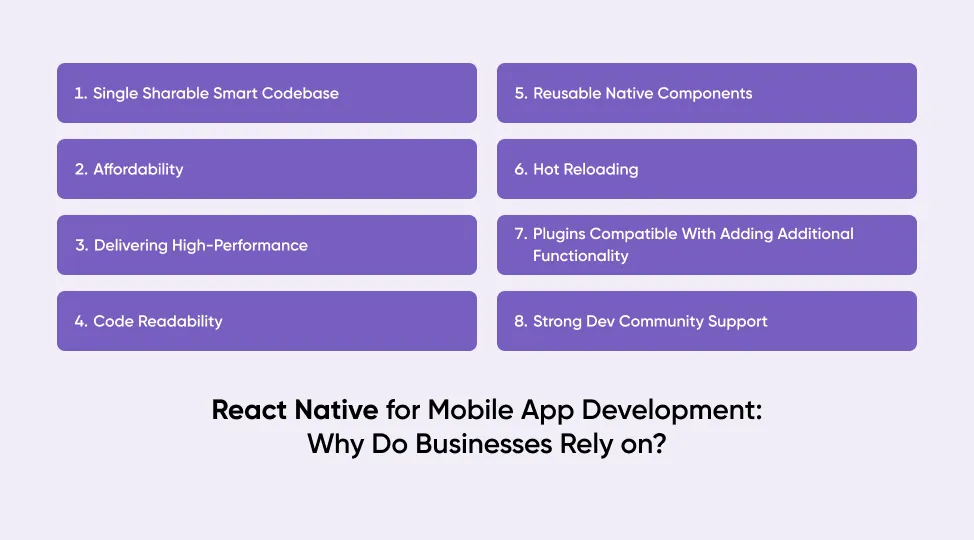
React Native for Mobile App Development: Why Do Businesses Rely on?
 Whether anyone envisions launching an online store, social media entertainment apps, finance, healthcare, or education sector, React Native app development companies are reliable cater with game changing solutions. They address client expectations and adapt trends to bring the best to the world.
React Native is a versatile tool with a bundle of accessibility features that enable efficiency, scalability, and agility. Below are the highlights of why businesses choose React Native.
Single Sharable Smart Codebase
There is no compromise on quality, performance, or native user experience. It drives consistency with sharable business logic and UI components. It saves numerous sleepless nights of developers hustling with code to debug and maintain. Implementing features to cater to both platform users with a native feel.
Affordability
All business owners like to spend less and get maximum returns and profit. React Native enhances the profit quotient and probability with the availability of a single codebase. There is no need to spend budget and effort setting up different development teams to handle different scenarios. Satisfying the business needs with utmost affordability.
Delivering High-performance
Whatever UI elements are required to develop native apps, React Native has all. Developers can utilize those building blocks to render avant-garde digital experiences. From subtle to critical versatile user-centric apps, React Native is a suitable tech stack. It ensures the high-level build for both versions.
Code Readability
Developers work on a single codebase targeting both platforms. Thus, they need to put in writing efforts only once. There’s no room for anomalies, lengthy faulty code lines, or duplicity.
As there’s a single codebase, discovering and analyzing the bottlenecks takes less time. We don’t need to assign the testing responsibilities to different QAs to switch and scan the iOS and Android versions. Ultimately, React Native app development drives efficiency and maintains a clean and readable codebase.
Reusable Native Components
Build apps beyond your imagination using an agile approach. React Native enables reusable components and building blocks to render applications for mobile and web platforms. With React Native mobile development, businesses can turn their business vision and aspirations into reality.
Hot Reloading
Iteration trips are always going on in the development world!
React Native enables instant runtime edits to specific application parts without interrupting the states. It can modify the UI without an entire reload. This gives developers relief without juggling the frustrative tasks of managing flawless workflows with instant inclusion of new features.
Plugins Compatible with Adding Additional Functionality
Sometimes, native mobile app development tools restrict hardware accessibility. By accessing React Native app development services, device access is extended, as it enables the incorporation of advanced third-party functionalities. This library keeps the essence of native apps without compromising performance and functionality.
Strong Dev Community Support
React Native hasn’t completed a decade yet. It's a new pick across the dev world. To help the newbie developers' dev community contribute with resources and best practices. Guiding at every step with relevant tutorials, libraries, and documentation. Also, garnishing the latest trends to develop future-proof solutions.
All such capabilities are also evident in the mobile app versions of the big brands. Uber Eats, Instagram, Meta, and Airbnb have hired React Native app development experts to demonstrate them practically to drive consistency and improve user experience. The below section draws attention to the use case of React Native for diverse business ideas.
Optimal Scenarios to Pick or Avoid React Native for Mobile App Development
Major businesses and small enterprises are adopting React Native app development to launch their business ideas; however, its capabilities are sometimes insufficient to address certain situations. Thus, individuals must properly research the competition, marketplace, customer interest, future dynamics, and budget.
Whether the build would be successful or if there are some roadblocks. Pay attention to these bullet points before initiating any idea with React Native for mobile app development.
-
If you are planning an early launch to target a wide audience with a tight budget, React Native will add value to it.
-
Another thing that makes React Native is that you need to build from ground zero when the concept is new. There’s no previous app version available. So the development team can easily develop the product without encountering complexity.
-
React Native flexes its capabilities for low-to-medium-level featured apps. Its availability of reusable components saves time, effort, and development costs. A clean, sharable codebase also enables ease of code management.
Alright, we've clarified when you should continue with React Native. Now, it's time to know when it’s off track.
-
Businesses must be clear about their potential audience base and where they’re getting the highest return on user attention. Is it the right thing to launch IDA for iOS and Android users, or should they wait to see reaction and engagement with only one app version? After the app gets launched, there are many things to take care of, like maintenance, updates, budget, time, resources, etc.
-
Suppose the project requires high maintenance and regular audits to ensure the app is secure and robust. In that case, we must assign resources 24/7 to a single project for its documentation and evolution. Because of that, they won’t have chances to experiment and work on other projects.
-
JS-based tools and libraries can build and launch smart apps. However, some projects demand critical hardware capabilities. To build high-performance UIs, they can only be integrated and implemented with native build platforms and development tools.
In meanwhile, know more about React Native tips and strategies, refer to this blog post: https://quokkalabs.com/blog/react-native-cross-platform-apps-tips-strategies/
React Native App Development Challenges at a Glance
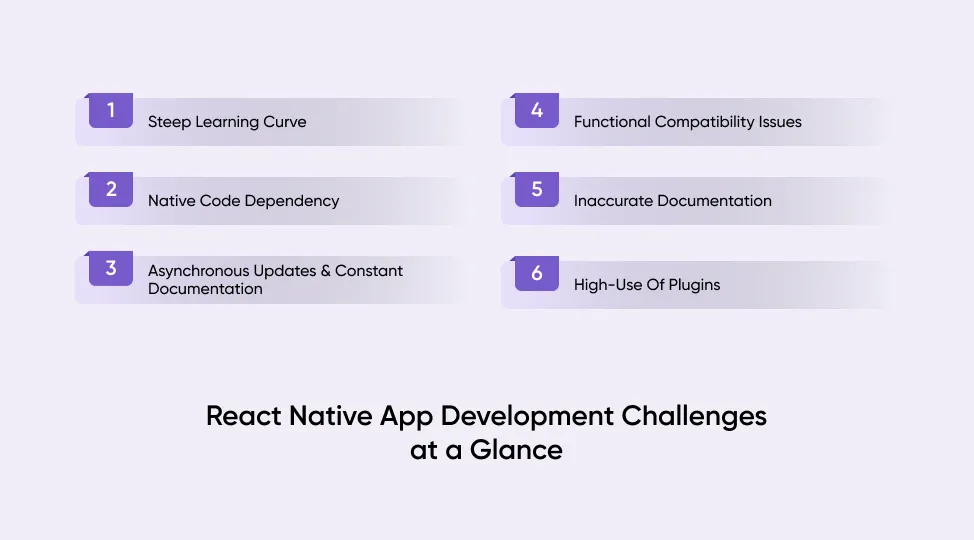 Experts suggest utilizing React Native for mobile app development. However, like other frameworks or libraries, it involves some challenges, so in this section, we will gauge them and learn about potential solutions to deal with them.
Steep Learning Curve
Businesses need to be aware of mobile app development-related concepts to avoid some challenges and get comfortable practicing this new scenario. They may lag in testing and debugging, UI design principles, patterns, and API fetching/ calling.
Solution:
So, before directly starting a complex project, it's better to go through some tutorials, guides, and videos to learn how it works. Connect with React Native app development team members for the best tips and tricks and assist them so you can be confident enough to take on future responsibilities.
Native Code Dependency
We need to add some native code to deliver a native app experience that integrates advanced features. This will surely elevate the app's complexity level.
Solution:
To optimize app performance, it is essential to practice code organization. Hire React Native app development companies to troubleshoot issues. They are efficient at handling real-life scenarios and can establish a robust RN bridge by referring to the documentation.
Asynchronous Updates & Constant Documentation
Visuals and animation engage mobile users with the app. Developers are aware of that, but handling high-frequency updates due to an asynchronous bridge is sometimes quite challenging.
Solution:
To resolve the bottlenecks and ensure proper data transmission through the RN bridge.
Practice batching updates, debouncing, and throttling for data handling.
Keep the app profiling practice on discovering the hotspots for performance optimization.
Handle animation, gestures, and high-frequency visuals utilizing native libraries.
Functional Compatibility Issues
You may have seen that when any app launches, the organization releases a note regarding the functionality and accessibility. It includes which device these features would not perform or face complexities and advises updating the OS. The same applies to React Native as the updates continue, so some devices may not support the latest features.
Solution:
The best way to avoid such challenging instances is to perform testing on all new and older moderators and release fallbacks to let people know the app remains functional or non-functional with some features. Moreover, developers can adapt some app performance optimization techniques to avoid lazy loading or rendering. Also, it can split resource-intensive features and code.
Inaccurate Documentation
As you know, the React Native version keeps releasing new features and updates. If all the essential and accurate information is not documented, how will developers learn about it and implement it in the real world?
Solution:
Developers should continue visiting the knowledge base, community forums, blogs and newsletters, social media channels, and websites.
High-use of Plugins
We use plugins to access advanced functionality support. If the plugins are newly created and unreliable, try to avoid integrating them. Always refer to libraries from trusted resources and participate in the community to suggest improvements.
Re-rendering lengthy and irrelevant code can also cause issues besides the issues mentioned above.
Solution:
It's better to keep updated with React Native mobile development groups for tricks and the latest updates. Efficient state management practices, error handling, CI/ CD, and UI/ UX design principles will add value to React Native apps.
Essentials Toolkit: React Native App Development
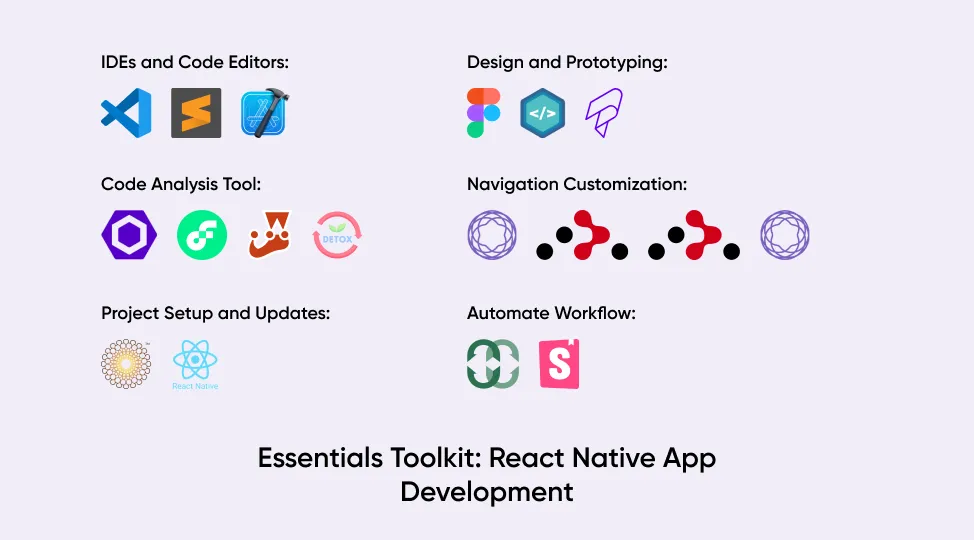 To streamline the project workflow as per the developer's preferences, we have curated the best tool enlisting below:
Visual Studio Code, Sublime Text, Xcode, Android Studio
- Project Setup and Updates:
Expo, React Native CLI
ESLint, Flow, Jest, Detox
Figma, Native Base, React Native Paper Library
- Navigation Customization:
React Native Router, React Native Router Flux, React Native Navigation
Lefthook, Storybook
Enjoy the hustle of the development world. Keep elevating your craft of app development and following best practices. Refer to blogs, forums, webinars, and seminars to understand the latest concept releases.

Are You Eager to Lock in the Deal for the Next React Native Project?
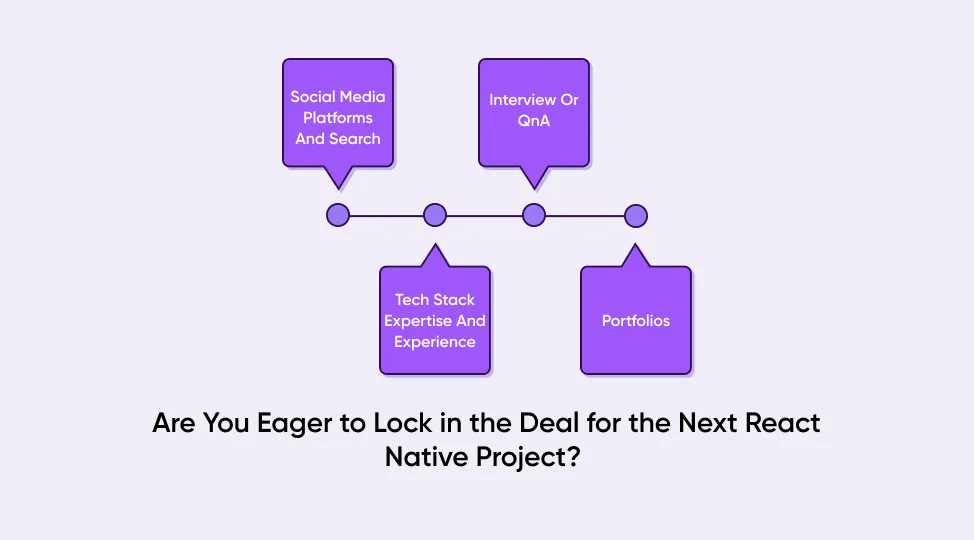 React Native for mobile app development is quite an exciting thought. Yet, be mindful that hiring an individual developer or an entire team is quite daunting and stressful. A brief checklist is mentioned below:
-
Visit social media platforms and search the web or other sources for prospects.
-
Get to know the professional tech stack expertise and experience
-
Schedule Interviews or QnA sessions
-
Ask for portfolios to know their niches
The blog draws attention to legitimate features and relevant use cases in different scenarios to shape scalable future-proof solutions. Collaborate with the right people to launch unbeatable mobile apps and tract user attention.
Final Words:
React Native for mobile app development is a trending thread around the discussion corners. With each new version, it gets better and unlocks new opportunities. Developers can leverage the ongoing trends to showcase their expertise, launching future-proof, feature-rich apps for SMEs and enterprises. Anyone wanting to launch something innovative and advanced must collaborate with React Native Developers!
FAQs:
1. What are the common challenges in React Native app development?
Ans. Platform-specific native features, overuse of third-party plugins, frequent animation, re-rendering, bugs, etc., are some of the common challenges a developer faces. Practicing best practices can help navigate these battlegrounds effectively.
2. How’s the debugging session for React Native?
Ans. Like any other tech stack ecosystem, React Native apps undergo testing phases. The development team tests them for network conditions, device and platform compatibility, and UI/ UX, like how they look or function in real time. They use ChromeDevTools, Debugging, and testing tools for manual and automated testing and debugging.
3. Why do businesses prefer React Native?
Ans. Nowadays, everything is fast-paced, and customers leave and frequently join. If the features, speed, and performance fail to engage them or if the app encounters lagging or privacy concerns. React Native, with its cross-platform native feel experience, can connect users from both iOS and Android. It can also yield a huge ROI.
4. Share the best brand facilitated with React Native app development.
Ans. Walmart, Airbnb, Uber Eats, and Tesla have elevated their brand values after introducing React Native. It has optimized mobile app performance with smooth navigation, animation, and interactive, appealing UIs. These apps are faster and more fabulous.