Engineer context-aware assistants using RAG, semantic retrieval, tool orchestration, and identity-aware access controls. Monitor prompts, responses, agent actions, hallucination risk, data exposure, latency, and token consumption across production workflows.
Operationalize Autonomous Systems with Enterprise Control
Deploy governed AI environments with RBAC, policy-as-code, model guardrails, prompt-injection protection, PII controls, immutable audit trails, and human-in-the-loop approvals across multi-agent architectures, cloud platforms, and regulated enterprise ecosystems.
Enterprise AI Agent Services for Controlled, Observable Autonomy
Operationalize AI agents with end-to-end observability, policy enforcement, security validation, and audit-ready controls, helping reduce runtime risk, support compliance, optimize performance, and improve production reliability.
01
AI Agent Observability & Runtime Monitoring
Instrument agent workflows with distributed tracing, execution telemetry, prompt-response logging, dependency mapping, latency analysis, and token-cost monitoring. We establish production-grade visibility across agent execution flows, tool calls, memory systems, model interactions, and multi-agent orchestration layers.
02
AI Governance Architecture & Policy Engineering
Design centralized governance frameworks using policy-as-code, role-based access control, approval workflows, model registries, and lifecycle controls. We align AI agent operations with enterprise risk policies, accountability requirements, data governance standards, and regulatory obligations.
03
Agent Security, Guardrails & Threat Protection
Secure autonomous systems against prompt injection, data exfiltration, unauthorized tool execution, model misuse, and privilege escalation. We implement input-output filtering, identity-aware controls, sandboxed execution, PII protection, behavioral guardrails, and zero-trust security patterns.
04
Agent, Compliance Validation & Red Teaming
Continuously validate task performance, task completion, policy adherence, hallucination risk, and tool-use reliability. Our evaluation pipelines combine synthetic testing, adversarial simulations, regression analysis, human review, and compliance evidence generation across pre-production and live environments.
05
AI Incident Response & Operational Optimization
Establish automated alerting, anomaly detection, rollback procedures, escalation paths, and forensic audit trails for agent failures. We identify likely root causes, contain operational impact, optimize model routing, help reduce inference costs, and improve service-level performance across enterprise AI ecosystems.
Enterprise AI Governance Portfolio
Production AI Systems Engineered for Secure Autonomy and Measurable Control
Explore how Quokka Labs operationalizes agent observability, runtime policy enforcement, and audit-ready governance strengthening system reliability, accelerating compliance, and reducing security exposure across enterprise AI environments.
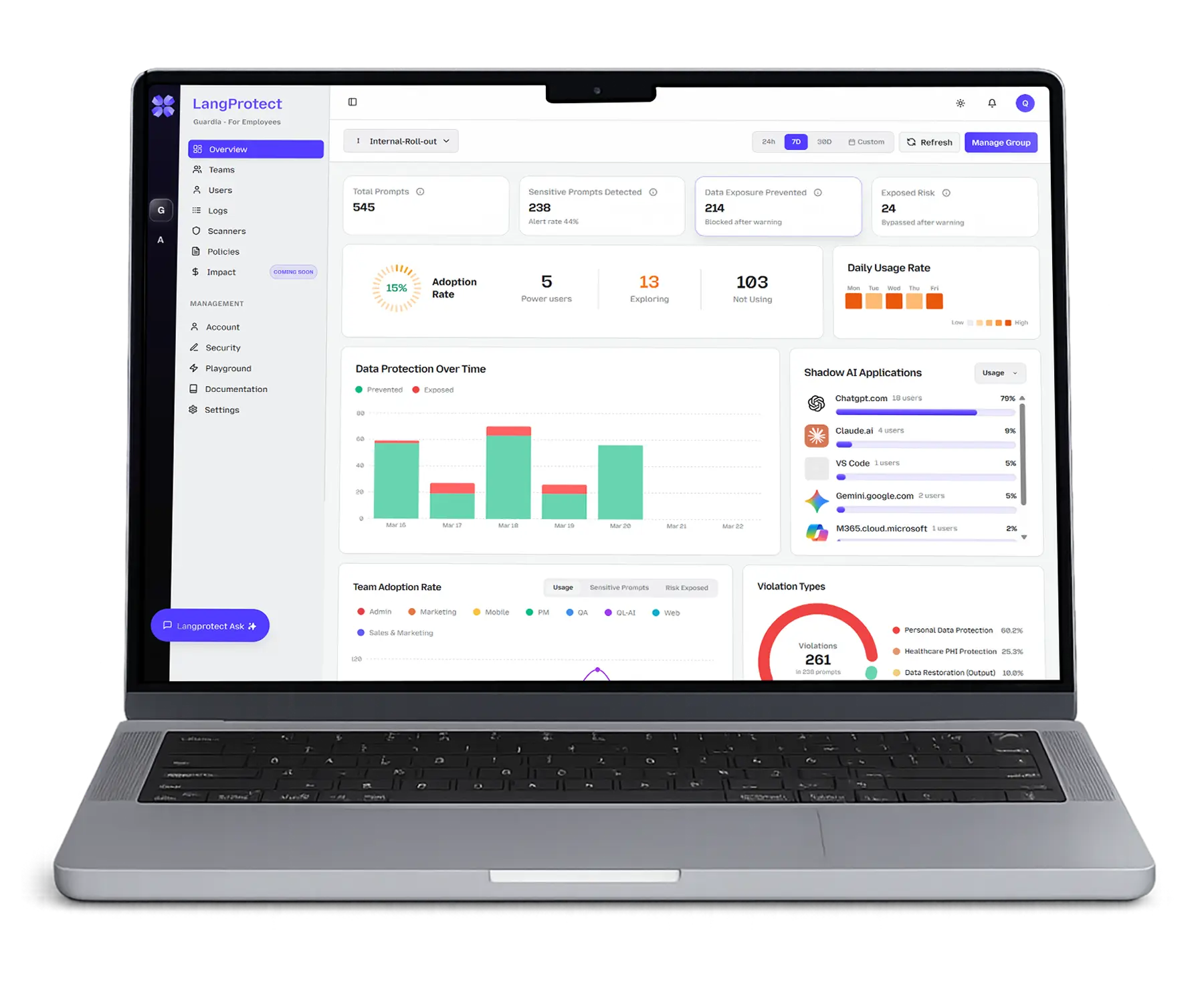
LangProtect
LangProtect centralizes agent telemetry, execution tracing, policy enforcement, and risk detection across production AI workflows. The platform monitors prompts, model responses, and anomalous agent behavior through guardrails and controls.
A security-focused platform engineered for continuous risk detection, controlled access, event monitoring, and auditable operations, strengthening enterprise visibility across sensitive digital workflows and user interactions ecosystems.
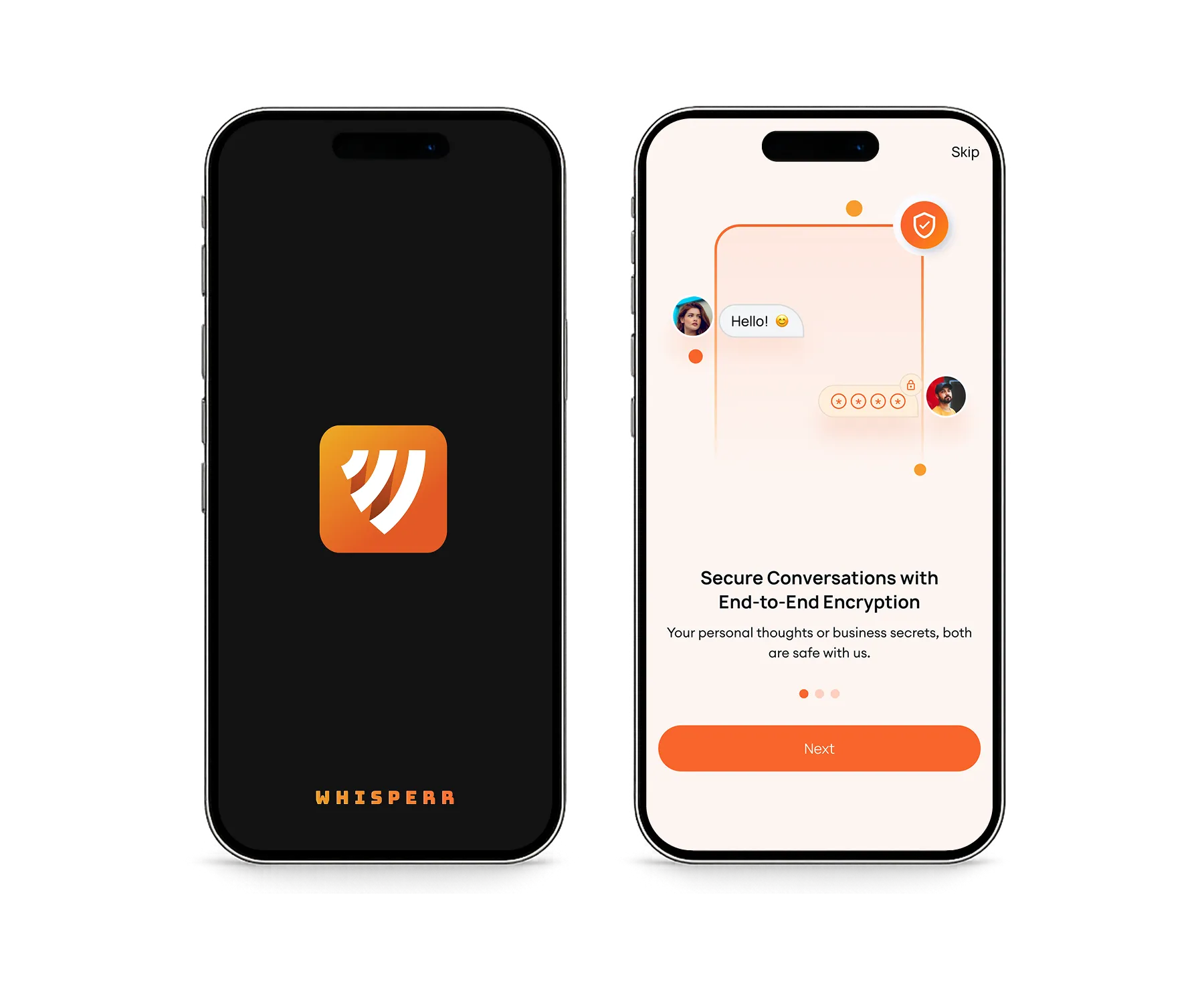
An encrypted communication platform integrating AI assistance, privacy controls, access governance, and cross-platform observability to support secure enterprise messaging with traceable, policy-aligned digital interactions at scale.
From Agent Discovery to Governed, Production-Scale Operations
Our governance lifecycle integrates architecture, observability, security validation, policy automation, and continuous assurance, helping reduce deployment risk, support compliance, and improve reliability across autonomous AI systems.
1
Enterprise Context & Risk Mapping
We analyze agent use cases, business-critical workflows, data classifications, model dependencies, tool permissions, and regulatory obligations. This establishes risk tiers, ownership boundaries, governance requirements, and measurable reliability objectives before production implementation.
2
Governance Architecture & Control Design
We define the enterprise control plane across agent runtimes, model gateways, memory layers, RAG pipelines, identity systems, and external tools. Policy-as-code, RBAC, approval gates, and audit controls are embedded into the target architecture.
3
Observability & Telemetry Instrumentation
We implement distributed tracing, prompt-response logging, tool-call telemetry, token-cost monitoring, latency analysis, and agent execution-flow visibility. Unified dashboards expose agent behavior, system dependencies, failure patterns, and performance bottlenecks across multi-agent environments.
4
Security, Guardrails & Agent Evaluation
Agents undergo adversarial testing for prompt injection, data exfiltration, privilege escalation, hallucinations, and unauthorized tool execution. Automated evaluation pipelines validate task accuracy, policy adherence, output quality, and operational resilience against defined acceptance thresholds.
5
Controlled Deployment & Policy Enforcement
We deploy agents through governed CI/CD pipelines with environment isolation, model versioning, release approvals, runtime guardrails, and rollback mechanisms. Real-time policy enforcement helps block policy-violating actions while supporting scalable, low-latency execution.
6
Continuous Assurance & Optimization
Production agents are continuously monitored for anomalies, policy changes or deviations, performance degradation, security events, and cost variance. Automated and human-reviewed remediation workflows, forensic audit trails, and lifecycle optimization strengthen reliability, compliance readiness, and operational efficiency.
Govern AI agents across clinical support, claims, patient engagement, and administration using PHI controls, human oversight, execution tracing, and audit monitoring to support safer, compliant operations.
Govern AI agents across clinical support, claims, patient engagement, and administration using PHI controls, human oversight, execution tracing, and audit monitoring to support safer, compliant operations.
Deploy governed AI agents for fraud detection, credit, transactions, servicing, and reporting with explainability, PII protection, decision traceability, anomaly detection, and rigorous enterprise model risk controls.
Govern AI agents across discovery, support, merchandising, fraud prevention, and fulfillment using behavioral monitoring, data loss prevention, execution policies, and cost observability to support more reliable and controlled commerce operations.
Embed observable AI agents into multi-tenant SaaS platforms with tenant isolation, permission controls, latency monitoring, token-cost visibility, and continuous performance governance across enterprise-scale operations.
Standardize enterprise AI governance across global capability centers using model gateways, agent registries, policy automation, evaluation pipelines, unified telemetry, and consistent compliance controls across regions worldwide.
Modernize citizen services with accountable AI agents using data sovereignty, role-based access control (RBAC), immutable audit trails, human oversight, and transparent controls across critical public service workflows.
Enterprise AI Agents Governed for Security, Compliance, and Controlled Scale
Embed zero-trust controls, policy-as-code, and audit-ready governance across AI agent lifecycles to help reduce regulatory exposure, strengthen data protection, and support secure production deployment.
NIST AI RMF
ISO/IEC 42001
EU AI Act
MITRE ATLAS
NIST AI RMF
ISO/IEC 42001
EU AI Act
MITRE ATLAS
GDPR
HIPAA
CCPA/CPRA
PCI DSS
GDPR
HIPAA
CCPA/CPRA
PCI DSS
ISO/IEC 27001
SOC 2
NIST CSF
CIS Controls
ISO/IEC 27001
SOC 2
NIST CSF
CIS Controls
OAuth 2.0
OpenID Connect
SAML 2.0
SCIM
FIDO2
OAuth 2.0
OpenID Connect
SAML 2.0
SCIM
FIDO2
AWS
Microsoft Azure
Google Cloud
Kubernetes
AWS
Microsoft Azure
Google Cloud
Kubernetes
OWASP
OWASP LLM Top 10
OWASP API Security
CWE
OWASP
OWASP LLM Top 10
OWASP API Security
CWE
SLSA
SBOM
Sigstore
in-toto
SLSA
SBOM
Sigstore
in-toto
OpenTelemetry
MITRE ATT&CK
SIEM
SOAR
OpenTelemetry
MITRE ATT&CK
SIEM
SOAR
Why Quokka Labs
Why Choose Quokka Labs for AI Agent Monitoring and Governance
Quokka Labs combines agent engineering, security architecture, and continuous assurance to help reduce runtime risk, support compliance readiness, and operationalize reliable AI autonomy across complex enterprise environments.
Enterprise Architecture Depth
Governance is engineered across models, agent runtimes, RAG pipelines, memory layers, APIs, identity systems, and infrastructure, helping eliminate fragmented controls and strengthen end-to-end operational accountability.
Full-Stack Agent Observability
Capture distributed traces, input and output events, tool calls, execution paths, latency, token consumption, and failure states to establish production-grade visibility across single-agent and multi-agent workflows.
Policy-as-Code Enforcement
Translate enterprise risk requirements into machine-enforceable policies, including RBAC, approval gates, execution constraints, data-access rules, and automated policy responses across the AI agent lifecycle.
Security-First Engineering
Protect autonomous systems against prompt injection, data exfiltration, privilege escalation, unauthorized tool execution, and model misuse through zero-trust controls, runtime guardrails, and adversarial validation.
Continuous Evaluation and Assurance
Operationalize automated evaluation pipelines for task accuracy, hallucination risk, policy adherence, regression detection, and tool reliability, supporting measurable quality before and after production deployment.
Platform-Agnostic Enterprise Integration
Integrate governance and observability across cloud platforms, model providers, orchestration frameworks, SIEM systems, CI/CD pipelines, and existing enterprise controls without introducing restrictive architectural dependencies.
From architecture and observability to policy enforcement and continuous assurance, Quokka Labs establishes the enterprise control layer required to scale autonomous AI securely and reliably.
Enterprise AI Technology for Observable, Governed Agent Operations
Integrate model providers, agent orchestration, telemetry, security, and cloud controls to support reliable deployment, improve runtime visibility, enforce policies, and reduce operational risk across production AI agent ecosystems.
OpenAI
AI Agent Governance Insights
Enterprise AI Agent Insights for Governed, Observable, and Secure Operations
Explore technical guidance on agent observability, runtime governance, evaluation pipelines, security controls, and cost optimization for deploying reliable, compliant AI systems at enterprise scale.
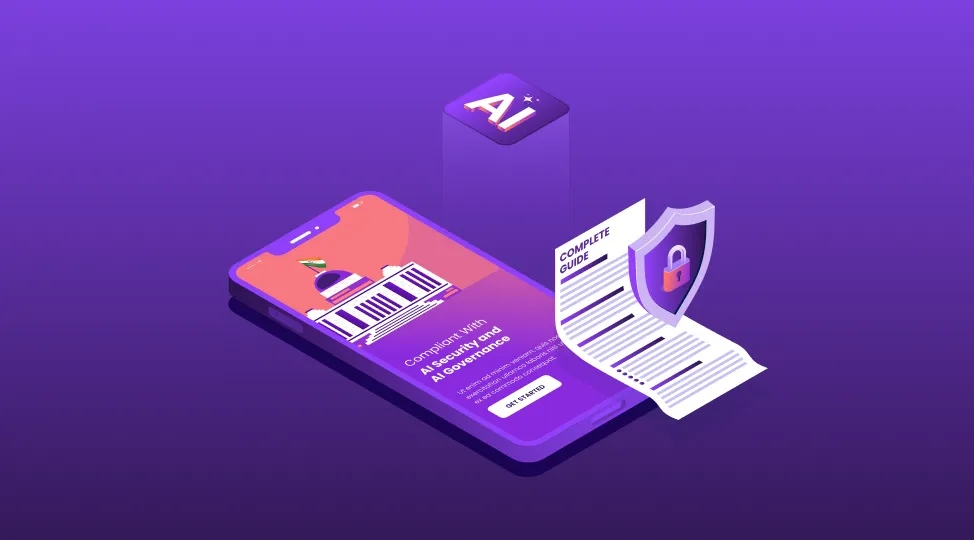
How to Stay Compliant With AI Security and AI Governance...
AI now powers decisions, products, and customer journeys, but it also expands your risk surface. This guide shows how to stay...
Trusted by Enterprises Operationalizing Governed AI at Scale
Quokka Labs combines enterprise AI engineering, security architecture, and production governance to support reliable deployment, reduce operational risk, and enable measurable outcomes across complex technology ecosystems.
0+
Years of Enterprise Engineering Excellence
0+
Digital & AI Engagements Delivered
0%
Client Retention Rate
0+
AI-Powered Solutions Shipped
Operationalize Governed AI Agents
Ready to Scale AI Agents with Enterprise-Grade Monitoring and Governance?
Engage Quokka Labs to assess agent architecture, runtime risk, observability gaps, and governance readiness accelerating secure deployment, strengthening compliance, reducing failures, and improving production reliability.
< 24 Hours Senior Expert Response
Every inquiry is reviewed by an AI product strategist or senior solution architect within one business day.
150+ Engineering & Cloud Experts
A multidisciplinary delivery organization spanning wide range of experts
5.0 Top-Rated Development Partner
Recognized across leading B2B technology-review categories
Book an AI Governance Consultation
AI Agent Monitoring & Governance FAQs
What metrics should enterprises monitor for AI agents?
Monitor execution traces, prompts, model responses, tool calls, memory retrievals, policy decisions, latency, error rates, token consumption, cost per outcome, and user feedback. These signals reveal where agent behavior, reliability, security, or economics deviate from defined service-level objectives.
How is AI agent observability different from traditional APM?
Traditional APM measures infrastructure health; agent observability explains why an agent acted, which context it used, which tools it invoked, and whether outcomes met policy and quality thresholds. Both telemetry layers should correlate through standardized traces, metrics, logs, and events.
Can governance policies stop unsafe agent actions in real time?
Yes. Runtime governance can evaluate tool requests, data access, transaction scope, and risk before execution. Policies may allow, block, redact, rate-limit, sandbox, or route high-impact actions for human approval reducing excessive agency and unauthorized operations.
How should enterprises evaluate AI agents before production?
Use scenario-based datasets, adversarial tests, tool-use simulations, and regression suites to measure task completion, factuality, policy adherence, recovery behavior, latency, and cost. Release gates should compare versions against defined thresholds, while production evaluations detect drift and emerging failures.
How can agent traces be captured without exposing sensitive data?
Apply data minimization, field-level redaction, encryption, retention controls, regional storage, tenant isolation, and role-based access. Sensitive prompt, completion, memory, and tool payloads should be selectively captured, tokenized, or excluded while preserving metadata required for forensic analysis and auditability.
Can monitoring work across multiple models, frameworks, and clouds?
A vendor-neutral monitoring layer can instrument heterogeneous models, agent frameworks, vector stores, APIs, and cloud environments using common telemetry schemas. This enables centralized tracing, evaluation, policy enforcement, and cost attribution without coupling governance to one model provider or orchestration platform.
What evidence is required for AI governance and compliance audits?
Governance evidence should include agent inventories, ownership, model and prompt versions, policy decisions, approval records, evaluation results, access logs, incidents, remediation actions, and immutable execution traces. These artifacts support risk reviews and demonstrate how controls operate throughout the AI lifecycle.