Edge AI for IoT changes more than inference location. It changes how teams manage fleet updates, device compatibility, observability, connectivity, rollback, and total inference economics. The strongest production architectures balance on-device, gateway, and cloud workloads based on latency, cost, privacy, hardware limits, and operational risk.
Key Takeaways
Key takeaways:
- Edge AI for IoT works best when architecture follows the workload, not the hardware trend.
- Edge vs cloud inference cost must be calculated across the full lifecycle, including connectivity, updates, monitoring, and recovery.
- Hybrid architectures are often the practical choice, keeping fast decisions local and complex workloads in the cloud.
- Fleet-scale deployment is harder than model deployment because hardware variance, rollback, observability, and drift compound quickly.
- AI model optimization for edge devices should balance accuracy, latency, memory, power, and hardware compatibility.
- Safe edge AI deployment requires staged rollouts, signed artifacts, telemetry, and last-known-good rollback paths.
- The Edge AI Deployment Map helps teams choose between cloud-first, gateway, on-device, and hybrid inference before scaling.
Paying Cloud Inference Costs for Decisions Your Devices Could Make Locally?
We’ll map what should run on-device, at the gateway, and in the cloud.
The edge AI market is being sold as a hardware story.
That is incomplete.
In October 2026 alone, Qualcomm pushed on-device AI into broadband gateways, while Silicon Labs tied embedded AI workflows to enterprise data platforms (Source).
The real contest is no longer whether devices can run models; it is whether companies can operate thousands of models safely, cheaply, and consistently.
For edge AI for IoT, inference cost is only one line item. Fleet updates, hardware variance, observability, rollback, power limits, and model drift decide production economics.
At scale, the winning architecture is usually neither edge-only nor cloud-only, but deliberately hybrid.
What Does Edge AI for IoT Actually Change in Production?
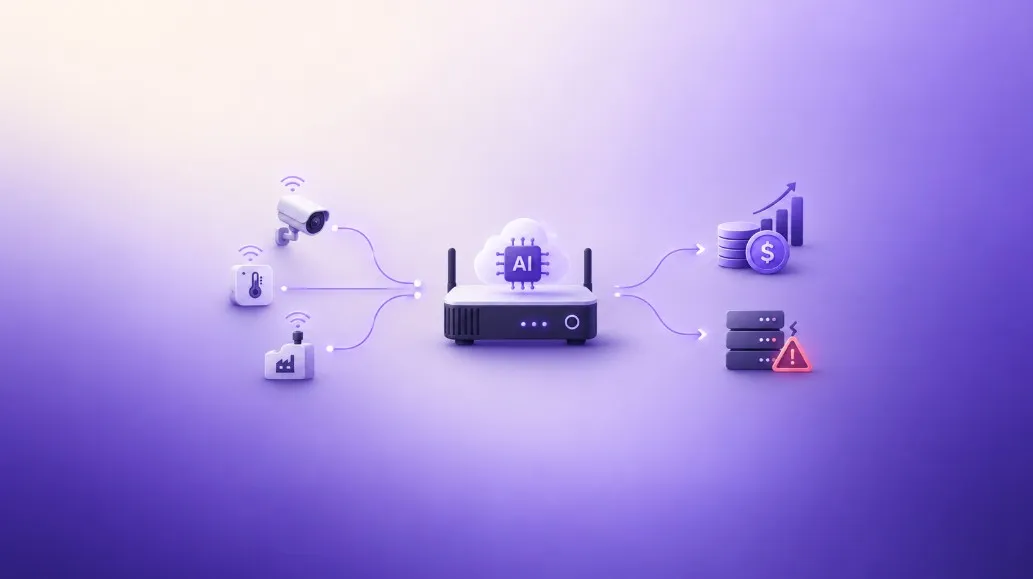
Edge AI for IoT moves inference closer to where data is generated, allowing devices or nearby gateways to classify, detect, predict, or act without sending every input to a centralized cloud. Its practical value comes from lower decision latency, less upstream data transfer, continued operation during connectivity loss, and tighter control over sensitive data, not simply from placing an AI model on smaller hardware.
That distinction matters. A successful edge AI deployment still needs cloud infrastructure for model training, fleet control, aggregated analytics, retraining, policy management, and complex workloads.
The architecture changes from device → cloud → decision into a distributed decision system:
| Layer |
Best responsibility |
| Device |
Immediate inference, filtering, local action |
| Edge gateway |
Aggregation, heavier models, protocol translation |
| Cloud |
Training, complex reasoning, fleet analytics, long-term storage |
| Control plane |
Model versions, deployment policy, telemetry, rollback |
This is why modern edge computing IoT architectures are increasingly hybrid.
AWS, for example, now documents patterns where constrained devices perform quantized local inference and send only complex anomalies upstream for deeper reasoning.
How Should You Calculate Edge vs Cloud AI Inference Cost?
The wrong comparison is “cloud GPU price versus edge chip price.”
The useful comparison is total cost per useful decision over the device lifecycle.
What belongs in the cost model?
| Cloud inference |
Edge inference |
| Inference requests |
Incremental AI-capable hardware |
| Compute duration |
Energy consumption |
| Data transfer |
Model storage |
| Streaming infrastructure |
Fleet-management infrastructure |
| Storage and preprocessing |
OTA model and runtime updates |
| Connectivity |
Field recovery |
| Cloud observability |
Device telemetry |
| Scaling overhead |
Hardware lifecycle constraints |
A practical model is:
Cloud cost = inference volume + data movement + processing + storage + connectivity
Edge cost = hardware uplift + energy + fleet operations + update traffic + recovery
Hybrid cost = local baseline + cloud escalation + fleet operations
Where does the economic crossover happen?
Edge vs cloud inference cost is primarily a fixed-versus-variable-cost decision. Cloud inference usually increases with inference volume and transmitted data. Edge inference shifts more expense into device hardware and distributed operations. Moving inference locally becomes economically attractive when avoided cloud processing and data-transfer costs exceed the incremental hardware, energy, deployment, observability, and fleet-management costs over the device’s expected service life.
That is the basis of edge AI inference cost optimization.
Do not optimize only the model. Optimize how often inference runs, which inputs are processed, what crosses the network, and which events require cloud escalation.
How Does the Edge AI Deployment Map Decide Where Inference Should Run?
Quokka Labs' Edge AI Deployment Map is a decision framework for choosing where intelligence belongs before choosing hardware.
It maps four deployment patterns against latency, connectivity, device capability, data sensitivity, and workload complexity.
| Deployment zone |
Use when |
Main constraint |
| Cloud-first |
Latency is flexible and models are large |
Network dependence |
| Gateway AI |
Many constrained sensors share local compute |
Gateway availability |
| On-device AI |
Decisions must happen locally |
Compute, memory, power |
| Hybrid cascade |
Most decisions are simple; some need stronger models |
Orchestration complexity |
Zone 1: Cloud-first
Keep inference centralized when devices generate small amounts of data, connectivity is dependable, and model complexity changes frequently.
Cloud remains the easier operational model because one model deployment can serve the entire fleet.
Zone 2: Gateway AI
A local gateway works well when individual sensors cannot support on-device AI but multiple devices operate in one factory, store, building, vehicle, or site.
This reduces raw upstream traffic without requiring accelerator hardware in every endpoint.
Zone 3: On-device AI
Use edge AI inference directly on the endpoint when network round trips are unacceptable, privacy requirements restrict data movement, or devices must operate offline.
Zone 4: Hybrid cascade
For many enterprises, this is the strongest production architecture.
A smaller local model handles frequent decisions. Uncertain, high-value, or computationally expensive cases move upstream.
This avoids forcing one inference architecture onto every request.
Teams exploring the wider business architecture can also review Quokka Labs' guide to AI and IoT in business.
What Breaks When You Scale Edge AI Across IoT Device Fleets?
A model that works on 20 devices can still become an operational problem on 20,000.
1. Hardware stops being uniform
Device fleets accumulate processor revisions, memory differences, firmware versions, accelerators, camera sensors, and thermal characteristics.
One model artifact may no longer behave identically everywhere.
Your fleet registry should therefore track hardware + firmware + runtime + model compatibility, not just device IDs.
2. Model rollout becomes a production-risk event
A bad cloud deployment can often be reverted centrally.
A failed edge update may leave devices disconnected, partially upgraded, or unable to load the previous model.
Production systems need:
AWS IoT Jobs supports controlled rollout rates and automatic abort conditions, while Azure recommends phased fleet deployment and explicit rollback configurations.
3. Observability becomes fragmented
Cloud inference gives operators centralized logs.
Edge AI for IoT distributes failures across physical locations.
Measure at least:
-
inference latency;
-
model version;
-
confidence distribution;
-
memory and CPU/NPU use;
-
temperature;
-
restart count;
-
input-data quality;
-
failed updates;
-
offline duration.
4. Model accuracy drifts by location
A vision model may encounter different lighting across facilities. Acoustic models meet different machinery. Sensors age.
Fleet-wide accuracy can therefore hide local degradation.
5. Power and thermal limits become runtime constraints
A benchmark taken on a development board does not describe a sealed enclosure operating continuously.
Thermal throttling can turn a model that passed latency testing into one that misses production deadlines.
6. Your edge platform eventually ages
Runtime lifecycle is easy to ignore during pilots. It becomes expensive later.
AWS ended support for Greengrass V1 on October 7, 2026, illustrating why edge platforms require planned runtime and dependency migration alongside model maintenance.
Your Edge AI Pilot Works. Will the Fleet Still Work at 10,000 Devices?
Quokka Labs can help map the architecture before inference cost, rollout risk, and fleet complexity become expensive to unwind.
How Do You Deploy AI Models on IoT Devices Without Creating Fleet Risk?
To deploy AI models on IoT devices, treat the model as one versioned component of a larger product, not as a file copied onto hardware.
Start with AI model optimization for edge devices
Optimize against the actual production target:
Quantize only after measuring the baseline
INT8 or lower-precision inference can reduce memory and computation substantially, but the engineering question is not “Can we quantize?”
It is whether the optimized model still meets the application’s accuracy and latency thresholds on every supported hardware class.
ONNX Runtime specifically recommends models optimized for less powerful hardware when performing on-device inference.
Separate models from firmware where hardware permits
Independent model packaging lets teams update inference logic without replacing an entire firmware image.
It also simplifies controlled rollback.
Treat deployment as an experiment with stop conditions
Never push immediately to the whole fleet.
Use representative test devices, then a small production cohort, then progressively larger groups.
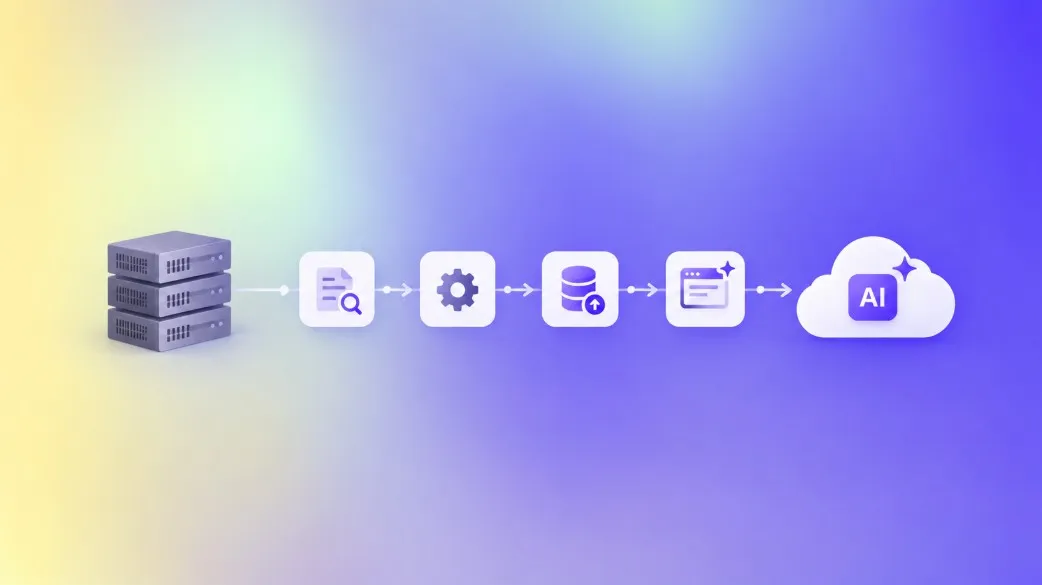
To scale edge AI across device fleets safely, organizations need centralized model versioning, hardware-aware targeting, signed artifacts, staged rollout, automatic failure thresholds, rollback, and device-level telemetry. The control plane matters as much as the inference runtime. Without these capabilities, every model update becomes a distributed software release across devices that may differ in hardware, connectivity, temperature, operating state, and software version.
When Should Edge AI for IoT Stay Local, Stay in the Cloud, or Use Both?
Use architecture requirements rather than ideology.
| Requirement |
Edge |
Cloud |
Hybrid |
| Millisecond local response |
Strong |
Weak |
Strong |
| Offline operation |
Strong |
Weak |
Strong |
| Large changing models |
Weak |
Strong |
Strong |
| Sensitive raw data |
Strong |
Depends |
Strong |
| Simple centralized operations |
Weak |
Strong |
Moderate |
| High-frequency inference |
Strong candidate |
Cost-sensitive |
Strong |
| Complex reasoning |
Limited |
Strong |
Strong |
| Constrained hardware |
Limited |
Strong |
Strong |
Companies trying to reduce AI inference costs should first identify which inference requests actually require cloud compute.
A useful pattern is local filtering followed by selective escalation. Sending one meaningful event upstream can be more valuable than transmitting thousands of raw observations.
Reliable upstream pipelines remain important. Quokka Labs' data engineering services address the data layer needed to connect distributed intelligence with enterprise systems.
Architecture choices spanning AI, existing platforms, and operating models may also require broader digital transformation services.
What Should You Look for in an Edge AI Implementation Partner?
Searching for an edge AI development company often produces teams focused primarily on model creation. Production edge AI requires a wider engineering scope.
Evaluate an edge AI implementation partner on whether it can own:
-
edge/cloud architecture;
-
embedded inference optimization;
-
IoT fleet control;
-
backend and data engineering;
-
observability;
-
device identity and security;
-
OTA deployment and rollback;
-
model lifecycle management;
-
production integration.
An IoT software development company that cannot demonstrate model operations may struggle with the AI layer. An AI specialist without distributed-device experience may struggle once the fleet leaves the lab.
That is why effective edge AI development services and edge AI deployment services need to connect the model, device, control plane, data platform, and business application.
For products where edge intelligence is part of a broader platform, product engineering services can connect device behavior with the application and cloud architecture.
When the core question is what should run locally versus centrally, ai strategy consulting should start from the problem and economics before selecting the model or accelerator.
How Should Enterprises Start Scaling Edge AI for IoT?
Do not begin by asking which edge chip to buy.
Start with four measurable questions:
-
What decision must happen locally?
-
What does one cloud inference path currently cost end to end?
-
What must continue working when connectivity disappears?
-
How will you update and recover 10,000 devices without touching them physically?
Those answers determine the architecture.
Quokka Labs is an end-to-end AI-native engineering and solutions company with 15+ years of engineering expertise. Its positioning is solution-first: start from the business problem, define what should be engineered, and take the system through architecture, secure deployment, and scale.
Our Ai Native Engineering services can help enterprises decide where inference belongs, architect the device-to-cloud control plane, and engineer production systems that can scale edge AI across device fleets.
For AI-driven product experiences above that infrastructure, explore our ai app development services.
Final Word
Edge AI for IoT is not simply a decision to move inference from the cloud onto a device. It is an architecture decision that changes how you manage cost, latency, connectivity, model updates, observability, security, and failure recovery across the entire fleet.
The right design starts by deciding which decisions must happen locally, which workloads still belong in the cloud, and how both environments will operate as one system.
At production scale, the difficult part is rarely running the first model on a device. It is keeping thousands of devices compatible, measurable, recoverable, and economical as models, hardware, and operating conditions change.
Use the Edge AI Deployment Map to evaluate cloud-first, gateway, on-device, and hybrid inference against your actual workload before committing to hardware or fleet architecture.
Planning an Edge AI Architecture That Can Survive Production Scale?
Map your inference workloads, device constraints, fleet operations, and edge vs cloud inference cost before committing.
Frequently Asked Questions About Edge AI for IoT
1. Should my company move AI inference from the cloud to edge devices?
Move inference closer to devices when latency, connectivity, privacy, bandwidth, or recurring cloud processing costs create measurable constraints. Most enterprises benefit from hybrid edge AI for IoT, keeping time-sensitive decisions local while sending complex workloads and centralized analytics to the cloud.
2. How do I compare edge vs cloud inference cost for my IoT fleet?
Calculate total lifecycle cost, not only compute pricing. Compare cloud inference, data transfer, storage, connectivity, and processing against edge hardware, energy, fleet management, updates, monitoring, and recovery. The better architecture depends on inference frequency, device lifespan, and operating conditions.
3. How can I reduce AI inference costs across thousands of IoT devices?
Start by identifying which requests actually require cloud processing. Use on-device AI for repetitive, latency-sensitive decisions, optimize models through quantization, filter unnecessary data locally, and escalate only complex cases. This hybrid approach can reduce AI inference costs without limiting model capability.
4. What usually breaks when companies scale edge AI across device fleets?
Hardware differences, failed model updates, weak rollback processes, fragmented observability, thermal limits, connectivity gaps, and model drift become major problems. To scale edge AI across device fleets, teams need hardware-aware deployment, staged releases, telemetry, compatibility controls, and automated recovery mechanisms.
5. How do I deploy AI models on IoT devices without disrupting production?
Treat every edge AI deployment like a distributed software release. Package models independently where possible, sign artifacts, validate device compatibility, begin with representative canary devices, define automatic failure thresholds, monitor runtime behavior, and maintain a verified last-known-good model for rollback.
6. What should I look for when choosing an edge AI development company?
Choose an edge AI implementation partner that can engineer more than models. Evaluate experience across device software, AI model optimization for edge devices, fleet orchestration, cloud integration, observability, security, OTA deployment, rollback, and data engineering required for production-scale edge AI operations.
7. Should my IoT product use on-device AI, gateway inference, cloud AI, or a hybrid architecture?
Use on-device AI for immediate or offline decisions, gateway inference for groups of constrained devices, and cloud AI for large or frequently changing models. A hybrid edge AI architecture usually fits mixed workloads where latency, cost, privacy, and model complexity differ.