Key takeaways:
- Digital transformation* digitizes and connects processes; AI transformation redesigns how work is performed.
- Enterprise AI changes workflows, decision rights, roles, governance, and operating models, not just software features.
- AI transformation depends on strong data, application, integration, and modernization foundations.
- AI pilots stall when companies add AI without redesigning the underlying workflow.
- Success should be measured through business outcomes such as turnaround time, automation rate, cost per case, and exception rate.
- The strongest AI transformation strategy starts with a measurable business problem, not a model or tool.
- AI transformation consulting becomes critical when enterprises need to move from isolated AI use cases to governed, production-ready systems.
Ready to Redesign Work Around AI?
Turn high-value workflows into governed, measurable AI-enabled operating systems built for production.
Most companies still call a Copilot rollout “AI transformation.” That label is harder to defend.
McKinsey’s October 2026 research found 80% of respondents report productivity gains from AI, yet 37% report positive EBIT impact and just 6% qualify as AI high performers (Source).
The gap explains what changed after digital transformation: software no longer only digitizes work; AI can analyze, decide, generate, and execute it. Digital transformation modernized systems and processes. AI transformation redesigns workflows, roles, decision rights, governance, and economics around human-plus-machine execution.
The real question is no longer whether enterprises use AI. It is whether work itself has changed.
What is AI Transformation vs Digital Transformation?
Digital transformation uses cloud, software, APIs, automation, data platforms, and modern applications to improve how a business operates. It typically digitizes transactions, removes manual handoffs, connects systems, and makes processes measurable.
AI transformation changes who or what performs the work. Enterprise AI can interpret unstructured information, generate outputs, recommend decisions, and execute multi-step tasks under defined controls.
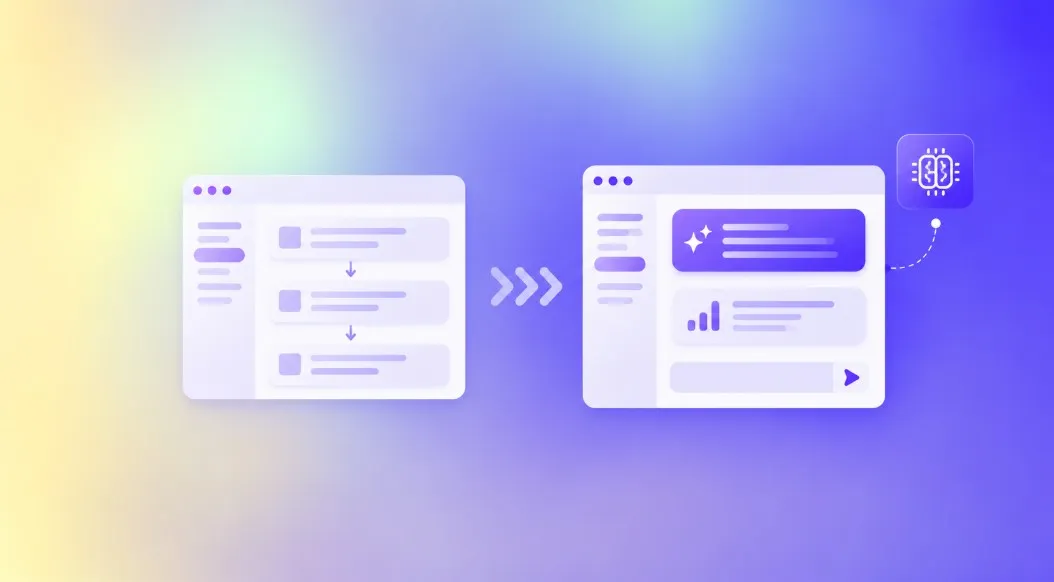
Digital transformation changes the systems through which work moves. AI transformation changes how work itself is performed. The first digitizes and connects processes; the second redesigns workflows around machine reasoning, generation, and action while assigning humans clearer roles for intent, judgment, exception handling, and accountability.
| Area |
Digital transformation |
AI transformation |
| Primary aim |
Digitize and standardize processes |
Redesign work and decision flow |
| Software role |
Record, route, calculate, automate rules |
Interpret, generate, decide, act |
| Human role |
User and process operator |
Director, reviewer, exception owner |
| Data |
Reporting and system integration |
Grounding, context, retrieval, feedback |
| Governance |
Access, compliance, process controls |
Plus model risk, autonomy, output quality |
| Success metric |
Adoption, uptime, cycle time |
Business outcome, automation rate, exception rate |
What Changed at Work Between Digital Transformation and AI Transformation?
Traditional digital transformation strategies moved work from paper, spreadsheets, and disconnected systems into software. The workflow usually remained recognizable: a person opened a system, reviewed information, made a decision, and clicked the next action.
AI transformation changes that sequence.
A governed AI system can receive a case, retrieve context, classify it, draft an action, call approved tools, route exceptions, and preserve an audit trail. Humans move from performing every step to defining intent, setting boundaries, reviewing sensitive decisions, and improving the system.
Microsoft’s 2026 Work Trend Index found 66% of surveyed AI users said AI gave them more time for high-value work, while 58% said they were producing work they could not have produced a year earlier. It also found organizational conditions mattered more than individual effort for reported AI impact.
The work shift in one line
Digital transformation made work digital. AI transformation makes parts of work executable by software that can reason within boundaries.
That is why an AI transformation strategy is an operating-model decision, not an AI-tool purchasing plan.
How Does the Transformation Delta Table Explain What AI Changes?
The Transformation Delta Table is a practical way to identify the gap between a digitally modern business and an AI-transformed one.
| Transformation layer |
Digital transformation baseline |
AI transformation delta |
Leadership question |
| Unit of work |
Task, transaction, workflow step |
Goal, case, decision, outcome |
What can AI own end to end? |
| Decisioning |
Human judgment or fixed rules |
Model-supported or agent-executed decisions |
Which decisions require human approval? |
| Interfaces |
Screens, forms, dashboards |
Natural language, agents, APIs |
Can work happen without opening another screen? |
| Data |
Integrated records |
Context available at decision time |
Can AI retrieve trusted, permissioned context? |
| Architecture |
Apps, cloud, APIs |
Models, orchestration, retrieval, evaluations |
Where does the AI control layer sit? |
| Governance |
Identity, access, compliance |
Autonomy limits, model risk, traceability |
What happens when confidence is low? |
| Workforce |
Roles built around tasks |
Roles built around judgment and outcomes |
Which responsibilities change? |
| Measurement |
System adoption and process speed |
Cost per case, turnaround, automation, quality |
Is the business result improving? |
The delta matters because many enterprises already completed major digital transformation programs. Their next bottleneck is not another portal. It is redesigning work across the systems they already own.
Is AI Transformation Replacing Digital Transformation?
No. AI transformation depends on the foundations created by digital transformation.
If core applications cannot expose data reliably, identity is fragmented, workflows are undocumented, or integrations break under load, AI will amplify those weaknesses. In that situation, enterprise application modernization and data engineering services may be prerequisites to enterprise AI.
Digital transformation and AI transformation therefore overlap:
-
Modernize the system when legacy architecture blocks integration or change.
-
Fix the data layer when context is incomplete, stale, or inaccessible.
-
Redesign the workflow when software exists but people still perform most reasoning and coordination.
-
Introduce AI where machine reasoning or action can improve a measurable business unit.
For connected physical operations, the same logic extends beyond software. Quokka Labs’ analysis of AI and IoT in business shows why data, devices, and intelligent decisioning must be designed as one operating flow.
Why Do AI Transformation Strategies Stall After Digital Transformation?
The common failure is simple: organizations add AI to the old process map.
Deloitte’s 2026 enterprise AI research found 48% of respondents said their organization had introduced AI without redesigning the workflows or roles around it; only 12% reported redesign at scale with a new operating model.
Five structural causes
-
The workflow stays human-first. AI drafts content, but approvals, data gathering, routing, and follow-up remain manual.
-
Data is available but not usable in context. Enterprise AI needs current, permissioned, traceable information at the point of action.
-
Autonomy is undefined. Teams do not specify what AI may decide, what it may execute, and when humans must intervene.
-
Pilots are measured by usage. Logins and prompts do not prove lower turnaround time, lower processing cost, better quality, or more revenue.
-
Ownership is split. Business, technology, risk, security, and data teams optimize different parts of the same workflow.
BCG’s 2026 research similarly argues that AI-first value requires redesigning workflows, roles, and operating models rather than layering AI onto structures built for human-only execution.
Your AI Pilots Should Not Stop at Proof of Concept
Map the workflow, data, architecture, and governance needed to move enterprise AI from isolated experiments into production.
Contact us!
What Should an AI Transformation Strategy Include in 2026?
A credible AI transformation strategy starts with one business workflow, not a list of models.
1. Select a measurable workflow
Choose a workflow with visible volume, cost, delay, errors, or revenue impact. Define the baseline before engineering begins.
2. Redesign the human-AI operating model
Map each step as human-led, AI-assisted, AI-executed, or exception-only. Then define approval thresholds, escalation rules, and accountable owners.
A production AI workflow needs more than a model. It needs a defined business outcome, trusted data, integration with systems of record, evaluation criteria, permission boundaries, human escalation, security controls, monitoring, and an owner accountable for the result. Without those elements, an AI pilot is still an experiment.
3. Engineer the data and application foundation
Use digital transformation consulting to identify structural gaps, then apply software product engineering services where the workflow needs new product or platform capabilities.
Architecture must support change
Keep model choice separate from business logic where possible. Design retrieval, tool access, evaluation, observability, and security so models can change without rewriting the entire workflow.
4. Govern autonomy before scaling it
Define data access, action permissions, confidence thresholds, logging, retention, human review, and rollback. Governance belongs inside the architecture, not in a policy document added after deployment.
5. Scale only after business evidence appears
PwC’s 2026 guidance argues for concentrated AI bets rather than broad enterprise mandates. That matches the practical sequence: prove value in one or two high-impact workflows, standardize reusable controls and components, then expand.
When Do You Need AI Transformation Consulting Instead of Digital Transformation Consulting?
Choose digital transformation consulting when the core problem is fragmented systems, legacy applications, weak integrations, cloud migration, poor process visibility, or inaccessible data.
Choose AI transformation consulting when the digital foundation exists but work still depends on people reading, interpreting, deciding, coordinating, and updating multiple systems manually. Effective AI consulting should connect that operating-model redesign to architecture, governance, and measurable business outcomes.
You likely need both when modernization and AI workflow redesign must happen together.
| Your current problem |
Best starting point |
| Legacy core blocks change |
Digital transformation / modernization |
| Data is fragmented |
Data engineering |
| AI pilots cannot reach production |
AI transformation consulting |
| Teams use copilots but workflows are unchanged |
Work redesign + enterprise AI |
| New AI-native product is required |
ai app development services |
| Strategy is unclear |
ai strategy consulting |
How Should Leaders Measure AI-Driven Digital Transformation?
Do not measure transformation by the number of AI tools deployed.
Measure the business unit of work:
-
turnaround time per case
-
cost to process one case
-
percentage of work completed without manual intervention
-
exception and rework rate
-
decision accuracy or quality
-
revenue or conversion impact
-
compliance incidents and policy breaches
-
time from signal to action
This is where AI-driven digital transformation becomes auditable. Technology metrics still matter, but they support the business metric rather than replace it.
What Does AI Transformation Mean for Roles, Teams, and Governance?
AI changes roles before it eliminates entire functions. Tasks move between humans and software; decision rights become explicit; managers supervise outcomes and exceptions rather than only activity.
AI transformation changes the division of labor. Machines can take on more analysis, drafting, retrieval, coordination, and bounded execution, while humans retain responsibility for intent, judgment, sensitive decisions, exceptions, and accountability. The management challenge is therefore not simply adoption; it is redesigning roles and controls around a mixed human-AI workforce.
Microsoft and McKinsey’s 2026 research both point toward the same organizational issue: employee-level AI use can rise faster than the operating model around it. That creates productivity without equivalent enterprise value unless leaders redesign the system of work.
How Should You Choose an AI Transformation Partner in 2026?
Evaluate an AI transformation company on its ability to move from problem definition to production, not on how many models appear in its capability deck.
Ask five questions:
-
Can the team map the business workflow before proposing AI?
-
Can it engineer data, applications, integrations, AI, security, and governance as one system?
-
Does it define human and AI decision rights explicitly?
-
Will success be measured in business units rather than prompt volume?
-
Can the same architecture move from proof-of-value to governed production?
Quokka Labs is an end-to-end AI-native engineering and solutions company with 15+ years of engineering expertise. Our approach is solution-first: we start from the business problem, define what should be engineered, and take the system through architecture, integration, secure deployment, and scale.
For enterprises comparing Ai Native Engineering services or broader AI transformation services, the useful starting question is not “Which AI should we buy?” It is “Which unit of work should change, and what architecture will carry it safely?”
The Final Takeaway on AI Transformation vs Digital Transformation
Digital transformation changed how companies use technology. AI transformation changes how companies organize and execute work.
The distinction matters because adding AI to existing software does not automatically change business performance. Enterprises need to redesign workflows, decision rights, data access, governance, human oversight, and measurement around AI-enabled execution.
The strongest AI transformation strategy therefore starts with a business problem, not a model. Identify the unit of work that should change, define what AI can safely execute, engineer the supporting architecture, and measure the outcome in business terms.
For leaders evaluating AI transformation consulting, AI transformation services, or broader digital transformation consulting, the priority is moving from isolated AI usage to production systems that are governed, integrated, measurable, and accountable.
Turn Your AI Strategy Into a Production-Ready Operating Model
Identify where AI should change the work, then engineer the data, architecture, governance, and workflows required to take it into production.
FAQs: AI Transformation vs Digital Transformation
1. How do I know whether my company needs AI transformation or digital transformation?
Choose digital transformation when legacy systems, fragmented data, or disconnected processes are the main problem. Choose AI transformation when your digital foundation exists, but employees still perform repetitive analysis, decisions, coordination, and workflow execution manually across enterprise systems.
2. What should an enterprise AI transformation strategy include before implementation?
An enterprise AI transformation strategy should define priority workflows, measurable business outcomes, data readiness, system integrations, human decision rights, AI autonomy limits, governance, security, evaluation criteria, and production ownership before selecting models, platforms, or AI transformation services.
3. When should I hire an AI transformation consulting company instead of handling AI internally?
Consider AI transformation consulting when internal teams lack experience connecting enterprise AI with workflow redesign, data architecture, application integration, governance, and production deployment. The right partner should help define what to automate before recommending specific models, agents, or platforms.
4. How can I measure ROI from AI-driven digital transformation?
Measure AI-driven digital transformation using business metrics such as cost per case, turnaround time, automation rate, exception rate, conversion impact, decision quality, and rework. Avoid treating AI adoption, prompt volume, licenses purchased, or pilot count as primary ROI indicators.
5. Why are our enterprise AI pilots not creating measurable business value?
Enterprise AI pilots often stall because companies add AI to existing workflows without redesigning roles, approvals, integrations, and decision rights. Business value usually appears when AI becomes part of an end-to-end workflow with measurable ownership, governance, and production controls.
6. What should I look for when comparing AI transformation services providers?
Compare AI transformation services providers on workflow discovery, architecture, data engineering, enterprise integration, AI governance, security, production engineering, and measurable business outcomes. Prioritize providers that can move from problem definition to deployment instead of offering isolated proofs of concept.
7. How are AI transformation consulting and digital transformation consulting different?
Digital transformation consulting focuses primarily on modernizing applications, cloud platforms, data, integrations, and digital processes. AI transformation consulting goes further by redesigning how work is performed, deciding which tasks AI executes, defining human oversight, and governing enterprise AI at scale.