Most founders do not lose money because they moved too slow. They lose it because they bought the wrong scope.
In 2026, the gap between a quick AI demo and a usable product is still huge, and that is exactly why most ask about AI app development cost! It is one of the first questions serious buyers ask.
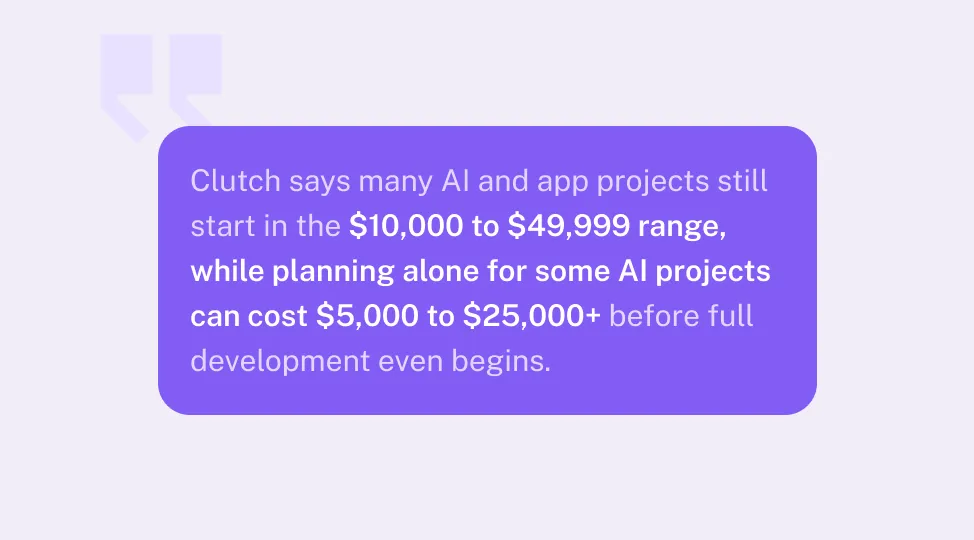
That means your first budget should buy clarity, not just code. (Source: Clutch)
AI App Development Cost In 2026 Starts with One Hard Truth
Here is the hard truth. Budget does not decide whether your app succeeds. Scope does.
That is why so many founders get frustrated after one bad build. They asked for a full product on a tiny budget, got a messy prototype, then had to pay again to rebuild the same thing properly. It happens a lot. The cheap version often skips the parts that protect the product later, like backend structure, access control, testing, logging, and support after launch.
So when people ask, how much does AI app development cost, the honest answer is this. It depends on what you are trying to buy. Proof is cheaper. Trust is not.
This is also where AI development pricing gets confusing. A vague hourly estimate sounds flexible, but for a non technical founder, it usually creates more risk. You do not need open-ended billing. You need a clear scope, written deliverables, and a realistic boundary between phase one and phase two.
So the better question is not, what does AI cost. It is, what can your budget safely buy?
Stop Guessing What Your AI Budget Can Buy
See what a real $5K, $10K, or $15K AI scope should include before you commit to the wrong team, the wrong features, or another expensive rebuild.
How Much Does AI App Development Cost When You Only Have $5K, $10K, Or $15K
Let us answer the real buying question fast.
| Budget |
What You Usually Get |
Best For |
Biggest Limitation |
| $5K |
Clickable prototype, narrow proof of concept, basic UI, maybe one AI workflow |
Testing an idea fast |
Not production ready |
| $10K |
Lean MVP, core flow, auth, simple backend, limited integrations |
Founder validation and early demos |
Still constrained scope |
| $15K |
Stronger MVP, better UX, cleaner backend, analytics, security basics, launch prep |
Investor demos and first users |
Not a full enterprise product |
This is the part many founders miss. Price is shaped more by scope than by screen count. A tiny app with auth, model calls, retry logic, error handling, usage controls, and admin tools can cost more than a larger looking app with fake depth.
That is also why AI MVP cost USA can feel higher than expected. Buyers in the US usually expect discovery, cleaner communication, QA, deployment support, and fewer excuses. And yes, planning alone for AI projects can run from $5,000 to $25,000 or more, which is a strong reminder that smaller budgets need to stay brutally focused.
Now let us break down what each budget tier really buys, because this is where most founders get misled.
What A $5K AI Build Actually Gets You
A $5K Ai development cost build can be useful. But only when you treat it like proof, not a product.
Best Case Outcome At $5K
At this level, you can usually expect:
-
a clickable prototype or very narrow proof of concept
-
one simple AI workflow
-
basic front end screens
-
prompt based behavior using an existing model
-
maybe a low code or no code base
-
limited internal controls
That can be enough to test interest, show an advisor, or validate one clear user problem. It can help you move quickly. It can even help you avoid building the wrong thing. That matters.
What It Usually Does Not Include
What it usually does not include is the part founders assume is there:
-
scalable backend
-
proper rate limiting
-
secure key handling
-
deep testing
-
polished UX
-
analytics
-
structured logs
-
strong error handling
-
reliable handoff docs
And that is where the damage starts. A vendor may call it a full app. It is not. It is a proof layer.
Who This Budget is Right For
A $5K build works best for:
If your real goal is learning, not launching, this tier can do the job.
Where Founders Get Burned
This is the danger zone. Some teams promise “full AI app” at this price, but skip the boring stuff that keeps the product standing. That means exposed API keys, weak auth, fragile flows, and code nobody wants to touch later.
So yes, AI app development cost can start low. But at $5K, you are buying proof, not trust.
That is why many founders move up. They do not just want to show the product. They want to use it.
What A $10K AI MVP Usually Gets You
This is where things start to feel real.
A $10K budget is often the first level where an MVP has enough shape to support actual feedback instead of polite compliments. It is still lean. Still constrained. But much more useful.
What Improves at This Level
At $10K, you can usually get:
You are no longer buying pure hope. You are buying momentum.
Typical Deliverables
A realistic $10K scope may include:
-
discovery and scoping
-
wireframes or practical UI design
-
one functional AI workflow
-
backend for core logic
-
MVP level QA
-
deployment support
-
a short bug fix window after launch
This is also the budget where a good team can cut waste. They can tell you what belongs in version one, what should wait, and what sounds nice but kills timeline.
Why $10K is Often the Sweet Spot for Seed Founders
For many founders, this is the practical middle.
It is enough for investor demos that do not feel embarrassing. Enough for first user interviews. Enough to start collecting real product feedback. And enough structure to avoid a rewrite too early.
This is also where a skilled ai app development company can create the right tradeoff between speed and foundation. Not overbuilt. Not flimsy. Just focused.
What Still Stays Out of Scope
A $10K MVP still will not cover:
So if you are asking, how much does AI app development cost, and your expectation is “real product, limited scope, credible demo,” then $10K is often the most honest starting point.
What A $15K AI MVP Can Unlock
Now we are talking about a stronger first product.
A $15K budget does not buy an enterprise platform. It does buy a much safer MVP.
What Gets Better Beyond the Basics
At this tier, the difference is not just more features. It is better quality in the layers users do not see right away, but definitely feel later:
-
stronger architecture decisions
-
more polished UX
-
smoother onboarding
-
analytics and event tracking
-
stronger testing coverage
-
cleaner APIs
-
better logging and monitoring
That makes the app feel more dependable. And that feeling matters.
Realistic Scope At $15K
A smart $15K scope can often include:
This is also the point where cross platform mobile app development services can make sense for founders trying to launch on both platforms without doubling cost too early.
Why This Tier Feels Safer
Investors and early users are not only judging the idea. They are judging whether the product feels stable, intentional, and worth another step.
A cleaner MVP sends that signal. Less breakage. Better flows. Fewer obvious security mistakes. Easier roadmap for version two.
What It Still Will Not Buy
Even here, you are not getting:
-
enterprise grade compliance
-
custom model pipelines
-
a broad multi platform ecosystem
-
deep automation across many departments
-
full product market fit iteration
Still, $15K can go much further when the budget is spent on the right layers.
AI Development Pricing Depends on More Than the Number on Your Budget
This part matters because bad estimates usually ignore hidden work.
The Biggest Cost Drivers
Your AI development pricing is shaped by:
-
product scope
-
model choice
-
third party integrations
-
custom backend work
-
UI complexity
-
security requirements
-
QA depth
-
launch timeline
The Hidden Cost Drivers Founders Miss
This is where budgets quietly bleed:
A lot of cheap quotes ignore these parts completely. Then they appear later as “small extras.” They are not small. They are the difference between a demo and a dependable app.
That is one reason AI MVP cost USA often feels higher. US buyers usually want speed, reliability, tighter communication, and fewer avoidable mistakes. Clutch’s latest pricing guides still show that many AI and app development projects land in the $10,000 to $49,999 range, not because every product is huge, but because real delivery includes more than raw coding.
What You Are Really Paying for in AI App Development Cost
You are not just paying for code. You are paying to reduce expensive mistakes.
Strategy
You are paying for:
Design
You are paying for:
Development
You are paying for:
-
front end
-
backend
-
integrations
-
AI workflow setup
-
environment handling
This is where a strong android app development company USA buyer would look beyond pretty screens and ask what happens when traffic spikes, prompts fail, or usage costs rise.
Protection
You are paying for:
-
auth
-
permission logic
-
key protection
-
logging
-
basic security review
Launch Confidence
You are paying for:
-
QA
-
deployment
-
bug fixing
-
handoff support
The cheapest build often becomes the most expensive fix. That line sounds dramatic, but it is true.
Red Flags to Watch Before You Accept Any AI Development Pricing
If you have been burned before, this section will feel familiar.
Pricing Red Flags
Watch out for:
-
a full app promised at $3K to $5K with no scope limits
-
hourly pricing with no cap
-
no technical discovery call
-
no mention of maintenance
-
no bug support after launch
Technical Red Flags
Also watch for silence around:
If a team cannot explain these things simply, that is the problem.
Process Red Flags
And then there is process:
-
no fixed milestones
-
no written scope
-
no acceptance criteria
-
no communication rhythm
-
no ownership handoff
A good iOS mobile application development company will not hide behind vague process. They will show what is included, what is not, and what success looks like.
Fixed Price Vs Cheap Freelancer Bids for AI App Development Cost
Cheap bids look attractive for obvious reasons. Runway pressure is real. So is urgency.
But fixed price usually wins for non technical founders because it reduces confusion, not just cost risk.
| Option |
Looks Cheaper Up Front |
Scope Clarity |
Delivery Risk |
Best For |
| Solo freelancer |
Yes |
Low to Medium |
High |
Tiny experiments |
| Cheap agency bundle |
Sometimes |
Low |
Medium to High |
Risky short-term builds |
| Fixed price scoped team |
Not always |
High |
Lower |
Serious MVP buyers |
The problem with ultra cheap bids is not that every freelancer is bad. It is that the scope is often foggy, the process is thin, and the buyer carries too much risk.
If your last build failed, this is probably why.
How To Choose the Right Budget Based on Your Real Goal
Choose $5K if you need fast validation and only one narrow workflow has to work.
Choose $10K if you need a real MVP, early user feedback, and something you can show investors without apologizing through the whole demo.
Choose $15K if you want a stronger launch ready MVP, cleaner architecture, and a better shot at version two without redoing everything.
Before any budget, answer these:
-
what one workflow must work perfectly
-
who the first user is
-
what can wait until phase two
-
what happens if AI fails
-
what success looks like in 30 days
That is the start of good ai implementation. Not more features. Better focus.
Sample Scope Breakdown for A Founder Asking How Much Does AI App Development Cost
Here is a simple planning view.
| Scope Area |
$5K |
$10K |
$15K |
| Discovery |
Light |
Moderate |
Deeper |
| Design |
Minimal |
Practical |
Polished |
| AI workflow |
One narrow flow |
Core feature |
Stronger feature set |
| Backend |
Limited |
Usable |
Cleaner and more stable |
| QA |
Light |
Standard MVP |
Stronger coverage |
| Launch support |
Basic |
Included |
Better handoff |
Use this as a directional planning tool, not a universal quote. Every product is different. Still, this table is much closer to reality than the usual “we can build anything” sales line.
The Smartest Way to Lower AI App Development Cost Without Hurting the Product
The smartest way to lower AI app development cost is not to squeeze the vendor. It is to narrow the scope.
Do one must win workflow first.
Use existing models before going custom.
Delay the nice to haves:
-
advanced dashboards
-
multi language support
-
deep permissions
-
custom analytics views
And yes, keep version one a bit ugly if it works. Reliability beats polish in the first round. Every time.
Final Takeaway
Here is the clean version.
$5K buys proof.
$10K buys momentum.
$15K buys stronger confidence.
None of them buy everything.
The right scope beats the biggest wishlist, every single time. If you know the outcome you need, your budget starts working harder. If you do not, even a bigger budget disappears fast.
That is why working with Quokka Labs, an AI native engineering company, can help founders turn limited budgets into focused, usable AI MVPs instead of wasting money on bloated scope and weak delivery.
Need A Real AI MVP Scope Before You Spend Another Dollar?
Get a fixed price breakdown of what your app can realistically include at $5K, $10K, or $15K, without vague promises or bloated estimates.
FAQs
How Much Does AI App Development Cost In 2026?
AI app development cost in 2026 usually depends on scope, model choice, integrations, security, and testing depth. A narrow prototype may fit around $5K, a lean MVP can often start around $10K, and a stronger MVP may sit closer to $15K. Clutch’s latest pricing data shows many AI and app projects still land in the $10,000 to $49,999 range.
Is $10K Enough for An AI MVP In The USA?
Yes, $10K can be enough for a lean AI MVP in the USA if the scope is controlled. That usually means one core user journey, basic auth, simple backend logic, one or two integrations, and enough polish for real feedback. It is often the best starting point for founders who need to validate demand without wasting runway.
It is not enough if you expect:
-
heavy customization
-
complex multi role systems
-
custom model training
-
enterprise grade compliance
-
broad platform ecosystems
That is why AI MVP cost USA feels manageable at $10K only when version one stays disciplined.
What is Included in AI Development Pricing?
Usually discovery, design, development, backend setup, testing, deployment, and limited post launch support. Stronger AI development pricing also includes risk controls like auth, logging, and usage management.
Why Does AI MVP Cost USA Feel Higher Than Offshore Quotes?
Because buyers in the US often expect stronger communication, better QA, tighter scope control, faster responses, and fewer security mistakes. Those things add cost, but they also remove expensive chaos.
Can I Build an AI App For $5000?
Yes, but only if the scope is very tight. A $5K AI app is usually a prototype, proof of concept, or one thin workflow. It may be enough for:
It usually does not include production grade security, deep QA, strong backend architecture, or advanced analytics. So yes, you can build something at that price, but it will not be a full scale launch ready product.
What Budget Should a Non Technical Founder Start With?
Usually $10K to $15K. That range often gives better clarity, a better product shape, and lower risk than ultra cheap bids. In the final decision, Ai development cost matters less than whether the scope is honest.
What Factors Affect AI App Development Cost The Most?
This is one of the most searched questions for a reason. The biggest cost drivers are not always the visible screens. They are usually the deeper product layers. The main factors are:
Many current pricing guides also point out that data handling, evaluation, monitoring, and production reliability can raise costs faster than the demo itself.
How Long Does It Take To Build An AI MVP?
A simple AI MVP can often take a few weeks to a couple of months, depending on how narrow the scope is. The timeline moves faster when you use existing models and keep the feature set focused. It slows down when you add:
That is why timeline and cost usually move together. If you want a faster launch without wasting budget, cut scope before you cut quality.
Tags
AI MVP
AI application
AI development
App Development